
Polymarket Fee Surge Explained: Where Did 90%+ of Extreme Fees Come From?

 Prefer us on Google



Original Title: "Deep Dive into Polymarket's Fee Formula: How Did 90%+ Extreme Fee Rate Come About?"
Original Author: Azuma, Odaily Planet Daily
Polymarket suddenly found itself in a fee controversy.
Many community users discovered last night that when trading on Polymarket, they were charged unusually high fees, resulting in a significant reduction in received shares or earnings compared to before.
Overseas user Frosen (@frosen) even posted a screenshot, indicating that they tried to place an order for 100 shares at a price of 0.1 cents in an "economics" market, but the Polymarket frontend displayed a correct payout amount of only $5.2 (which should normally be $100) — corresponding to an outrageously high fee rate of 94.8%!
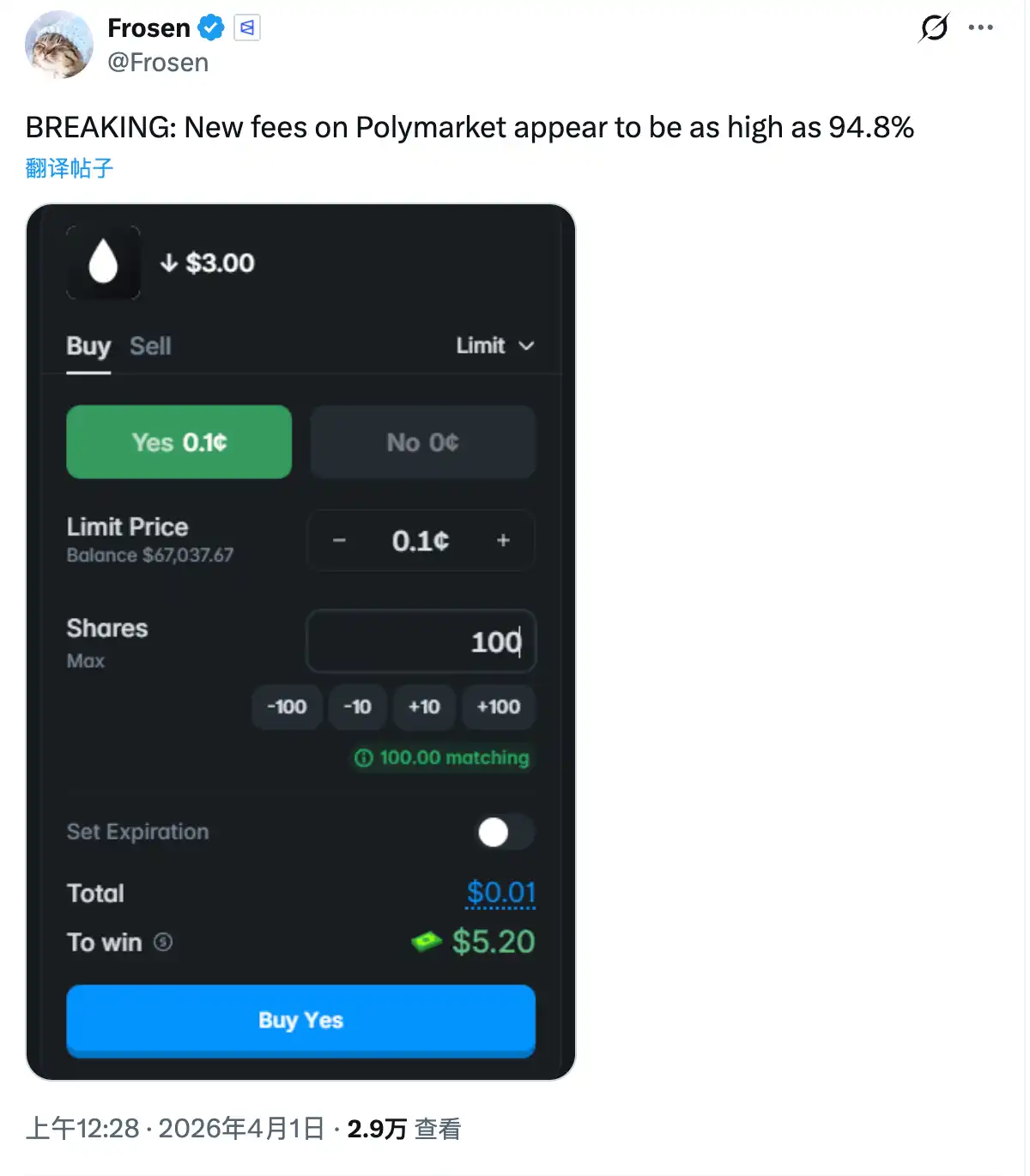
What's going on? Is Polymarket going crazy for money? Odaily, based on Polymarket's official disclosure and community investigation, found that the direct cause of this unexpected situation was that Polymarket modified the platform's fee formula last night, with three versions of changes:
· First was the "old formula" introduced since March 30: fee = C × p × feeRate × (p × (1 - p))^exponent;
· Then came the first modification, the formula that caused the unexpected situation (referred to as the "abnormal formula"): fee = C × feeRate × (p × (1 - p))^exponent;
· Subsequently, after realizing the issue, Polymarket made corrections, resulting in the current version of the "new formula": fee = C × feeRate × p × (1 - p);
· It's important to note that in all three formulas, C refers to the number of shares traded, p refers to the share price, and feeRate and exponent are variables.
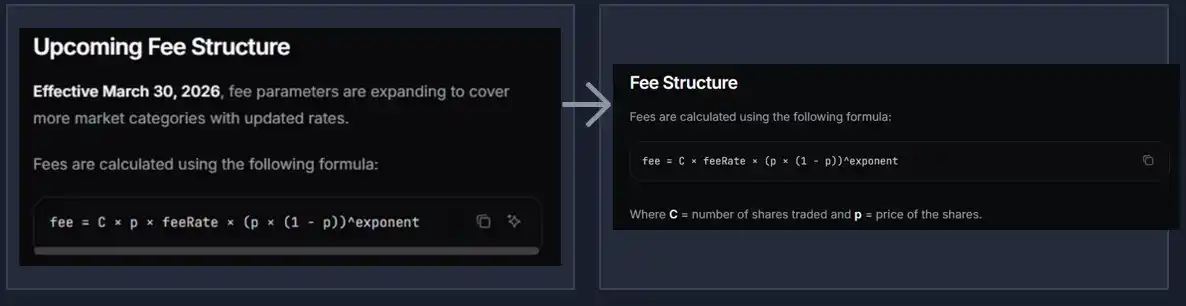
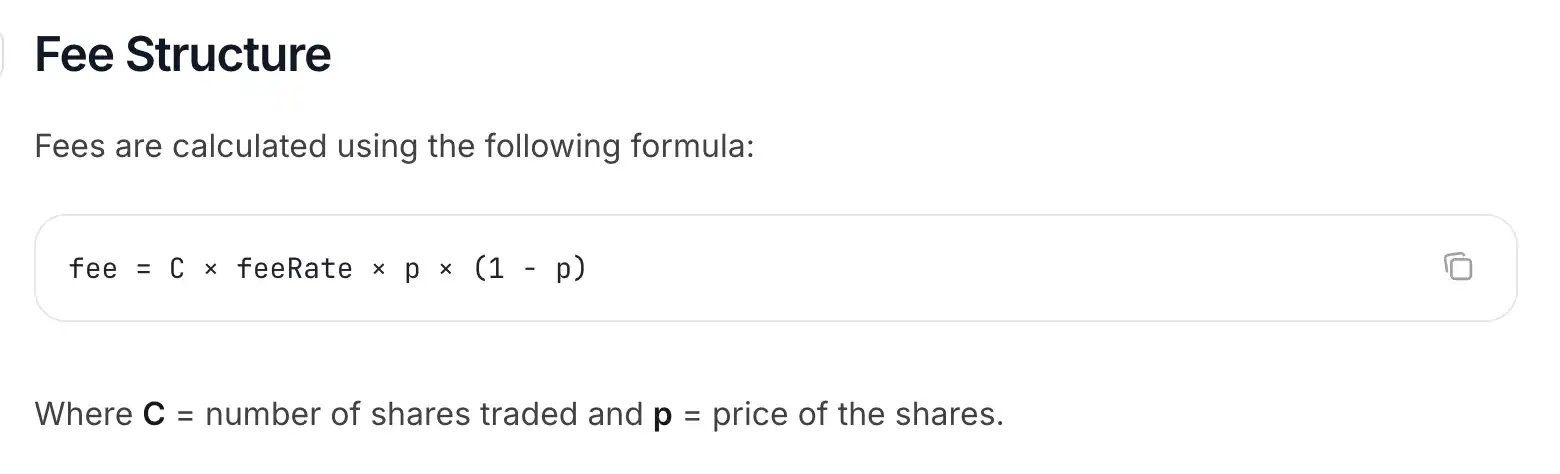
Decoding the Abnormal Formula, How Did the 94.8% Outrageous Fee Rate Occur?
You don't need to worry too much about the math details. By comparing the "Old Formula" and "Anomalous Formula," you can easily see that the latter only removes one "× p" (this is the multiplication symbol, not the lowercase x), meaning it ultimately multiplies the share price one less time.
Since the price of all shares on Polymarket is always less than 1 USD, this will inevitably lead to a overall increase in fees. The lower the price of shares, the more significant the fee increase due to skipping one multiplication — when the share price approaches 0, the fee rate may become absurdly high.
As for how absurd this fee can become, it also depends on the same variable ^exponent present in both the Old Formula and Anomalous Formula. Translated directly, ^exponent means "raised to the power of exponent," and this variable is mainly used to control the steepness of the fee curve.
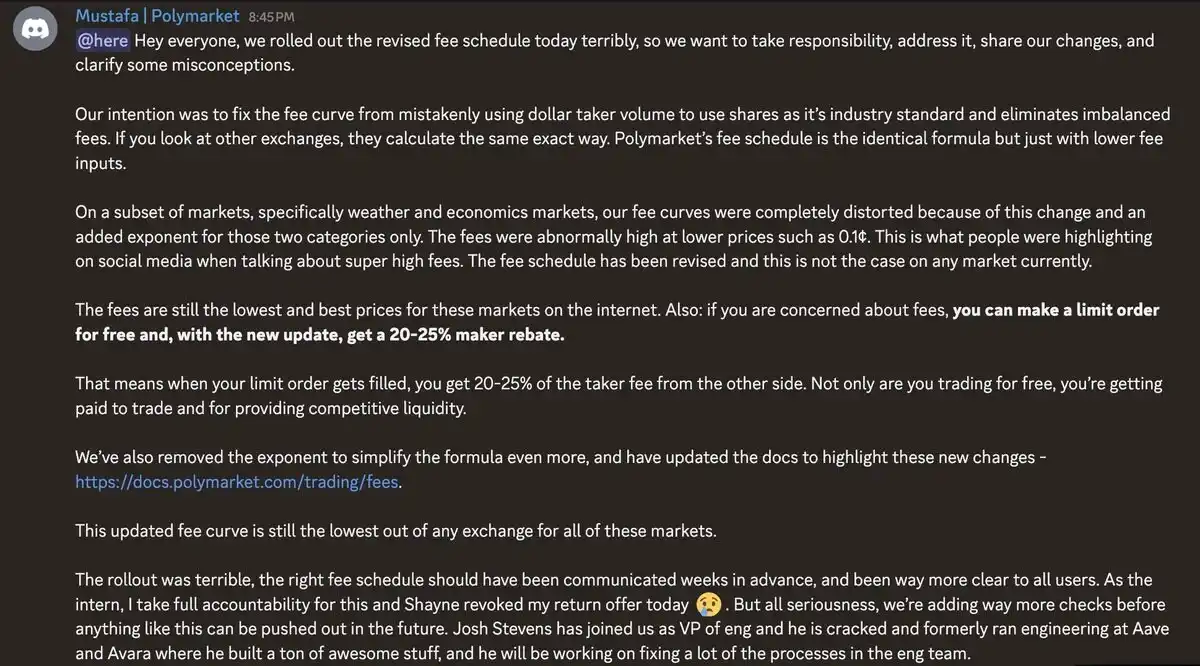
According to Polymarket staff member Mustafa, the anomaly formula introduced last night only included the exponent in two types of markets: "Weather" and "Economic." According to overseas KOL Quant Chad (@Autonomous_Chad), the exponent parameter set for these two major markets at the time was 0.5.
Now, going back to Frosen's case and plugging the corresponding numbers into the equation fee = C × feeRate × (p × (1 - p))^exponent from this anomaly formula. Knowing that C equals 100, meaning Frosen wants to place an order for 100 shares; p equals 0.001, meaning 0.001 USD (0.1 cents); exponent equals 0.5, meaning another power operation on (p × (1 - p)); the final fee rate is 94.8%.
By feeding this to an AI directly, you can reverse-engineer that the feeRate level at that time was around 0.03, while also reconstructing the formula calculation details that Polymarket applied to this order.
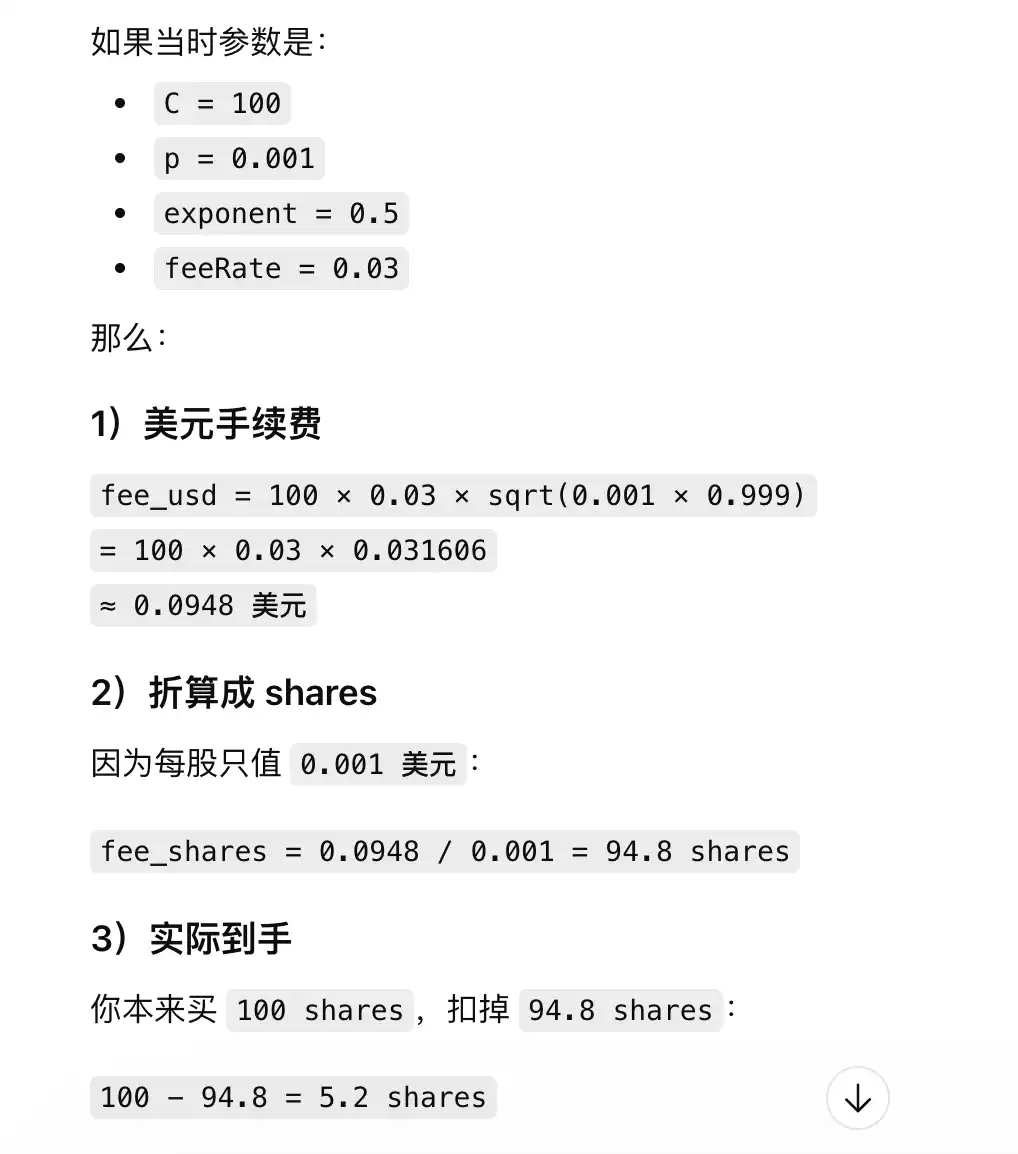
In simple terms, Polymarket calculated, based on the anomalous formula, that the fee for this order should be 0.0948 USD. Since Polymarket deducts the corresponding value of shares directly from the buy order, and the share price at the time was only 0.001 USD, it needed to deduct 94.8 shares. Therefore, Frosen would ultimately receive only 5.2 shares, even if the prediction is correct, the potential profit would only be 5.2 USD.
Polymarket Remedial Action
Shortly after the anomalous fee issue arose, Polymarket promptly responded by modifying the formula to its current version, fee = C × feeRate × p × (1 - p). Compared to the anomalous formula, the new formula removed the '^exponent'—effectively raising the exponent parameter from 0.5 to 1 in the anomalous formula fee = C × feeRate × (p × (1 - p))^exponent.
In the anomalous formula, the '^exponent' effect was to perform another power operation on the p × (1-p) data set. In Polymarket's actual operational scenario, the theoretical result range of p × (1 - p) is between '0.000999 - 0.25'—as p approaches 0.5 (shares price approaches $0.5), this data set gets closer to 0.25; when p approaches 0 or 1 (shares price approaches 0 or $1, with extreme quotes at $0.001 and $0.999), this data set gets closer to 0.000999.
Within the '0.000999 - 0.25' range, regardless of the value taken, raising the exponent parameter from 0.5 to 1 directly reduces the final fee result in the formula calculation, thereby decreasing the overall cost.
More importantly, this reduction has a more pronounced inhibitory effect on exceptionally high fees near very low price levels—when p × (1-p) = 0.000999, the fee under the new formula is only about 3.16% of the fee under the anomalous formula, representing a decrease of approximately 96.84%; when p × (1-p) = 0.25, the fee under the new formula is 50% of the fee under the anomalous formula.
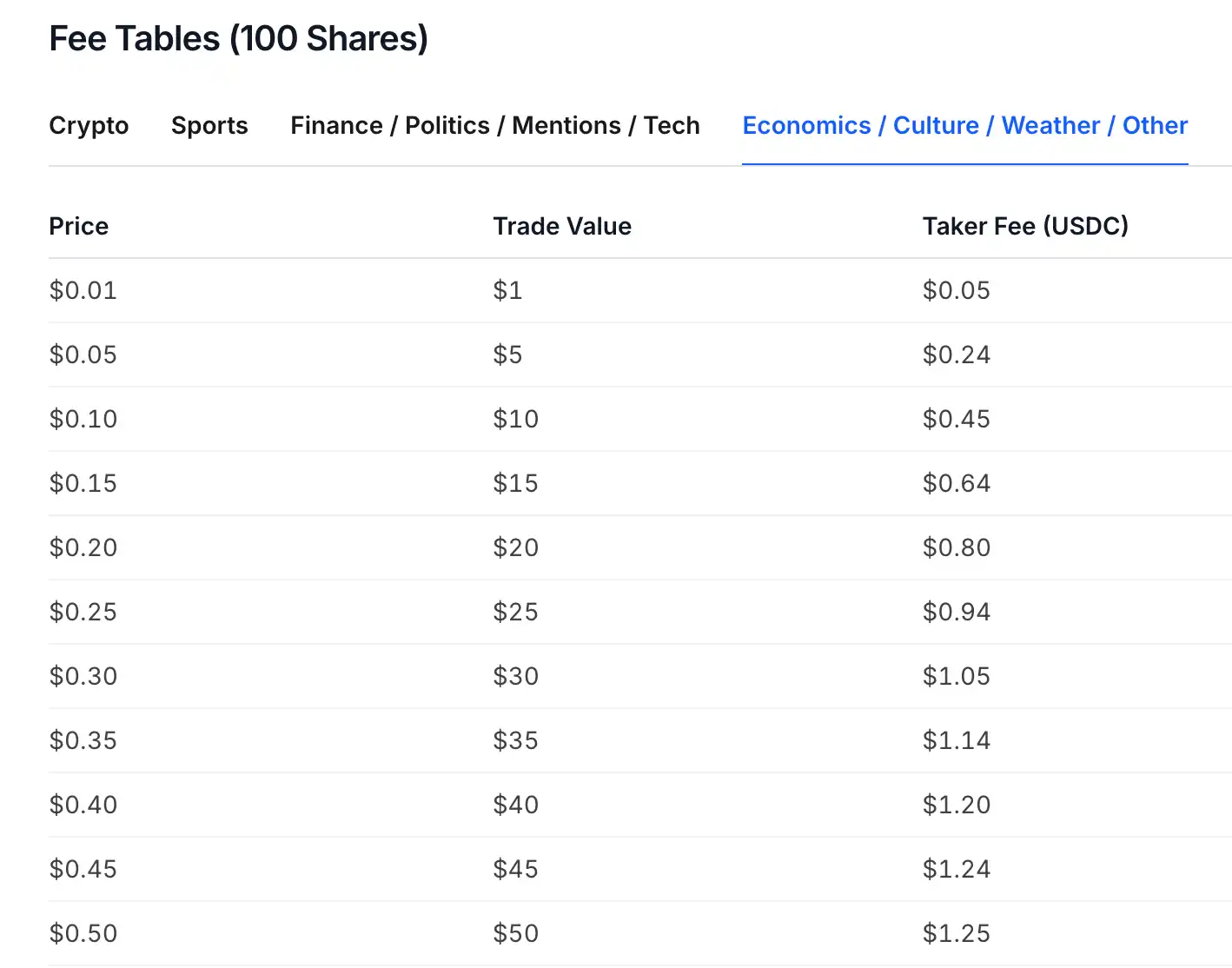
As indicated in the Polymarket official documentation, following the implementation of the new formula, fee rates at extremes in the 'Weather' and 'Economics' market categories have now decreased to 5%.
How Can Retail Users Avoid Fees?
I know most users are lazy to look at the above formula, but are also concerned about Polymarket's current fee issue.
In response to this, Mustafa mentioned on the official Discord: "If you're worried about fees, you can place limit orders for free, and after this new update, you can also receive a 20%-25% maker rebate—this means that when your limit order is executed, you will receive 20%-25% of the taker fee, essentially enabling you to not only trade for free but also potentially earn rewards by trading and providing competitive liquidity."
So let's change our habits, try not to market buy directly anymore, switch to using limit orders more often, and you can also try using Polymarket's Split feature more frequently, indirectly build your position by selling the other side of the shares through a reverse limit order.
Disclaimer: This content is provided for general branding and informational purposes only and doesn't constitute financial, investment, legal, or tax advice. Any events, rewards, online events, or related information mentioned herein should not be considered a recommendation, solicitation, or invitation to purchase, sell, trade, or otherwise deal in any crypto assets or to use any services. Crypto assets are highly volatile and may result in loss. WEEX services and online events may not be available in all regions and are subject to applicable laws, regulations, and eligibility requirements. You are responsible for ensuring that your use of WEEX services complies with local laws and for carefully assessing the risks before participating in any crypto-related activities.
You may also like

Ripple is regulated in Europe before it is classified in America: inside the Luxembourg license

Nokia and AI: How the Cell Phone Manufacturer Reborn in Data Centers

The U.S. CBDC Ban Until 2030 Will Take Effect Without Trump's Signature
Tangem: the risk of laser attacks is "virtually nonexistent"

Crypto IPO market stalls as capital rotates to AI and macro uncertainty weighs

Living in Europe Puts a Target on Your Back for Having Bitcoin

Nano Banana 2 Lite vs. Nano Banana 2: When to Save Your Money and When to Upgrade

Royalty Automation: Is the Market Dispensing with State Bureaucracy?

Haddad Attacks Selic at 14.25%: What Changes in the Fiscal Debate

S&P 500 Earnings in Q2 2026: Highest Increase in 5 Years
Pantera Capital: As Perpetual Contracts Move to Financial Centers, Hyperliquid Aims to Embrace All
Bitcoin: Ki Young Ju Sees a Rebound in the Coming Months
Vitalik Buterin urges Elon Musk to remake X for AI governance

Margex Review 2026: Overview of the Crypto Trading Platform

ESMA targets MiCA crypto custodians with resilience review
From Automotive Finance to Bitcoin and AI Engines: An Analysis of Cango's 'What Not to Do' Strategy

Goldman Sachs Report Analyzes China's AI Large Model Competitive Landscape: Who Will Be the Long-Term Winner?
Strategy's Cryptocurrency Selling Limit Exceeds $1.25 Billion: A Detail Overlooked by the Market
Vitalik: Open to Slowing or Pausing AI, Supports d/acc Platforms

SK Hynix Rings the Bell in New York: Nasdaq Crowds Overflowing
KOR Protocol Secures $7.5 Million Funding to Become the Clearinghouse for Creative Assets in the AI Era

Important News from Last Night and This Morning (July 10 - July 11)

Web3 Newsletter: Industry Highlights and Must-See Trends This Week
The Shovel Sellers of the AI Cold War: A New Arms Race Beyond the Moon Landing, the Second Act of 'Money into Taiwan Stocks' is Just Beginning

From Transaction Fees to Stablecoins: The Revenue Drivers and Moats Behind Web3 Business Models
The New DeFi Battle: Platforms Compete to Enter Traditional Businesses
Apple Sues OpenAI for Theft of Trade Secrets
Crypto: XRP ETFs Experience Largest Capital Outflows of the Year

Fear Surrounding Solana Reaches Peak in 2026, According to Santiment
a16z Co-founder Marc Andreessen Joins Federal Reserve AI Working Group
Ripple is regulated in Europe before it is classified in America: inside the Luxembourg license
Nokia and AI: How the Cell Phone Manufacturer Reborn in Data Centers
The U.S. CBDC Ban Until 2030 Will Take Effect Without Trump's Signature
Tangem: the risk of laser attacks is "virtually nonexistent"
Crypto IPO market stalls as capital rotates to AI and macro uncertainty weighs
Living in Europe Puts a Target on Your Back for Having Bitcoin

Contents
Latest articles


Latest coin listings on WEEX


