What Is RWA (Real-World Asset Tokenization)? The Biggest Opportunities in 2026


Quick summary: Real-World Asset (RWA) tokenization converts physical or off-chain assets—real estate, bonds, invoices, commodities—into on-chain tokens that can be traded, fractionated, and programmatically used. In 2026, RWA moves from pilot to scale: institutional demand, regulatory clarity, and improved custody + compliance tooling create concrete yield and liquidity opportunities across real estate, trade finance, private credit, and treasury management. This guide explains how RWA works, why it matters now, the top market opportunities for 2026, practical risks, and how to evaluate RWA deals.
How RWA Tokenization Works — the mechanics in plain terms
Tokenization mints a digital token that represents a claim on an underlying, legally enforceable asset. The process usually follows these steps:
- Asset selection and legal wrapper. The asset owner (issuer) prepares legal documentation and creates a special purpose vehicle (SPV) or trust that holds the asset.
- Custody and attestation. A regulated custodian stores the underlying asset (e.g., a vault for gold, a trustee for bonds). Independent auditors confirm reserves.
- Token issuance. Smart contracts mint tokens (ERC-20, ERC-3643, or security-token standards) that represent fractional ownership or entitlement to cash flows.
- Marketplace listing and liquidity. Tokens list on regulated exchanges or private marketplaces. Secondary trading can occur 24/7 with atomic settlement in stablecoins or tokenized cash.
- Operational plumbing. Oracles feed price, event, or compliance data to smart contracts; payment rails and KYC/AML systems integrate with on-chain flows.
Key protocols and tooling: token standards (ERC-20, ERC-1400 family, ISO-like security token models), custody APIs (for vault proof), on-chain compliance modules, and DAO or governance flows for treasury disbursement.
[Image suggestion: Illustration of token issuance pipeline — legal wrapper, custodian vault, smart contract mint, exchange listing. Alt: diagram of RWA token lifecycle.]
Why 2026 is Different: Market and regulatory catalysts
Short answer: three converging forces make tokenized RWAs practical in 2026.
- Institutional demand for alternative yield. With bond yields volatile and banks constrained, asset managers are seeking private credit and short-duration income. Tokenization lowers entry barriers and speeds settlement.
- Regulatory progress and custody maturity. More jurisdictions accept regulated custodians and recognize token-representations when backed by legal claims. Banks and trust companies now offer token custody APIs.
- Infrastructure and standards. Interoperable token standards, better identity/KYC integrations, and audited proof-of-reserve tooling reduce operational friction.
Fact: fractional ownership models and 24/7 settlement directly appeal to family offices and sovereign wealth funds that need rapid rebalancing and immediate liquidity in stressed markets.
The core value propositions of RWA
- Liquidity: Fractional tokens turn illiquid assets into tradable units. A $5M property can become 500,000 tokens sold in increments.
- Programmability: Cashflows (rent, coupon payments) can be autopaid on-chain to token holders via smart contracts.
- Access: Retail and smaller institutions can access private markets previously reserved for large allocators.
- Transparency: On-chain settlements paired with proof-of-reserve and audited ledgers reduce reconciliation time.
- Composability: Tokenized assets can be used as collateral in DeFi lending or synthetic strategies—if legal frameworks allow.
Top 5 RWA opportunities for investors and institutions in 2026
Below I list the highest-probability, highest-impact opportunities I see for the year—each with a short playbook.
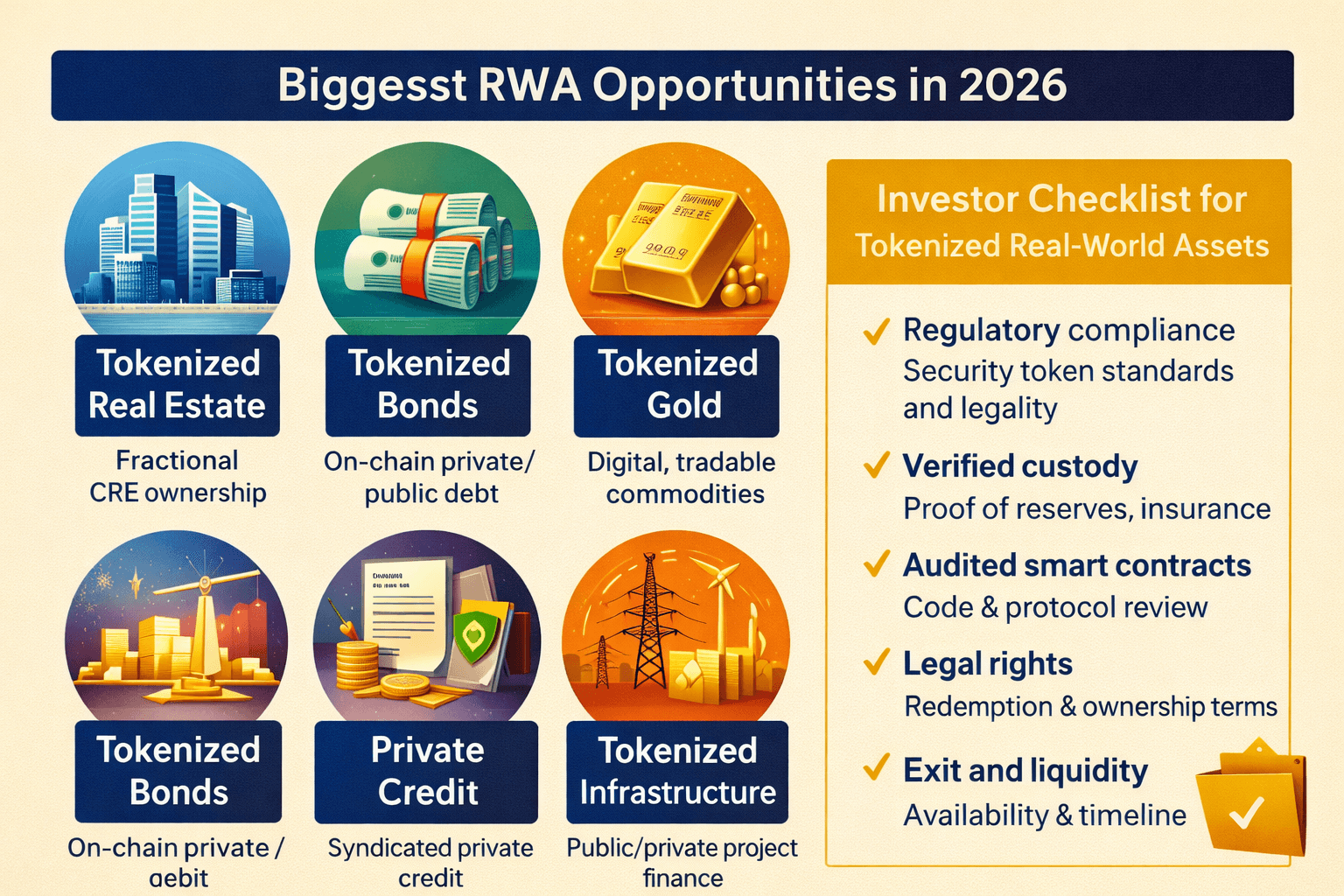
1) Tokenized Commercial Real Estate (CRE) — yield + price appreciation
Why: CRE faces funding friction in 2026 as banks trim balance-sheet exposure. Tokenization enables fractional investment in cashflowing retail, logistics, and multi-family assets.
Playbook: Use regulated platforms that list tokenized REIT tranches backed by audited rental rollups. Target assets with covered yields >4.5% and transparent capex plans. Look for platforms offering secondary markets and buyback/liquidity windows.
[Image suggestion: stylized city skyline with token fractions floating in front of buildings. Alt: tokenized real estate visualization.]
2) Short-term Trade Finance / Invoice Financing — rapid expansion
Why: SMEs need working capital. Tokenized invoices shorten settlement and transfer credit risk to a wider investor base.
Playbook: Invest via vetted invoice token pools with KYC/AML automated and insured receivable verification. Evaluate default histories, debtor credit grades, and platform loss reserves.
3) Tokenized Corporate Bonds and Private Credit — diversifying fixed income
Why: Corporates seek non-bank funding. Tokenized notes allow issuance, fractional trading, and instant settlement.
Playbook: Prefer issuers with audited SPVs, trustee structures, and on-chain payment oracles. Price relative to existing corporate credit spreads and factor in token liquidity premiums.
4) Tokenized Commodities (Gold, Energy Credits) — hedges and collateral
Why: Physical commodities benefit from tokenized settlement: faster transfer, lower custody friction.
Playbook: Choose tokenized commodities with LBMA or certified custody and regular third-party attestation. Use as collateral in low-leverage DeFi lending where allowed.
5) Treasury management for corporates — programmable cash
Why: Corporates want programmable liquidity, faster treasury operations, and yield on idle balances.
Playbook: Pilot tokenized short-term papers or on-chain commercial paper programs with major banks acting as custodians. Ensure compliance with local bank regulators.
Practical example: a tokenized CRE deal (table)
| Step | Action | What to check |
|---|---|---|
| Asset sourcing | Sponsor acquires building | Title search, occupancy, historical rent |
| Legal wrapper | SPV formed with trustee | Clear ownership docs, investor rights |
| Custody | Vault or registrar assigned | Proof-of-reserve, insurance policy |
| Token issuance | ERC-1400/ISO-like token minted | Token rights mirror legal claim |
| Distribution | Primary sale on regulated platform | KYC, AML, custody integration |
| Secondary | Marketplace trading with settlement | Liquidity depth, spread controls |
| Ongoing | Rent flows paid on-chain | Oracles, distribution schedule, audits |
How tokenization changes risk, and what mitigations matter
Tokenization shifts some risks rather than eliminating them.
Legal risk: If legal wrapper is poorly structured, tokens may be unsecured claims. Mitigation: legal opinions from qualified counsel, jurisdiction selection.
Custody risk: Custodian insolvency can disrupt redemption. Mitigation: choose regulated custodians with segregation rules and insurance.
Smart contract risk: Bugs or exploits can halt distributions. Mitigation: independent audits, upgradeable patterns with multi-sig governance.
Liquidity risk: Secondary markets can be shallow. Mitigation: market-making agreements, buyback facilities, and tranche design.
Compliance risk: Cross-border sales may trigger securities regulation. Mitigation: use security token standards and whitelisting.
Market structure and participants in 2026
Actors driving RWA adoption:
- Issuers: property managers, corporations, funds.
- Custodians: regulated trust banks, vault operators.
- Exchanges & Marketplaces: regulated security token exchanges and select crypto exchanges offering custody rails.
- Oracles and Data Providers: price feeds, event triggers, tenancy validation.
- Auditors / Legal Counsel: critical for investor confidence.
Key infrastructure: token standards aligned with securities law, custody APIs for institutional KYC, and atomic settlement rails connecting fiat rails to on-chain flows.
How regulators view RWA in 2026
Regulators focus on investor protection and AML. Many jurisdictions accept tokenized assets under existing securities frameworks if they meet disclosure and custody rules. For example, some national trust charters and sandbox programs now explicitly allow token issuance via regulated SPVs.
If you are an issuer, engage local securities counsel early and design redemption and reporting mechanics to match investor protection expectations.
Where to find the most credible RWA deals
- Regulated security token platforms: they require KYC and only list vetted issuances.
- Institutional custody partners: banks and trust companies that publish proof-of-reserve and segregation rules.
- Established asset managers: funds that tokenized a portion of their private credit or CRE holdings.
- Exchange listings with compliance rails: exchanges that do KYC and offer settlement in fiat/stablecoins.
Due diligence checklist: legal wrapper, custodian audit, ongoing reporting cadence, exit/liquidity plan.
Sample returns and structures
Typical tokenized deal returns differ by asset:
- Tokenized CRE income share: 3.5%–7% yield (net), depending on location and leverage.
- Invoice financing pools: 6%–12% annualized, short duration.
- Private credit tranches: 5%–10% depending on seniority.
- Tokenized bonds: priced relative to credit spreads; fractional trading may add 25–50 bps liquidity premium.
Always model net returns after custody fees, platform fees, and potential redemption windows.
Common business models for platforms (table)
| Model | Revenue Source | Investor suitability |
|---|---|---|
| Primary issuance platform | Issuance fees, ongoing servicing | Institutional and HNW |
| Secondary marketplace | Transaction fee, market-making | Sophisticated traders |
| Custodian + issuance | Custody fees, settlement rails | Banks, family offices |
| DeFi integration | Lending spreads, swap fees | Crypto-native allocators |
Pitfalls and scams to watch for
- Fake “backing” claims without verifiable attestation. Demand on-chain proof linked to audited off-chain records.
- Opaque SPVs controlled by insiders with weak governance. Look for independent trustees.
- Unrealistic yield promises that ignore underlying cashflow economics.
- Fragile legal structures in grey jurisdictions.
A simple sanity check: can you get a legal opinion and an auditor’s confirmation? If not, pass.
How retail investors can get started safely in 2026
- Start small with regulated platforms.
- Prefer senior, short-duration tranches for reduced tails.
- Confirm redemption mechanics and expected processing time.
- Use diversified baskets of invoices or property tokens rather than single assets.
- Keep a portion of capital in conventional liquid instruments as a buffer.
Institutional strategies that are gaining traction
- Tokenized money market for treasurers: corporates park idle cash in tokenized short-term paper with on-chain distribution.
- Collateral efficiency for lenders: using tokenized assets as immediate collateral in lending markets to reduce margin calls.
- Syndicated tokenized loans: divide large loans into tradable slices, increasing participation from smaller investors.
These strategies rely on enforceable legal rights and trusted custodians.
Final practical checklist for evaluating an RWA offering
- Does the issuer provide an independent custody attestation?
- Is there a trustee or independent board overseeing the SPV?
- Are smart contracts third-party audited?
- Are token rights identical to legal rights on the asset?
- Is there a viable secondary market or market-making commitment?
- What are all fees (custody, issuance, platform, redemption)?
- How fast are redemptions and what are the tax implications?
FAQs
Q1: Are tokenized assets insured like bank deposits?
Insurance varies. Custody insurance often covers physical loss or theft but rarely covers market losses. Verify the custodian’s insurance coverage and policy limits.
Q2: Can I redeem tokenized real estate for the physical asset?
Redemption rights depend on legal structure. Most retail token models allow cash redemption based on asset value, not physical delivery, due to practicality and cost.
Q3: Is RWA the same as security tokens?
Not always. Many RWA tokens are security tokens under law because they represent ownership or cashflow rights. Token standards and regulatory treatment determine classification.
Q4: What tax implications exist for tokenized assets?
Taxes follow jurisdiction rules: capital gains, income distributions, and withholding may all apply. Consult tax counsel for cross-border tokenized holdings.
Q5: How liquid are tokenized assets in practice?
Liquidity varies. Some tokenized invoice pools and tokenized papers trade readily; tokenized CRE often has limited secondary depth. Check market-making and historical spreads.
Tokenization of real-world assets is not a silver bullet. But in 2026 it has moved from proofs of concept to actionable market strategies. The successful deals will be legal-first, custody-strong, and institutionally integrated. If you approach RWA with the same diligence you’d use for private equity or credit, you’ll find unique yield and diversification advantages that conventional markets cannot match.