
What Is Pharos (PROS)? RealFi Layer 1 Blockchain Explained 2026
DeFi tried to replace banks. It didn't work. Too slow. Too messy. Too many rugs.
Now comes RealFi. Real-world assets on-chain. Bonds. Debt. Real estate. The trillions that DeFi couldn't touch.
Pharos (PROS) is one of the first Layer 1 blockchains built for this. Not for memes. Not for yield farming. For actual finance. Let me break down what it is, how it works, and whether it matters.
What Is Pharos (PROS)?
Pharos (PROS) is a Layer 1 blockchain launched in 2024. Built for one thing: RealFi (Real-World Finance).
Forget what you know about DeFi. DeFi is digital assets trading with digital assets. RealFi takes bonds, corporate debt, real estate — things that exist in the real world — and puts them on-chain.
Feature | What It Means |
Layer 1 | Its own blockchain. Not a token on Ethereum or Solana. |
RealFi focus | Tokenized real-world assets, not just crypto-native stuff. |
Institutional grade | Built for compliance, audits, and regulators. |
PROS token | Gas, staking, governance. The engine of the network. |
What is Pharos (PROS) trying to solve? The gap between traditional finance (trillions of dollars) and blockchain (still tiny). If that gap closes, Pharos wants to be the bridge.
Who Created Pharos?
Founded in 2024. Team comes from serious fintech backgrounds.
td {white-space:nowrap;border:0.5pt solid #dee0e3;font-size:10pt;font-style:normal;font-weight:normal;vertical-align:middle;word-break:normal;word-wrap:normal;}
Name | Role | Background |
Wish Wu | CEO | Ant Financial, Alibaba |
Alex Zhang | Head of R&D | Large-scale payment systems |
Not anonymous. Not some Telegram randoms. These people worked on systems handling billions of transactions.
Backers include:
- Hack VC
- Faction
- SNZ Holding
- Hash Global
- Chainlink
The Pharos Foundation handles ecosystem growth and governance. Standard structure for serious projects.
How Pharos (PROS) Works
Here's the technical stuff broken down.
Parallel execution engine
Most blockchains process transactions one by one. Slow. Pharos processes many at the same time. Think 8-lane highway vs single-lane road.
Dual virtual machine support
Works with Ethereum tools (EVM) AND WebAssembly (WASM). Developers can use whatever they know. Not locked into one system.
Compliance built in
This is the big one. Identity verification. Audit tools. Regulator-friendly features. Institutions won't touch a blockchain without these.
RealFi infrastructure
Not just "we support RWA" as a marketing line. The chain is literally designed to issue, trade, and manage bonds and debt on-chain.
Pharos (PROS) Tokenomics
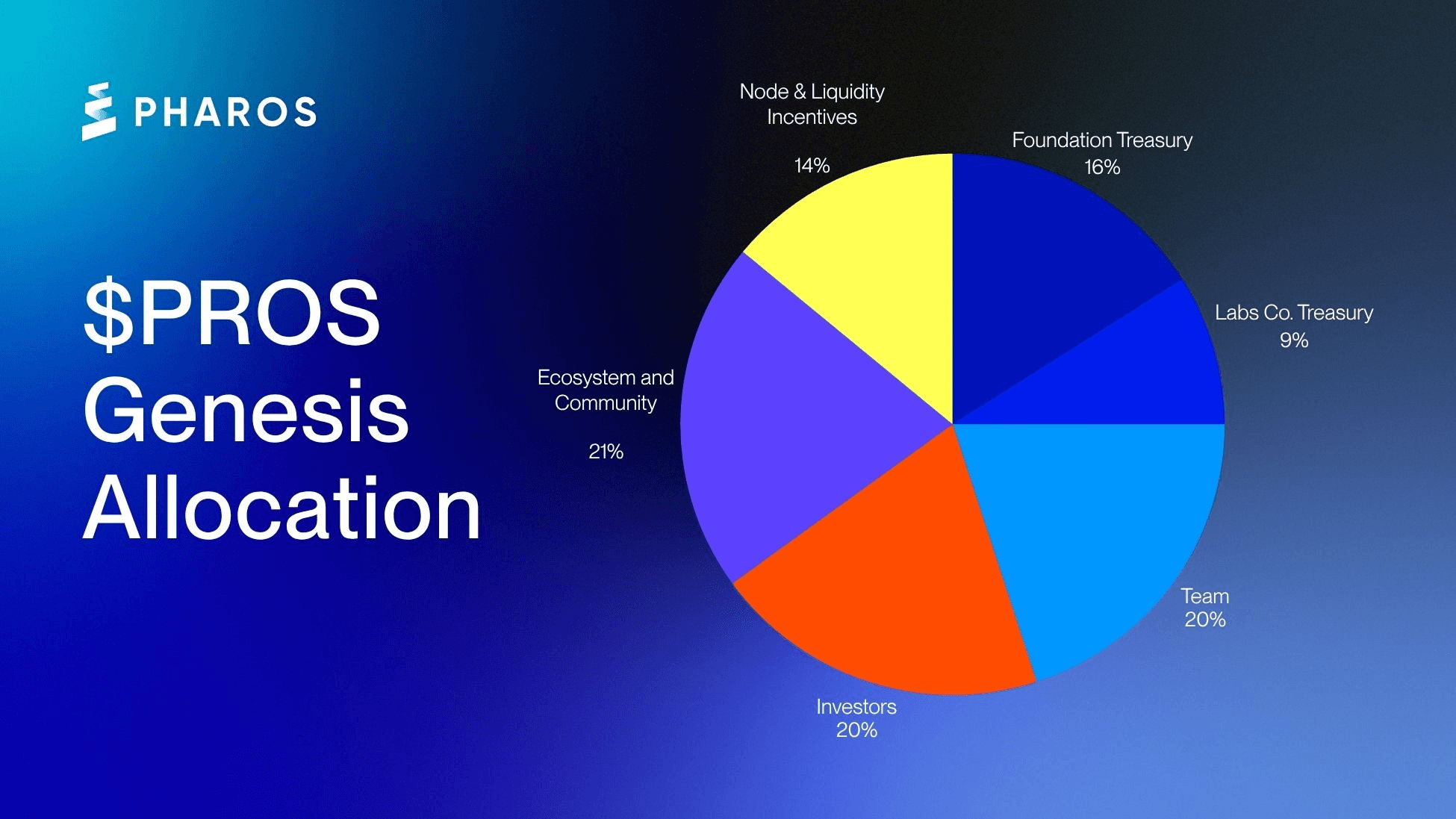
- Total supply: 1,000,000,000 PROS (fixed)
- Initial inflation: 0%
- Post-launch inflation: ~5% annually (adjustable by governance)
Allocation | % | Notes |
Ecosystem & Community | 21% | Includes 6% airdrop for early users |
Team | 20% | 12-month cliff, 36-month vesting |
Investors | 20% | Same vesting as team |
Foundation Treasury | 16% | Long-term ecosystem funding |
Lab Treasury | 9% | R&D and protocol upgrades |
Node & Liquidity Incentives | 14% | Validator rewards and liquidity |
Team and investors have lock-ups. Can't dump immediately. That's a green flag. 21% to ecosystem means they're serious about adoption, not just selling tokens.
Pharos (PROS) tokenomics look like a real project. Not a pump-and-dump setup.
What PROS Token Actually Does
Utility | How It Works |
Transaction fees | Pay for every operation on network |
Staking | Validators stake PROS to secure chain, earn rewards |
Governance | Vote on inflation, funding, protocol changes |
Ecosystem incentives | Rewards for devs, users, liquidity providers |
RealFi collateral | Future use — tokenized assets may use PROS as backing |
PROS isn't just a "governance token" with no reason to exist. It powers the whole network.
What Makes Pharos Different?
Same as other L1 blockchains:
- Needs validators
- Has a native gas token
- Smart contract support
- Governance model
Different from most L1s:
Aspect | Pharos | Ethereum / Solana |
Primary focus | RealFi (RWA) | General purpose DeFi |
Compliance layer | Built-in | Not native |
VM support | EVM + WASM | Usually one or the other |
Target users | Institutions, asset issuers | Retail, developers |
Most L1s say "anyone can build anything." Pharos says "institutions can tokenize real assets here." Different bet.
Where to Buy Pharos: Step-by-Step Guide
Step 1: Create & Verify Account
Download WEEX App or visit WEEX official website → Sign up with email/phone → Complete KYC.
Step 2: Deposit Funds
Go to "Assets" → "Deposit":
- Fiat: Bank transfer, card, or third-party payment
- Crypto: Send USDT or BTC to your WEEX wallet
Step 3: Buy Pharos (PROS)
- Spot Trading: "Trade" → "Spot" → PROS/USDT → Market order (buy now) or Limit order (set price) → Confirm.
Conclusion
Pharos (PROS) isn't another DeFi clone. It's a bet on RealFi — the idea that trillions in real-world assets will move on-chain.
The team has real credentials. The tokenomics are legit. The tech solves actual problems (compliance, scale, RWA support).
But it's early. Competition exists. Adoption isn't guaranteed.
If you believe tokenized finance is the next big cycle, Pharos belongs on your watchlist. Just don't treat it like a memecoin. This is a long-term infrastructure play.
Ready to trade? WEEX offers zero fees, instant execution, and the security you need. Sign up on WEEX Now and Start Trading!
FAQ
What is Pharos (PROS)?
A Layer 1 blockchain built for RealFi — tokenizing real-world assets like bonds and debt on-chain.
Who created Pharos?
Founded in 2024 by Wish Wu (ex-Ant Financial) and Alex Zhang (ex-Alibaba). Backed by Hack VC, Faction, Chainlink, and others.
What is PROS token used for?
Transaction fees, staking, governance, ecosystem incentives, and future RealFi collateral.
What is the total supply of PROS?
1 billion fixed supply. Initial inflation 0%, then ~5% annually adjustable by governance.
You may also like

What is World Cup Doge (WCDOGE) Coin? Is WCDOGE a Good Investment?
What is WCDOGE crypto? Meme token or football fan play? Real data, honest risks, and how to buy World Cup Doge.

SIM Owner Details: Legal PTA Check and Safety Guide
Learn what SIM owner details means, how to check SIMs on your CNIC through official PTA channels, and how to avoid lookup scams.
NBIS Stock: What Nebius’ AI Cloud Surge Means Now
NBIS stock jumped as Nebius reported rapid AI cloud growth. See the key Q1 2026 numbers, catalysts, valuation risks, and what to watch next.

WXT Bounty Hunter Program Explained: Earn Crypto Rewards While Learning to Trade on WEEX
The WXT Bounty Hunter Program is a WEEX campaign running from May 8 to May 18, 2026, designed to help beginners learn crypto trading while earning rewards.
Users complete simple tasks like depositing USDT, trading WXT, and holding tokens to receive WXT rewards. New users can earn bonuses such as 200 WXT, while advanced users can compete for larger rewards based on trading activity, including a 100,000 WXT prize pool.
The program uses net metrics (deposits and buys minus withdrawals) to ensure fairness and excludes institutional trading. Holding 300 WXT also unlocks extra benefits like enhanced airdrops.
Overall, it combines learning and earning, making it an entry point into crypto trading on WEEX.

Grass Token Price: GRASS Live Data, Drivers, and Risks
Track Grass token price, market cap, supply, unlocks, and key GRASS price drivers before trading the Solana AI and DePIN token.
WCOR Coin Explained: World Collective Oil Reserve on Solana
WCOR coin is a Solana token tied to an oil-reserve registry narrative. Here’s what it claims, current data, and the risks traders should watch.

What Is SAOS Crypto? Can SAOS Hit $0.1?
Is SAOS crypto a hidden gem? Strategic American Oil Supply on Solana explained. No hype, just data: $75K cap, locked LP, RWA narrative.

KAIO Airdrop: Share 50,000 USDT on WEEX with 0-Fee Trading
Trade KAIO/USDT with 0 fees on WEEX from May 7–14, 2026. New users can complete deposit and spot trading tasks to share 50,000 USDT in rewards.

What Is SAOS? Strategic American Oil Supply Token Explained
SAOS is a meme token on Solana with a 75,000 USD market cap and 22,000 USD locked liquidity, positioned around oil supply themes but lacking real asset backing
It thrives on pure narrative speculation, with no utility, website, or doxxed team, making it highly volatile and attention-dependent
Traders should distinguish SAOS from legitimate real-world asset projects, as its branding is speculative rather than substantive
Positive aspects include locked liquidity reducing rug pull risks, but low trading activity signals high uncertainty

How to Buy Public Asset Control (PAC) Token in 2026: Latest Solana Buying Guide
How to buy Public Asset Control (PAC) token in 2026, PAC contract address, Solana wallet setup, Jupiter swap guide, latest price, liquidity, and risks.

What Is Public Asset Control (PAC) Token and How Does It Work? Latest Solana PAC Token Guide
Public Asset Control (PAC) token explained. Learn what PAC is, how it works on Solana, current price snapshot, risks, and buying basics.

Can PAC Coin Reach $1 Soon? Analyzing Public Asset Control
PAC is a Solana-based meme token with a government-themed narrative, but it is highly speculative.
At its current price (~$0.0009) and 1B supply, reaching $1 would require a $1B market cap, which is very unlikely.
Short-term moves to $0.001 or $0.01 are more realistic, but the token is highly volatile due to low liquidity and hype-driven trading.
Overall, $1 is not a realistic target, and PAC is better suited for short-term speculation than long-term investment.

United Nations Oil Reserve (UNOS) Crypto: Solana Token, UN Links, and Risks
United Nations Oil Reserve (UNOS) Crypto explained: Solana token basics, UN links, oil-backing claims, market risks, contract checks, and buying cautions.

What Is Public Asset Control (PAC) Coin? Explained for Beginners
Public Asset Control (PAC) is a Solana-based token that uses a “government asset control” narrative involving oil and gold themes, but it has no verified ties to any real institutions or governments. It is mainly an entertainment-focused, speculative meme coin.
The project’s claims about links to entities like BlackRock or Palantir are unverified, and its own disclaimer states it is not a real financial or institutional asset. Like many new Solana tokens, PAC is highly volatile, with low liquidity and limited transparency, including no fully verified audit.
Overall, PAC is a high-risk speculative token driven by hype and storytelling rather than real utility. Beginners are advised to be cautious, verify contract details, and prioritize risk control before considering any trading.
What Is Official Saudi Oil Reserve (OSOR) Coin?
Learn what OSOR coin is, why its Saudi oil narrative matters, how to verify the contract, and what risks to check before trading.

Global Digital Oil Reserve (GDOR): What It Is, Risks, and How to Check It
Global Digital Oil Reserve (GDOR) is an oil-themed Solana token with unclear backing. Learn its risks, market data, and verification checklist.

Is OBC Crypto a Good Investment?
Is OBC crypto a good investment? We analyze the latest market data, holder concentration, liquidity risks, and short-term momentum. Read this before you invest in OBC token.

Can OSOR Reach $1? Full Price Analysis 2026
OSOR crypto price prediction 2026: Can Saudi Oil Reserve token reach 1? Read before buying.
What is World Cup Doge (WCDOGE) Coin? Is WCDOGE a Good Investment?
What is WCDOGE crypto? Meme token or football fan play? Real data, honest risks, and how to buy World Cup Doge.
SIM Owner Details: Legal PTA Check and Safety Guide
Learn what SIM owner details means, how to check SIMs on your CNIC through official PTA channels, and how to avoid lookup scams.
NBIS Stock: What Nebius’ AI Cloud Surge Means Now
NBIS stock jumped as Nebius reported rapid AI cloud growth. See the key Q1 2026 numbers, catalysts, valuation risks, and what to watch next.
WXT Bounty Hunter Program Explained: Earn Crypto Rewards While Learning to Trade on WEEX
The WXT Bounty Hunter Program is a WEEX campaign running from May 8 to May 18, 2026, designed to help beginners learn crypto trading while earning rewards.
Users complete simple tasks like depositing USDT, trading WXT, and holding tokens to receive WXT rewards. New users can earn bonuses such as 200 WXT, while advanced users can compete for larger rewards based on trading activity, including a 100,000 WXT prize pool.
The program uses net metrics (deposits and buys minus withdrawals) to ensure fairness and excludes institutional trading. Holding 300 WXT also unlocks extra benefits like enhanced airdrops.
Overall, it combines learning and earning, making it an entry point into crypto trading on WEEX.
Grass Token Price: GRASS Live Data, Drivers, and Risks
Track Grass token price, market cap, supply, unlocks, and key GRASS price drivers before trading the Solana AI and DePIN token.
WCOR Coin Explained: World Collective Oil Reserve on Solana
WCOR coin is a Solana token tied to an oil-reserve registry narrative. Here’s what it claims, current data, and the risks traders should watch.