
Is it a good idea to buy Uniswap's UNI token in 2026?
By: WEEX|2026/05/21 08:30:00
0
Share
With Uniswap v4 redefining DeFi and projects like Unipeg driving a surge in reactive assets, the UNI token is back on the radar. But before investing from Venezuela, Mexico, or any other country in the region, there are questions that cannot be ignored.
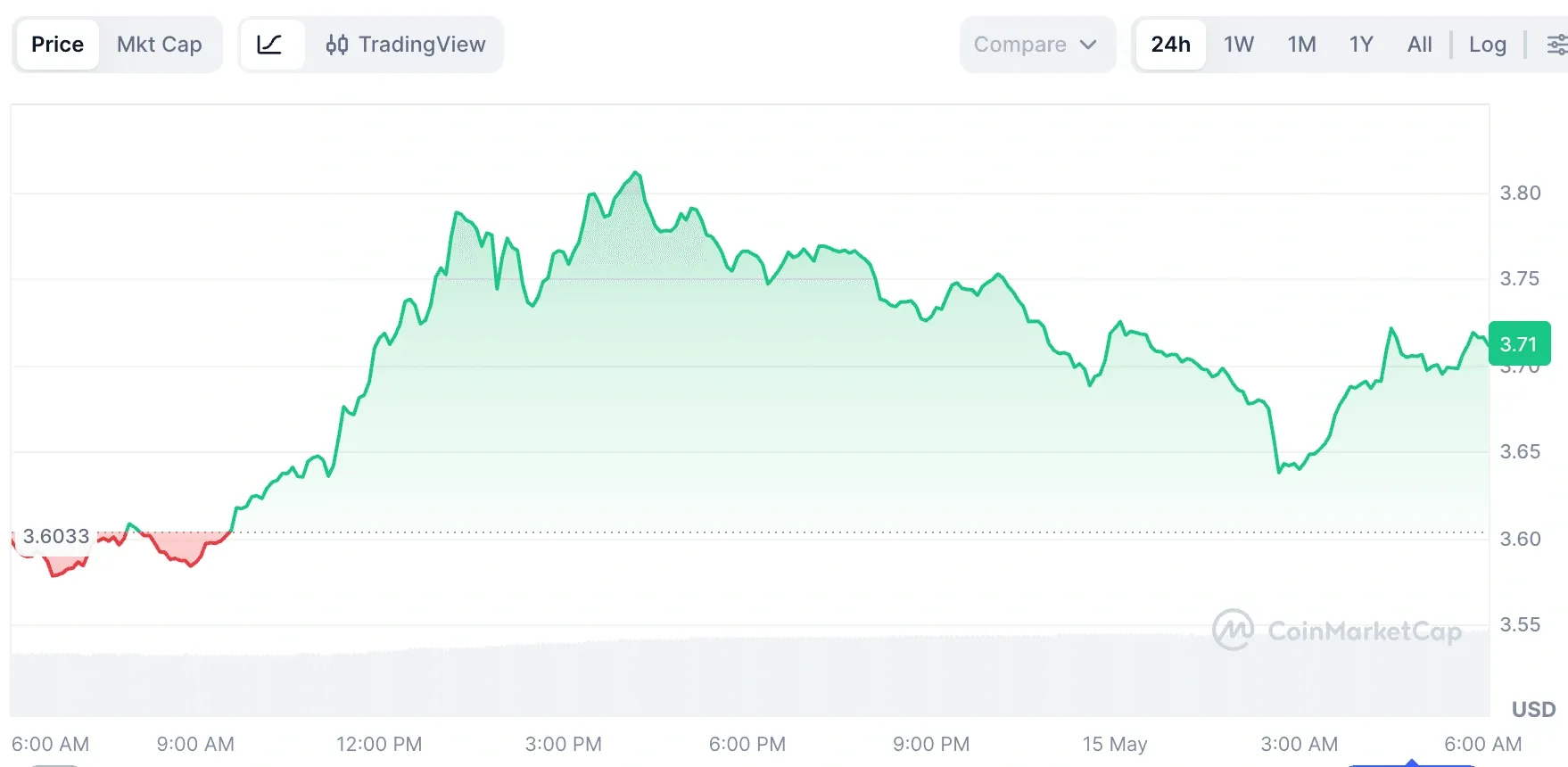
In the crypto ecosystem, few stories are as complex as that of the UNI token from Uniswap. Launched in September 2020 as the governance token for the world's most used decentralized exchange, UNI has lived through a full cycle: it rose from $3 to an all-time high of $44.90 in May 2021, fell more than 90% from that peak, and today trades in the $3 to $3.50 range, according to data from Coinbase and CoinLore.
At the same time, Uniswap v4 (launched in January 2025) introduced hooks, an architecture that opened the door to reactive assets: digital objects that are created the instant a swap occurs, without prior human intervention. Unipeg (uPEG) was the most viral experiment of that new category, and its rise renewed the interest of the entire Latin American crypto community in the platform that made it possible.
So the question that thousands of people in Venezuela, Mexico, Colombia, Argentina, and across the region are asking is the same: does it make sense to buy UNI on spot now? The answer is not simple, and in this article, we break it down with honesty.
The Latin American context: why UNI matters in a region with structural inflation
Before talking about the token, we must talk about the environment. Latin America is one of the regions with the highest crypto adoption in the world, with a year-over-year growth of 63% in 2025, according to the Geography of Crypto Report by Chainalysis. And the drivers of that adoption are well-known: inflation, devaluation, and the need for alternatives to the traditional financial system.
Venezuela is the most extreme case. With inflation estimated in the range of 600% to 650% annually during 2025, according to Professor Steve Hanke of Johns Hopkins University, the bolivar remains a currency that the population avoids holding. The exchange wallet (the digital tool that allows converting bolivars to digital assets in real-time) has become a daily survival mechanism, with USDT and other stablecoins leading usage. According to Chainalysis, Venezuela received flows equivalent to $44.6 billion in cryptocurrencies in the period from July 2024 to June 2025.
Mexico presents a different but equally relevant profile. With inflation closing 2024 at around 4.5% annually according to INEGI, the Mexican peso faces constant pressure, and remittances (which exceeded $63 billion in 2024, the country's second-largest source of income) have found in cryptocurrency platforms a cheaper and faster channel than traditional banks.
Across the entire region, the same logic applies: in Colombia, Peru, Argentina, and Ecuador, cryptocurrencies are no longer just a topic for tech enthusiasts. They are a real financial tool, and the choice of which assets to hold in your portfolio truly matters.
What the UNI token is and what it is actually for
UNI is the governance token for Uniswap, the most important decentralized exchange (DEX) in the world in terms of volume. Since its launch in 2020, it has served two main functions:
- Governance: UNI holders can vote on changes to the protocol: technical upgrades, community treasury allocation, activation of the fee-sharing mechanism, and any other decision relevant to the ecosystem.
- Potential fee switch: One of the most discussed proposals in the Uniswap community is the activation of the "fee switch": a mechanism that would redistribute a portion of the trading fees generated by the protocol directly to UNI holders. This proposal (the so-called "UNIfication") has already been approved in governance, and its effective implementation would be a significant catalyst for the token's value. According to Benzinga, the future accumulation of fees for UNI holders is one of the main factors supporting its long-term relevance.
What UNI is not: it is not a stablecoin, it has no fixed value, and it is not an inflation-hedge asset. It is a speculative token with real fundamentals, which places it in a different category than tokens that simply make promises and disappear, but also different from the safe assets that Latin Americans usually prioritize.
UNI and the rise of reactive assets: does the token benefit?
Here is one of the most interesting questions of the moment: with the boom of reactive assets like Unipeg (uPEG) (generated directly by Uniswap v4 hooks the instant a swap occurs), is there any benefit to the price of UNI?
The answer is: potentially yes, but indirectly and not automatically.
The reasoning is this: the rise of assets like Unipeg generates more volume in Uniswap v4 pools. More volume means more fees generated by the protocol. If the fee switch is effectively activated, those fees would flow to UNI holders. In that scenario, UNI becomes an asset with real yield, not just governance.
But there is an essential difference between Unipeg and UNI that is worth understanding before mixing them into the same investment decision: they are two completely different assets, with radically different risk profiles.
The real risks of experimental NFT tokens like Unipeg
Unipeg is, by its very nature, an experiment. Its characteristics make it a very high-risk asset:
Extremely low supply: There are only 10,000 uPEG tokens in total. That explains the high unit prices (which hovered around $2,140 at its peak of activity), but it also means that liquidity is minimal and that a few coordinated holders can move the price drastically in any direction.
No defined utility beyond collecting: Unlike UNI, which has real governance over a protocol with $100 billion in accumulated volume, uPEG is essentially an on-chain collectible. Its value depends almost entirely on the narrative and market interest in that narrative.
Extreme volatility: The price of uPEG went from zero to over $1,000 in its viral debut and then stabilized in very different ranges. That is typical of speculative microcaps, where timing is everything and arriving late can mean huge losses.
No technical investment whitepaper: Unipeg is an on-chain artistic and technical experiment. It does not claim to be anything else. Whoever buys it is betting that the market will continue to assign it value, not that there is an underlying business model generating cash flow.
That said, reactive assets like Unipeg are not scams or rug pulls. They are exactly what they claim to be: experiments at the frontier of what Uniswap v4's programmability can do. The risk is real, but it is the risk of the new and experimental, not the fraudulent.
UNI vs. uPEG: two assets, two risk profiles, two different decisions
To clarify the difference, here is a direct comparison:
UNI Token:
- Consolidated protocol with $100 billion in accumulated volume since January 2025.
- Real governance over the world's most important DEX.
- Potential to share fees if UNIfication is implemented.
- Current price: ~$3.09 to $3.49 according to CoinLore and Coinbase.
- Conservative 2026 projections: $1.43–$3.66 (CoinDataFlow). Optimistic projections: $12.89–$16.40 (Cryptopolitan).
- Risk: high for crypto, but with verifiable fundamentals.
uPEG Token (Unipeg):
- On-chain artistic/technical experiment using Uniswap v4 hooks.
- Supply of 10,000 units. No governance utility or shared fees.
- Price: extremely volatile, dependent on market narrative.
- Risk: very high. Only suitable for venture capital you are willing to lose entirely.
The distinction matters because in Latin America, where many users enter the crypto world with limited capital and wealth protection goals, mixing these two types of assets in the same basket can be costly.
So, is it a good idea to buy UNI in 2026?
The honest answer, with the data on the table, is: it depends on your profile and how you frame it in your strategy.
If your main goal is to protect yourself from inflation (the case for the majority in Venezuela, Mexico, and the entire region), UNI is not the right asset for that function. For that, there are stablecoins (USDT, USDC), which maintain parity with the dollar and have immediate liquidity.
But if you already have a solid savings base in stablecoins or Bitcoin, and you want to allocate a portion of risk capital to something that has real fundamentals and concrete upside potential linked to the growth of DeFi, UNI has arguments that other altcoins do not: it is the governance token of the world's most used DEX, with the fee switch as a potential catalyst and Uniswap v4 as the most innovative protocol in the ecosystem so far in 2026.
Analysts at Cryptopolitan project that UNI could reach a high of $10.54 in 2025 and oscillate between $12.89 and $16.40 in 2026. But there are also bearish projections of $1.43 for the same period. The dispersion of those projections tells you everything about the level of uncertainty: it is a speculative asset with good fundamentals, not a safe bet.
Why trading on WEEX makes the difference
If you decide to explore UNI, uPEG, or any other asset in the Uniswap ecosystem, the choice of exchange matters. WEEX is a platform that combines real access to the most innovative markets with institutional security standards and educational resources in Spanish that are genuinely scarce in the region.
WEEX enabled the UPEG/USDT pair for spot trading among the first exchanges in the region, and its Wiki in Spanish offers accessible technical analysis on both Unipeg and the UNI ecosystem, without the bias of speculative hype. For the Latin American investor who wants to move with judgment in a complex market, that combination of access and information is invaluable.
Additionally, we recommend these resources from the WEEX Wiki to deepen your strategy:
- 📖 Compound interest in the crypto environment?: How to make your crypto capital work for you through compound yield mechanisms, especially relevant if you are thinking about providing liquidity in Uniswap pools.
- 📖 Geopolitics and Cryptocurrencies: What is driving adoption in Latam: The definitive analysis of the factors driving crypto growth in Latin America, with a focus on Venezuela, Mexico, and Argentina.
Conclusion: UNI, Unipeg, and the maturity of the Latin American investor
The rise of reactive assets like Unipeg is a genuinely positive sign for the Uniswap ecosystem: it shows that the protocol remains a living laboratory of innovation where radically new ideas find their place. That indirectly benefits UNI, which is the governance token of that platform. But that connection is indirect, and the path between "the protocol grows" and "the token price rises sustainably" is full of variables that no analyst can predict with certainty.
For Latin Americans who arrived in the crypto world pushed by Venezuelan inflation, Mexican remittances, or recurring devaluations across the region, the most valuable lesson the crypto market has left is simple: diversification and information are the best shields. UNI can have a place in a well-constructed portfolio, especially if the fee switch is activated and Uniswap v4 volume continues to grow. Reactive assets like uPEG can have a place as an experimental bet with minimal capital. But neither replaces the solid foundation that every investor in the region needs: stablecoins like USDT to protect purchasing power, and reliable platforms like WEEX to operate with security and judgment. Build the foundation first, and then explore the frontier. Register on WEEX today to start your crypto experience on the right foot.
Disclaimer
WEEX and its affiliates provide digital asset exchange services, including contract trading and margin trading, only where legal to do so and for eligible users. All content is general information and does not constitute financial advice. You should seek financial advice before trading. Cryptocurrency trading is a high-risk activity and can result in the total loss of your assets. By using WEEX services, you accept all related risks and terms. Never invest more than you can afford to lose. Consult our Terms of Use and our Legal Statement for full details.


Customer Support:@weikecs
Business Cooperation:@weikecs
Quant Trading & MM:bd@weex.com
VIP Program:support@weex.com
