
BULLA Price Prediction 2026: Relief Rally or Bull Trap?


BULLA price prediction only gets interesting when you stop treating it like a normal altcoin. This is not a cash-flow story, a product-adoption story, or a "next infrastructure winner" story. It is a reflexivity story. As of April 20, 2026, CoinMarketCap showed BULLA around $0.0103 with a market cap near $10.3 million, 24-hour volume around $13.6 million, and a 24-hour range of roughly $0.00698 to $0.01257. At the same time, BULLA was still about 98% below its February 1, 2026 all-time high of $0.5506, yet more than 120% above its March 29, 2026 all-time low of $0.004624. That combination tells you exactly what this token is: structurally broken on the long chart, but still fully capable of violent upside bursts when positioning gets offside. For readers tracking the setup in real time, the live BULLA price page on WEEX is the cleanest internal starting point before moving into scenarios.
The more important point is that BULLA does not need deep utility to move. It only needs renewed attention, thin liquidity, and a market full of traders leaning the wrong way. That is why any serious BULLA price prediction has to focus less on fantasy targets and more on what usually breaks first in meme-coin trades: liquidity depth, derivative positioning, supply interpretation, and the market's ability to absorb inventory after the squeeze cools.
What BULLA Actually Is
BULLA is a classic meme coin: narrative-heavy, community-driven, and structurally dependent on attention rather than durable protocol cash flow. But the official project framing makes the story even clearer. On the official BULLA site, the token is positioned as the "meme fuel" of HasbiLand, an entertainment-first ecosystem tied to Hasbulla's online identity. The site does not try to sell a serious utility narrative. In fact, the tone is almost the opposite. The message is effectively simple: no roadmap, no promises, just meme energy and engagement.
That matters for price prediction because it removes a lot of false comfort. There is no deep product moat here to stabilize valuation after hype fades. BULLA works when culture, virality, and speculative turnover work. When they do not, the token can reprice brutally because there is no obvious fundamentals floor for the market to lean on.
The branding is also stronger than many meme projects. Hasbulla is not an anonymous mascot invented for a token. He is already a recognizable internet figure, which gives BULLA a distribution edge that many low-cap meme coins never get. That does not make the asset safer. It just makes it easier for the market to care about it again during the right cycle.
Why BULLAUSDT Moved So Fast in April
That setup helps explain the April 19, 2026 BULLAUSDT surge. The move had the structure traders usually see in micro-cap perpetuals when a crowded short trade gets squeezed: price jumps fast, open interest rises instead of collapsing, and momentum traders pile in after the first leg is already extended. According to the derivatives readings tied to that move, open interest relative to market cap pushed above 100%. That is the kind of number that tells you derivatives are no longer just following price. They are helping set it.
There was a second clue in the spot data. CoinMarketCap's April 20 snapshot showed 24-hour trading volume above the token's market cap, with a vol-to-market-cap ratio above 130%. For a small-cap meme token, that kind of turnover is not a sign of calm accumulation. It is usually a sign of fast hands, leverage, panic covering, and momentum-chasing all colliding in the same window.

There was also exchange-side evidence that BULLA remained an actively traded instrument rather than a dead chart. Binance announced a tick-size update for BULLAUSDT on March 31, 2026, with the change taking effect on April 2, 2026. That is not a bullish signal by itself, but it does confirm that BULLAUSDT stayed active enough in derivatives to matter operationally. On the spot side, WEEX had already published its BULLA listing notice in June 2025, which helps explain why the token remained accessible enough for retail traders to keep revisiting it.
In practice, this kind of rally is powerful but fragile. When a meme token is driven more by positioning than by organic spot demand, the first move can look stronger than it really is. A squeeze can be real without being durable.
Why the Current BULLA Structure Still Looks Dangerous
The bullish case is easy to understand. BULLA is a recognizable meme asset, it sits on BNB Chain, and it can still attract fast money when the market wants high-beta exposure. If sentiment across meme coins improves, BULLA can outperform slower, more fundamentally priced assets for short windows.
The harder part is the exit.
That is the part many weak BULLA price prediction articles ignore. A token can rally 30% to 50% in a very short period and still remain structurally poor if the move depends on thin order books and leveraged chasing. When open interest grows alongside price instead of washing out, the upside can extend further than expected. But the unwind usually happens the same way: a few key levels fail, late longs panic, and the market discovers that the order book looked deeper on the way up than it does on the way down.
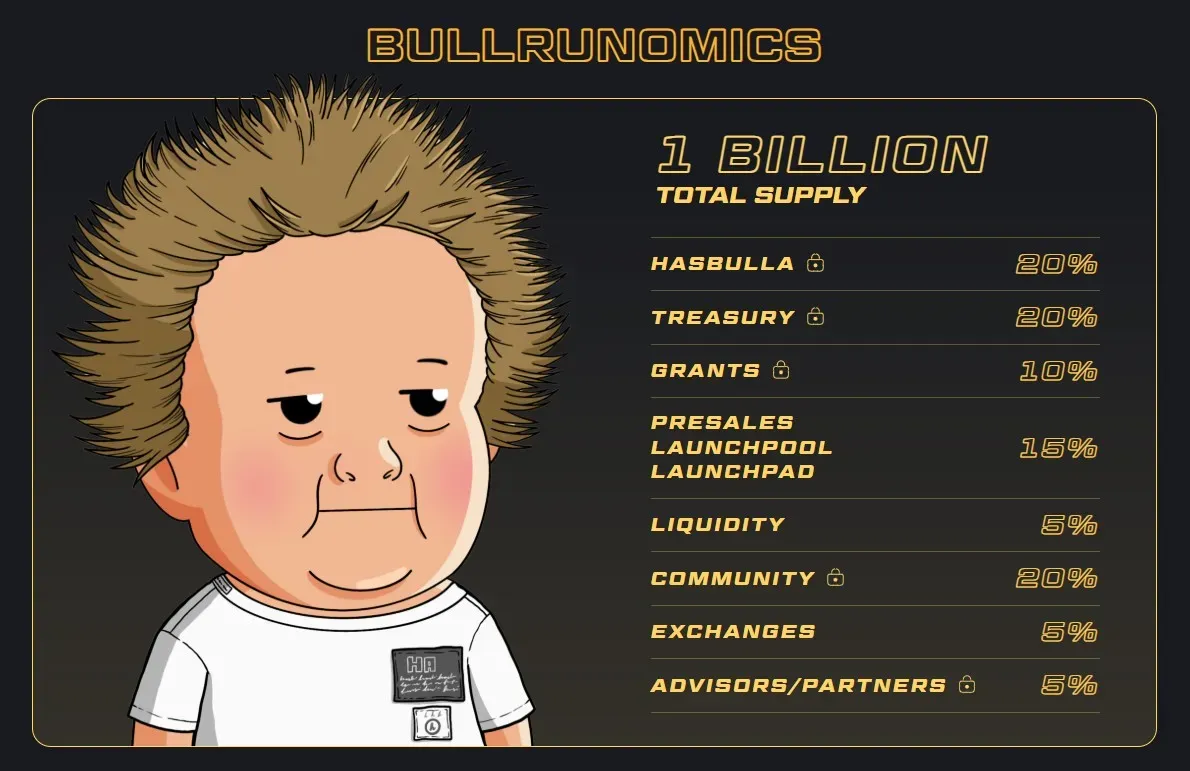
There is also a supply-clarity issue to keep in mind. CoinMarketCap currently reports BULLA with a total supply of 1 billion tokens and a circulating supply of 1 billion, implying full circulation. But the official BULLA site still presents the original token allocation and lock structure under the label "Bullrunomics." It lists 20% for Hasbulla, 20% for Treasury, 10% for Grants, 15% for Presales/Airdrop, 5% for Liquidity, 20% for Community, 5% for CEX Listings, and 5% for Advisors, with multiple tranches originally subject to cliffs and vesting periods. Even if much of that supply has since unlocked, the mismatch between aggregator-style circulation data and the project's original vesting framework is still worth noticing. If a token's supply picture feels too clean on the surface, experienced traders usually assume it deserves a second look.
Then there is behavior risk. A lot of people think the main danger in a trade like BULLA is buying too early. It usually is not. The main danger is being unable to exit cleanly after a spike, especially when liquidity gets thinner and slippage expands. This is why experienced traders worry less about whether the candle looks strong and more about whether they could still sell size without wrecking their own average price.
The Tokenomics Matter More Than the Branding
The official BULLA site is interesting because it admits what the project is while still showing how the supply was designed to support a long meme cycle. The 1 billion token supply was not simply dumped into the market at once. Several major buckets originally had cliffs and vesting schedules, including Hasbulla and Treasury allocations with six-month cliffs and 14-month vesting periods, plus an Advisors bucket stretching out to 48 months.
Why does that matter now? Because meme-coin traders often obsess over chart candles and ignore inventory mechanics. If a token has periodic supply reaching the market while social attention is cooling, every rebound becomes harder to sustain. In contrast, if a large part of the float is already fully circulating and the forced-seller overhang has faded, the token can become more responsive to short squeezes and narrative spikes. In BULLA's case, the market seems to be trading both stories at once: a token that can still squeeze because it is small and famous, but one that also carries enough structural uncertainty to keep conviction shallow.
The better reading is that BULLA is not just volatile because it is a meme coin. It is volatile because it is a meme coin with enough brand gravity to keep attracting traders, but not enough economic depth to make them stay for calm, multi-month accumulation.
BULLA Price Prediction 2026
The sensible way to frame BULLA price prediction is through ranges, not fake precision. BULLA is still a meme token with a broken long-term chart and real squeeze potential, so scenario analysis is more honest than pretending one target is "correct." The two anchor facts that matter most are simple: BULLA is still trading near the low end of its post-collapse range, and it can still produce outsized percentage moves because the market cap is small enough for attention to matter quickly.
| Scenario | 2026 range | What needs to happen |
|---|---|---|
| Bear case | $0.0045-$0.0075 | Meme liquidity fades, leverage unwinds, and the market stops rewarding short-covering rallies |
| Base case | $0.0080-$0.0180 | BULLA keeps producing tradable rebounds, but attention remains episodic and supply overhang caps upside |
| Bull case | $0.0200-$0.0500 | Meme-coin sentiment stays hot, exchange-side liquidity improves, and another strong squeeze cycle pulls in momentum traders |
Bear case
The bear case is still very live. If the late-April move turns out to be mostly a squeeze rather than the start of sustained demand, BULLA can retrace quickly toward the mid-to-lower single-digit cent fractions where meme tokens often stabilize after speculative exhaustion. This is especially true if broader market risk appetite weakens, if meme-coin traffic rotates into fresher narratives, or if traders realize the bounce was driven more by positioning than by genuine spot absorption.
Base case
My base case is not collapse, but instability. BULLA can remain active enough to trade while still failing to rebuild a strong long-term chart. In that version, price keeps bouncing hard enough to stay relevant, but every rally runs into profit-taking, supply absorption, and fading momentum before a full trend repair happens. This is the range where BULLA stays attractive to traders and exhausting to holders.
Bull case
The bull case depends on attention compounding instead of merely flaring. If BULLA keeps getting social traction, if meme-coin turnover on major venues stays elevated, and if traders keep using BULLAUSDT as a leverage vehicle rather than abandoning it after one spike, the token can revisit the two-cent zone and potentially stretch toward $0.05 in a more aggressive mania leg. But that is still a trading case, not proof of lasting fundamental value. The market would be pricing BULLA as a high-beta meme vehicle, not as a fundamentally stronger project.
What Traders Usually Miss About BULLA
The first thing traders miss is that being down 98% from the all-time high does not automatically make the token cheap. In meme markets, deep drawdowns often tell you less about value and more about how much speculative premium has already burned off.
The second thing they miss is that high volume is not always healthy volume. When a token with a roughly $10 million market cap prints volume above that market cap in a day, it can mean excitement, but it can also mean churn, leverage, and weak-handed participation dominating the tape.
The third thing they miss is that exit quality matters more than entry quality. Buying a breakout feels smart when the candle is green. Discovering there is not enough real depth to exit size after the move stalls is where the real pain starts.
The fourth thing they miss is that brand recognition is not the same as fundamental durability. Hasbulla gives BULLA stronger meme distribution than random small-cap tokens have. That helps it rebound. It does not guarantee the rebound lasts.
Can BULLA Reach $0.05 or $0.10 Again?
Yes, but that should not be treated as the default path.
For BULLA to reach $0.05 from roughly the current low-cent area, the market would need to reprice it several times higher while also sustaining much stronger turnover than it has shown in quieter periods. That is possible in a full meme rotation, especially for a token with an established internet face and exchange accessibility. A move toward $0.10 would require even more than that: sustained narrative dominance, aggressive speculative flow, and a market willing to overlook the token's lack of deep utility for much longer than usual.
This is why looking only at unit price is a trap. A token does not become cheap just because one coin trades below a dollar. What matters is the total valuation, the float structure, and how crypto market cap evolves relative to actual market demand. In practice, BULLA can print spectacular percentage moves without becoming a strong long-term asset.
Final View
My view on BULLA price prediction is tactical, not deeply bullish. BULLA remains interesting because meme coins can still generate extraordinary short-term returns when leverage, culture, and momentum line up. But the same ingredients that create the upside are also what make the downside vicious.
The cleanest reading is this: BULLA can still squeeze, but it has not yet proved that it can transition from a high-volatility meme trade into a durable asset with a reliable floor. The token is interesting for exactly the same reason it is dangerous. It is small enough to move, famous enough to re-enter the conversation, and thin enough to punish traders who confuse momentum with stability.
If you trade it, the smarter approach is to define your invalidation before entry, size smaller than you think you need to, and treat every green candle as something that can reverse faster than it formed. If you want a simple execution path instead of chasing every perp move, WEEX also has a practical guide on how to buy BULLA. And if you are going anywhere near leveraged meme coins, review risk management in crypto trading before you worry about upside targets.
FAQ
Is BULLA a good investment in 2026?
BULLA is a high-risk speculative asset, not a low-risk long-term hold. It can offer strong upside during meme-driven bursts, but it also carries extreme liquidity, sentiment, and drawdown risk.
Why is BULLAUSDT so volatile?
BULLAUSDT is volatile because the token trades like a leverage-sensitive meme asset. Thin liquidity, fast social rotation, crowded positioning, and small-cap market structure can create sharp squeezes and equally sharp reversals.
What is the biggest risk in any BULLA price prediction?
The biggest risk is confusing a squeeze with a durable trend change. A strong short-term rally can still fail if spot demand is weak, supply overhang remains, or traders rush for the exit at the same time.
Can BULLA recover to earlier highs?
It can rebound sharply, but reclaiming much higher historical levels would require a much bigger recovery in narrative strength, liquidity, and market participation than BULLA has proved so far.
DISCLAIMER: WEEX and affiliates provide digital asset exchange services, including derivatives and margin trading, only where legal and for eligible users. All content is general information, not financial advice-seek independent advice before trading. Cryptocurrency trading is high risk and may result in total loss. By using WEEX services you accept all related risks and terms. Never invest more than you can afford to lose. See our Terms of Use and Risk Disclosure for details.