Blockchain Scaling 101: Rollups and Alternatives

Reading time: approx. 7 minutes
Key Points
Blockchain scaling increases transaction capacity, lowers fees, and is crucial for the mass adoption of cryptocurrencies and Web3 applications.
Rollups (Layer-2 solutions) bundle transactions off the main blockchain and transfer them back to Layer 1 in batches. There are two main types: Optimistic Rollups (fast, but with withdrawal delays) and ZK-Rollups (secure, instant verification).
Alternatives to rollups include sidechains, state channels, Layer-1 blockchains (e.g., Solana, Avalanche), and Layer-0 protocols like Polkadot JAM. Each solution offers different approaches to scalability, security, and interoperability.
Leading rollup projects for 2025 include Arbitrum, Optimism, zkSync, Polygon zkEVM, StarkNet, Scroll, and Immutable X – they enable affordable, fast, and secure applications for DeFi, NFTs, and gaming.
Challenges include fragmented liquidity, complex user experience, and a lack of standardization. The future lies in better UX designs, AI integration, cross-chain communication, and innovative approaches like Polkadot JAM and proto-danksharding.
Introduction
Blockchain scaling is the key to the mass adoption of cryptocurrencies and decentralized applications. But how can we enable thousands of transactions per second without compromising security or decentralization? In this comprehensive guide, you will learn how modern scaling solutions like rollups (Layer-2 solutions), sidechains, state channels, and Layer-0 protocols like Polkadot work, what their differences are, and which projects will shape the market in 2025. Whether you are a beginner, investor, or crypto enthusiast: here you will find practical explanations, current trends, and concrete examples of how blockchain scaling is shaping the future of DeFi, NFTs, and Web3 – simple, understandable, and up to date.
Have you ever wondered how rollups and Layer-2 solutions are revolutionizing blockchain scaling and paving the way for mass-market, affordable, and fast crypto applications?
Discover it on WEEX now – trade the latest cryptocurrencies with cutting-edge scaling technology and secure yourself a welcome bonus of up to $100 for new users!
You can find a practical guide to Ethereum rollups on Coinstelegram.
Blockchain Scaling Explained Simply
Blockchain scaling means that a blockchain can process more transactions per second without compromising security. For beginners, the principle can be compared to a multi-lane highway: the more lanes there are, the more cars can drive at the same time – without traffic jams.
Without modern scaling solutions like rollups, networks like Ethereum would quickly reach their limits during high traffic – resulting in overloaded systems and extremely high transaction fees. Especially during periods of intense usage, such as NFT drops or significant market movements, it becomes clear how indispensable high-performance scaling technologies are.
Scaling is also a central aspect for the mass adoption of blockchain: only if applications function quickly, cost-effectively, and in a user-friendly manner can millions of users utilize Web3 solutions in the long term. However, many current scaling solutions involve central components whose full decentralization is still in the development process. The industry is working on further improving this aspect to achieve the ideal of a secure and decentralized blockchain.
Further background information on blockchain scaling and various scaling approaches can be found in the Chainlink Education Hub and FTD - Scaling of Blockchains.
How Do Rollups (Layer-2 Solutions) Work?
Rollups are a key Layer-2 technology aimed at significantly increasing the scalability and efficiency of blockchains like Ethereum. They work by bundling and processing transactions off the main blockchain (Layer 1) and then writing the compressed results back to the mainchain in batches. This maintains the security of the underlying blockchain while massively increasing throughput and speed.
There are two main types of rollups:
Optimistic Rollups: They assume that transactions are correct unless a dispute is filed. This makes them easy to implement, but leads to longer withdrawal times because a period for potential disputes must be waited out.
ZK-Rollups (Zero-Knowledge): These use cryptographic proofs to verify every transaction immediately and securely. This increases security and speed, but is technically more complex to develop.
Rollups are part of a larger spectrum of Layer-2 solutions. These also include sidechains, which act as independent blockchains connected to the mainchain, and state channels, which enable fast, direct transactions between two parties without storing every single one on the main blockchain.
By offloading transaction processing to Layer 2 and subsequently feeding the data back to Layer 1, networks like Ethereum become more powerful, cheaper, and accessible to the mass market. Rollups thus enable scalable DeFi applications, affordable NFT transactions, and fast blockchain games – and form a central building block for the future of blockchain technology.
Detailed explanations of the various rollup types and their role in Ethereum's scalability are provided by Ethereum.org and this technical article by Zerocap.
The Development of Rollups (Layer-2 Solutions)
The development of rollups has significantly driven blockchain scaling in recent years. Rollups originally emerged as a response to the growing bottlenecks and high transaction costs on Ethereum, which became evident due to the DeFi boom and the NFT hype starting in 2020. Early projects like Optimism and Arbitrum relied on the principle of Optimistic Rollups: here, transactions are bundled outside the main blockchain and only checked when necessary, which significantly improves speed and costs. In parallel, Zero-Knowledge Rollups (ZK-Rollups) were developed, where cryptographic proofs are generated for every transaction. This technology, as used by projects like zkSync and StarkNet, offers particularly high security and efficiency.
The integration of AI, modular blockchain design, and cross-chain communication is further accelerating development. Today, rollups are the backbone of modern Layer-2 scaling and are widely used by leading projects and companies – a decisive step toward the mass adoption of blockchain technology.
Practical Examples of Rollups (Layer-2 Solutions)
Rollups offer practical benefits in various areas. Here are some examples that are easy for beginners to understand:
DeFi with Arbitrum: If you want to swap tokens on Uniswap, fees on Ethereum often cost $5 - $50, depending on network load. On Arbitrum, they are typically under $0.30, making trading more affordable.
NFTs with zkSync: Creating an NFT on Ethereum can cost from $10 to over $100. On zkSync, fees are often less than $0.01 per transaction, making it easier for artists to start without high costs.
Gaming with Rollups: In blockchain games, where players often buy items, fees on Ethereum can quickly reach $5 per transaction. On rollups like zkSync, they are nearly free, making gaming more affordable.
Why this is important: These examples show how rollups make the blockchain more accessible to beginners by lowering costs and improving the user experience.
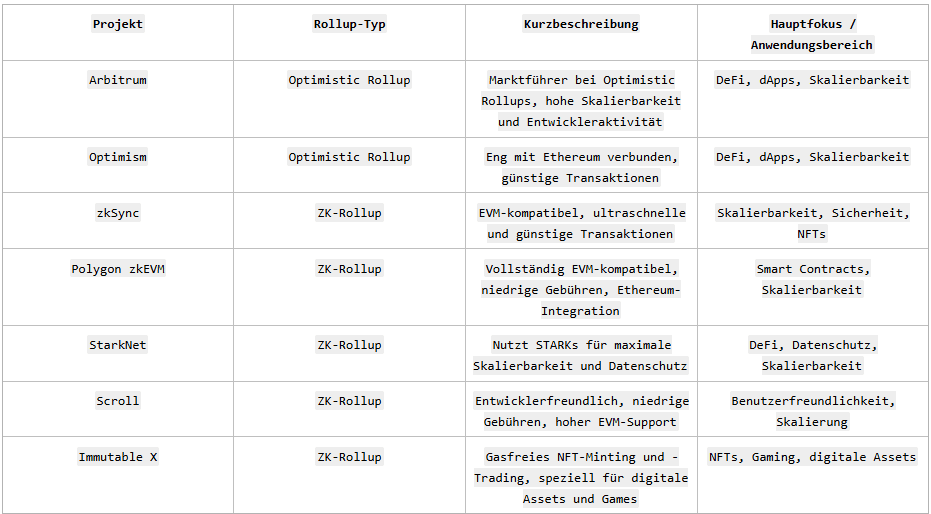
Comparison of Well-Known Rollup Projects
Advantages and Disadvantages of Rollups (Layer-2 Solutions)
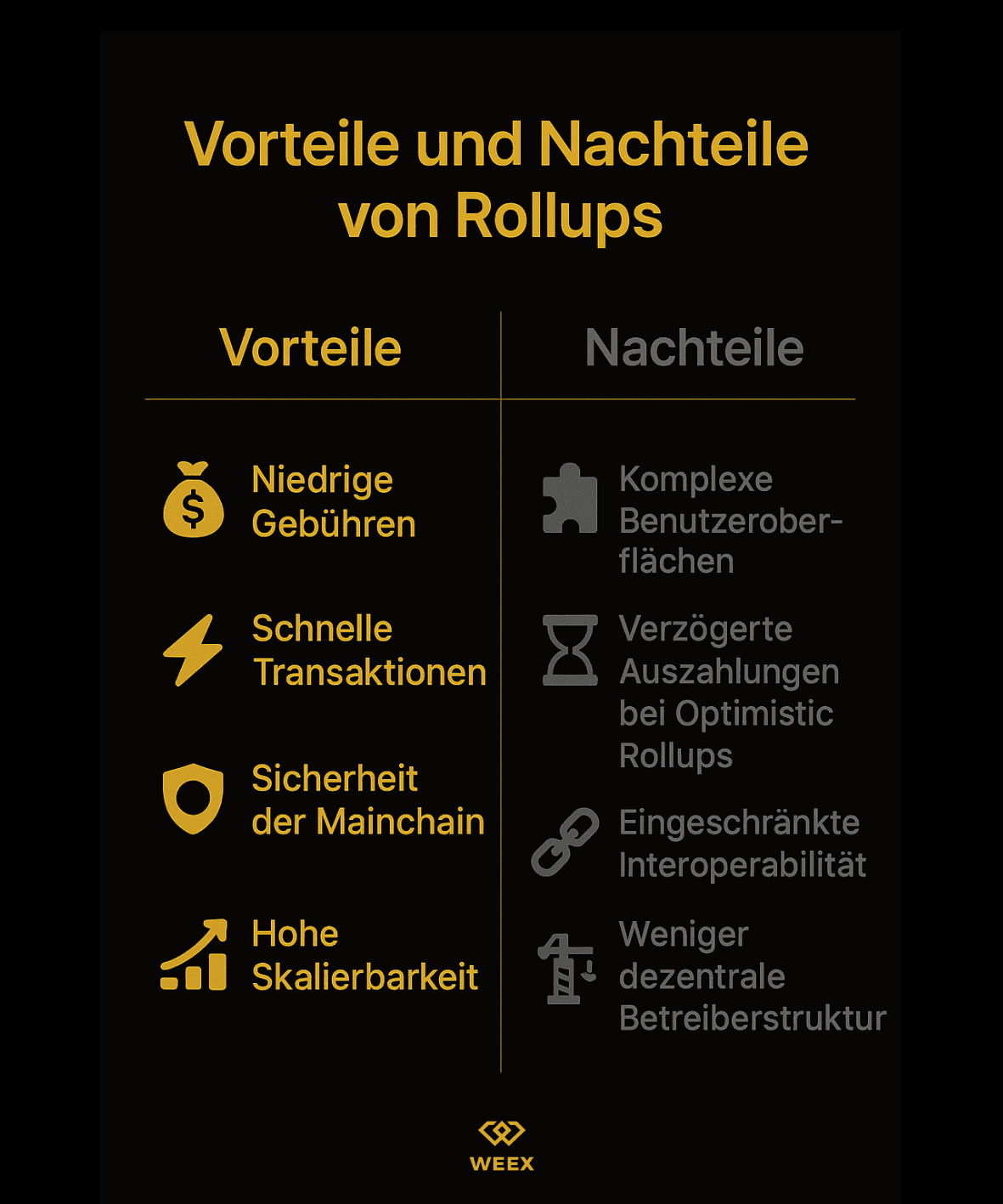
Rollups are considered one of the most effective Layer-2 scaling solutions for blockchains like Ethereum. They enable fast and cheap transactions by bundling large amounts of data off the main blockchain and returning them in batches. Nevertheless, there are also challenges – for instance, regarding user-friendliness, interoperability, and decentralization. The following overview shows the current strengths and weaknesses of rollups and what users should look out for.
Further information can be found at the Ledger Academy on blockchain rollups.
Difference Between Rollups and Other Scaling Solutions
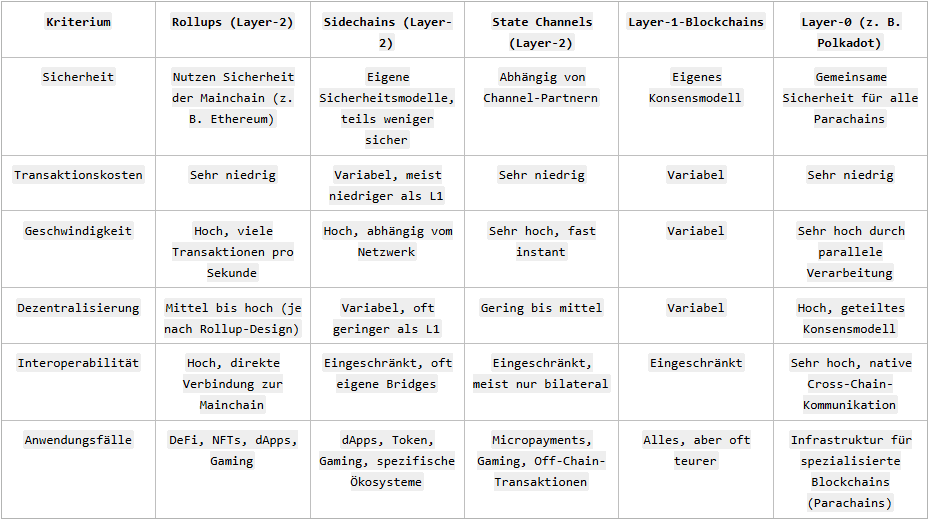
In Brief:
Rollups bundle transactions off-chain and secure them on-chain – they offer high security and efficiency.
Sidechains are independent blockchains connected to the mainchain but use their own security mechanisms.
State Channels allow fast, private transactions between a few parties outside the blockchain.
Layer-1 blockchains like Solana or Avalanche scale through their own architecture but usually operate in isolation.
Layer-0 solutions like Polkadot enable interoperability and security for many specialized blockchains ("parachains" = rollups).
Alternatives to Rollups (Layer-2 Solutions)
Although rollups are currently considered the leading Layer-2 scaling solution, there is a multitude of other approaches, each offering its own strengths and areas of application. Below you will find the most important alternatives to rollups that address blockchain scalability in different ways.
Sidechains: Independent blockchains connected to the mainchain (e.g., Polygon). High flexibility, but lower security.
State Channels: Direct off-chain communication (e.g., Lightning Network). Ideal for fast transactions with few participants.
Polkadot Cores & Polkadot JAM (Layer-0 blockchains): A new generation of modular blockchain architectures with potentially unlimited scalability.
Layer-1 blockchains like Solana, which achieve scalability through Proof of History and Proof of Stake without needing Layer-2.
These alternatives show that, besides rollups (L2s), there are many ways to make blockchain technology future-proof.
Overview of Alternatives to Rollups (Layer-2 Solutions)
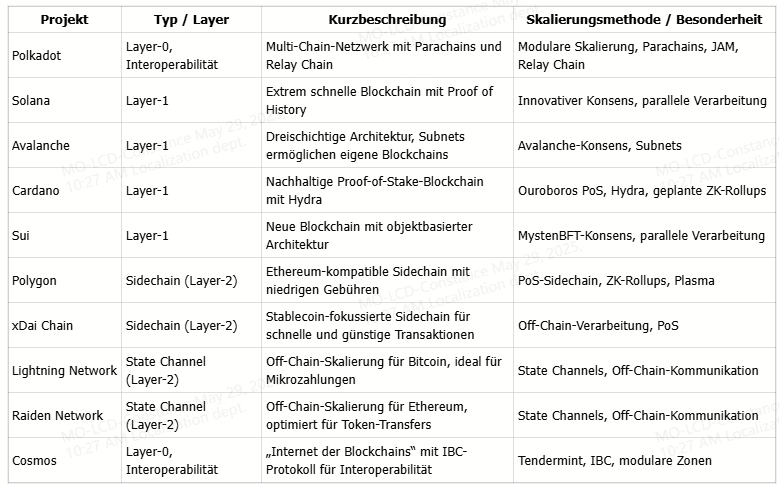
A comparison between Layer-1 and Layer-2 scaling solutions is provided in this LinkedIn article.
Challenges of Scaling
Scaling solutions like rollups and other Layer-2 technologies bring not only benefits but also specific challenges:
Fragmentation of liquidity: Since users and capital are distributed across different Layer-2 platforms, market liquidity suffers. This can lead to lower trading activity and less efficient markets.
Complex user experience: Users often have to manage multiple wallets, bridges, and networks. This technical complexity deters beginners in particular and hinders widespread use.
Lack of standardization: So far, there are no industry-wide standards for interoperability and security. This leads to isolated solutions that hinder seamless collaboration between different blockchains and Layer-2s.
To overcome these challenges, better user interfaces, targeted educational offerings, and stronger industry-wide collaboration are necessary in the long term. Only then can scaling solutions reach their full potential and drive mass blockchain adoption.
A critical look at the security of Layer-2 solutions can be found in the Bitcoin Blog article.
The Future of Blockchain Scaling
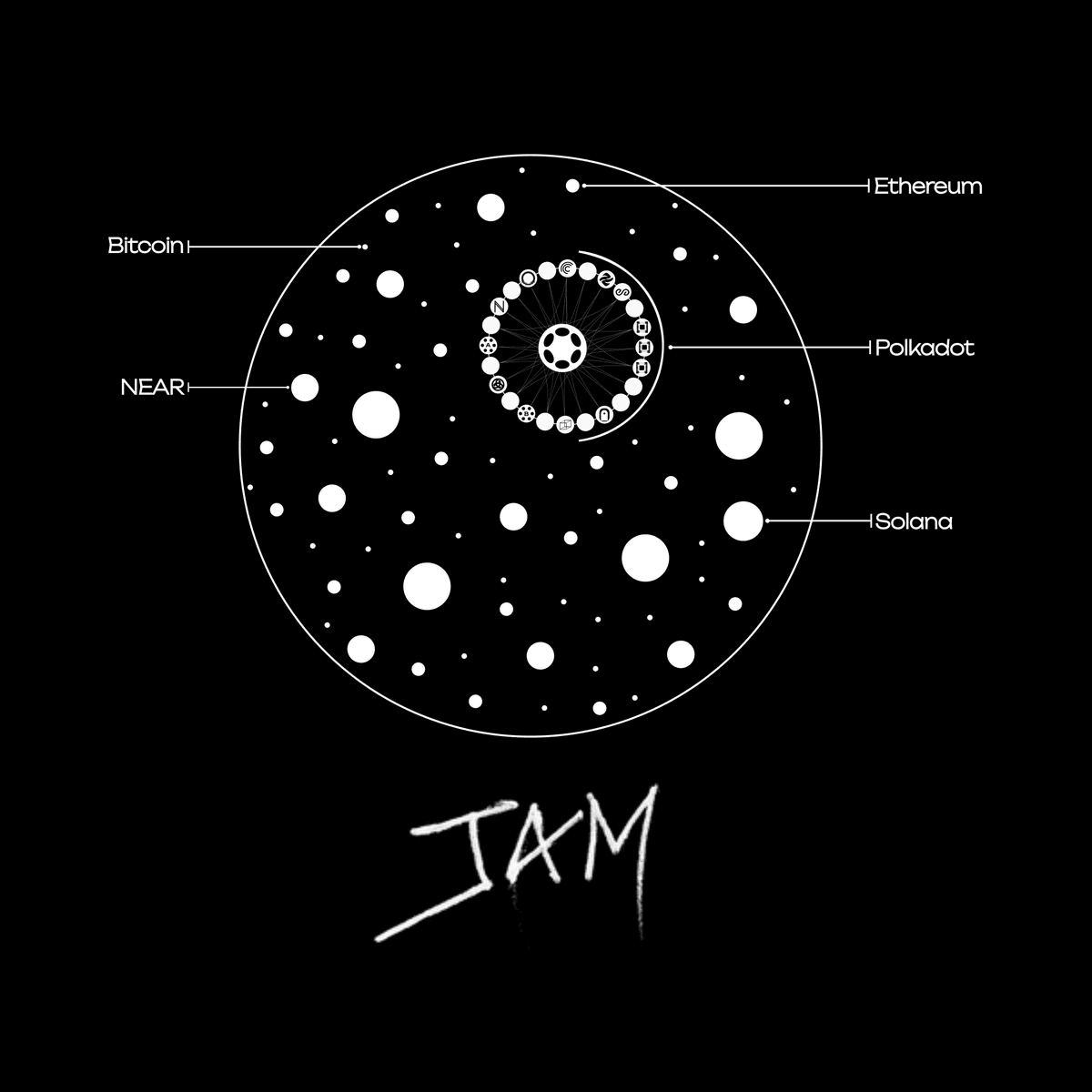
Rollups and Layer-2 solutions are evolving rapidly. With Ethereum upgrades like proto-danksharding, modular blockchain design, and innovative projects, scalability is being steadily improved. Polkadot's new JAM concept (Join-Accumulate Machine) is also considered a forward-looking solution, as it enables modular, interoperable blockchain structures. Additionally, AI integration, cross-chain communication, and greater regulatory clarity are further driving the development of high-performance, mass-market blockchain networks.
Current Layer-2 Trends and Top Projects for 2025
Layer-2 solutions are the backbone of blockchain scaling in 2025. They not only enable more transactions per second but also dramatically lower fees and make blockchain applications suitable for the masses.
Key Trends:
Rollups are gaining ground: Optimistic Rollups (like Arbitrum and Optimism) and ZK-Rollups (like zkSync and StarkNet) dominate scaling because they optimally combine efficiency, security, and low fees.
Layer-2 ecosystems are growing: Individual Layer-2 projects are evolving into comprehensive ecosystems with DeFi, NFTs, gaming, and seamless cross-chain communication, enabling new fields of application and innovation.
Rapid wave of adoption: More and more dApps, companies, and users are relying on Layer-2 solutions to make Web3 applications as fast, cheap, and user-friendly as classic Web2 offerings.
Top Layer-2 Projects for 2025:
Arbitrum: Market leader in Optimistic Rollups, popular in the DeFi sector.
Optimism: Closely integrated with Ethereum, ensures significant cost savings.
zkSync: Relies on Zero-Knowledge proofs for maximum security and speed.
StarkNet: Scales Ethereum with a focus on privacy and decentralization.
Top Scaling Projects for 2025:
Solana: Extremely fast Layer-1 blockchain with low fees and high user activity.
Polkadot: Modular multi-chain network with parachains and an innovative JAM upgrade for maximum interoperability.
Avalanche: Scalable platform with subnets and lightning-fast transactions for DeFi and Web3 applications.
Sui: New Layer-1 blockchain with object-based architecture, parallel execution, and low fees.
Cardano: Sustainable Proof-of-Stake blockchain with Hydra state channels and a focus on scalability and security.
Blockchain Fundamentals for Investors
Blockchain scaling solutions like rollups and their alternatives are particularly attractive to investors because they create the foundation for mass-market, efficient, and cost-effective blockchain applications. Scalable networks enable more users, lower transaction fees, and faster processes – this increases the attractiveness of decentralized applications (dApps) and can sustainably increase the demand for native tokens.
Projects that rely on high-performance scaling technologies early on are often better positioned for future growth. For investors, it is therefore worthwhile to closely follow the development and adoption of Layer-2 solutions and alternative scaling approaches, as these can significantly influence the value, usage, and potential of a blockchain.
How You Can Benefit from Scaling Solutions
Open a WEEX account: Register quickly and easily on WEEX to gain access to the latest crypto scaling solutions.
Trade rollup-based tokens and alternatives: Benefit from extremely low trading fees starting at 0.006% on WEEX and trade the latest rollup, Layer-1 & Layer-0 tokens.
Complete verification & secure bonus: After successful verification, you will receive a welcome bonus of up to $100 as a new customer.
Connect with the community: Join active crypto communities, exchange ideas, and always stay on the pulse of time.
Enjoy security: Store your cryptocurrencies securely on WEEX and benefit from the 1,000 BTC protection fund.
Interact on-chain: Alternatively, you can withdraw your coins to your own wallet and interact directly with decentralized applications on the blockchain.
Conclusion on Blockchain Scaling via Rollups and Alternative Solutions
The scaling of blockchains through rollups, sidechains, and Layer-0 solutions is crucial today for the success and future viability of the entire crypto industry. Anyone who understands the differences, opportunities, and challenges of these technologies can make informed decisions – whether as a user, developer, or investor. Rollups and their alternatives ensure low fees, high speed, and open up entirely new fields of application in Web3. Stay informed, observe the innovations surrounding Layer-2 and Layer-0 projects, and leverage the benefits of blockchain scaling to profit from the next growth wave in the crypto market.
Are you ready to profit from the opportunities of blockchain scaling and the next generation of Layer-2 solutions?
Start now with WEEX! Register on WEEX today, trade rollup-based tokens with extremely low fees (starting at 0.006%), and secure yourself a welcome bonus of up to $100.
Disclaimer – Legal Notice from WEEX Exchange
WEEX and its affiliates offer services for the exchange of digital assets, including derivatives and margin trading, only where legal and for eligible users. All content is general information, not financial advice – seek independent advice before trading. Trading cryptocurrencies involves a high level of risk and can lead to a total loss. By using the services of WEEX, you accept all associated risks and conditions. Never invest more than you can afford to lose. Further information can be found in our Terms of Use and in the Risk Disclosure.