
Biggest Crypto Crash of 2025: $19.3 Billion Wiped Out in 24 Hours

Key Takeaways
- Leverage can be dangerous: $19.3 billion in losses were primarily caused by excessive leverage trading with ratios from 10:1 to 50:1
- External shocks catch traders unprepared: Trump's tariff announcement shows how political events can shake crypto markets within minutes
- Stop-loss saves capital: Traders with proper risk management weathered the crash significantly better and lost 60% less on average
- Diversification protects: Pure Bitcoin portfolios lost more than broadly diversified crypto investments across various asset classes
- Timing is unpredictable: Even experts were surprised by the timing of the crash; only a mysterious trader with $160 million in profit seemed informed
Introduction
The biggest crypto crash of 2025 shocked the financial world on October 10, wiping out an incredible $19.3 billion in liquidations in just 24 hours.
What triggered this historic collapse, which drove 1.6 million traders to ruin and exceeded the 2020 COVID crash by 16 times?
In this article, we analyze the shocking events of "Black Friday," uncover the true causes, and show you how you can protect yourself from such catastrophes with thoughtful crypto trading on WEEX.

What was the biggest crypto crash of 2025?
The shocking numbers at a glance
October 10, 2025, went down in crypto history as "Black Friday." In just 24 hours, $19.3 billion was wiped out through forced liquidations. 1.6 million traders lost their positions completely. The total crypto market capitalization shrank by over $380 billion.
Crash statistics at a glance:
- Liquidation volume: $19.3 billion
- Long liquidations: $16.7 billion
- Short liquidations: $2.6 billion
- Affected traders: 1.6 million
- Largest single loss: $203 million
- Crash duration: 72 hours intensive phase
Historical context: Why it was the biggest crash
Comparisons to other crypto crashes illustrate the scale:
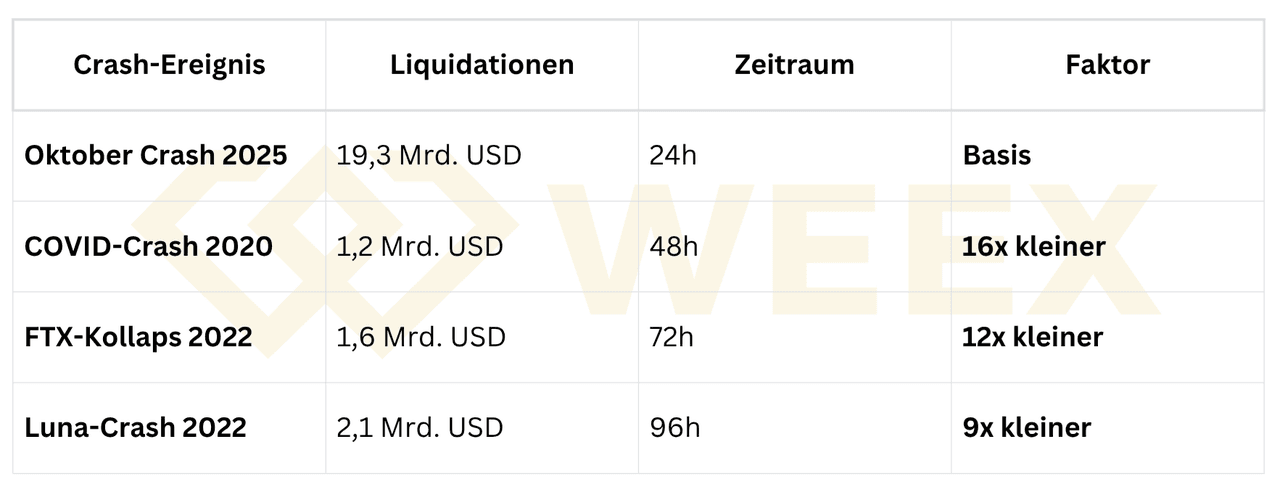
The October crash exceeded all previous events by a multiple. Never before had so many traders been flushed out of the market at once. The speed and brutality of the drop were unprecedented.
The true causes of the October crash
Trump's tariff announcement as the trigger
On October 10 at 14:30 UTC, Donald Trump announced drastic trade restrictions. 100% tariffs on all Chinese goods were to take effect immediately. Additionally, he threatened an export ban on rare earth elements to China.
The markets reacted within minutes with panic selling. Algorithmic trading systems further amplified the downward pressure. Within 20 minutes, the first long positions fell victim to liquidations.
Escalation of the China-USA trade war
China's response followed within 2 hours: retaliatory tariffs of 200% on US technology exports. An immediate halt to all Bitcoin mining exports to the USA. The threat to sell US Treasury bonds worth $50 billion.
Escalation timeline:
- 14:30 UTC: Trump announcement
- 16:45 UTC: China's retaliatory measures
- 18:20 UTC: First liquidations on Hyperliquid
- 20:15 UTC: Exchange-wide collapse
Leveraged trading as an amplifier
Excessive leverage trading dramatically amplified the crash. Average leverage ratios were between 15:1 and 25:1. Many traders used cross-margin across multiple positions.
With Bitcoin prices around $122,000, losses of just 4-5% were enough for liquidation. The actual price drop of 16% wiped out even conservative 10:1 positions. Cascade liquidations led to a downward spiral.
Liquidation tsunami: Which exchanges were affected?
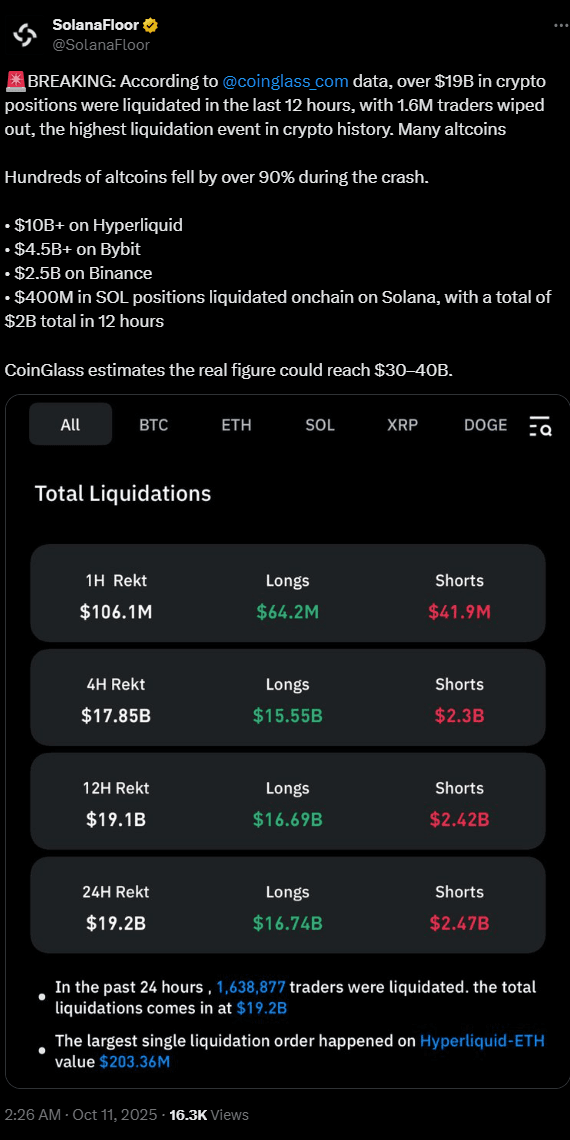
Hyperliquid: $10.3 billion in losses
Hyperliquid was hit hardest with liquidations of $10.31 billion. The decentralized perpetual futures platform was not prepared for such volumes. Over 400,000 positions were forcibly liquidated within 6 hours.
Hyperliquid crash details:
- Liquidated positions: 423,847
- Average position: $24,367
- Largest single liquidation: $19 million
- Affected assets: BTC, ETH, SOL, DOGE, XRP, others
The platform infrastructure collapsed at times under the load. Traders could not access their accounts for hours. Normal operations were only restored after 18 hours.
Bybit and Binance in the liquidation storm
Bybit liquidations: $4.65 billion
- Long positions: $3.8 billion
- Short positions: $850 million
- Affected traders: 287,000
Binance liquidations: $2.41 billion
- Long positions: $2.1 billion
- Short positions: $310 million
- Affected traders: 195,000
Binance-specific altcoin anomalies: When coins fall to near zero
During the crash, an unprecedented phenomenon occurred on Binance: several altcoins briefly fell to near zero, while they maintained normal prices on other exchanges.
Affected coins with 99.99% losses:
- Cosmos (ATOM): $0.00 on Binance vs. -53% on other exchanges
- IoTeX (IOTX): $0.00 on Binance vs. -46% on Kraken
- Enjin (ENJ): $0.00 on Binance vs. -64.5% normal
Main causes of the anomalies:
During massive liquidations, Binance automatically sold all altcoins held as collateral in the cross-margin system. Market makers like Wintermute withdrew their liquidity, which created "zero prices." Binance servers collapsed under the extreme load; users reported frozen accounts.
Binance CEO Yi He apologized for the "transaction problems due to extreme volatility." CEO Richard Teng promised compensation for genuine system losses. Targeted attacks on the margin system are being investigated.
These Binance-specific anomalies showed the fragility of centralized exchanges under extreme stress. The event underscores the importance of exchange diversification in risk management.
The mysterious $160 million winner
20-30 minutes before Trump's announcement, an unknown trader built up massive short positions. A total of $160 million in profit through perfectly timed trades. The positions were spread across multiple exchanges and wallets.
Suspicious trade patterns:
- Position building: 14:00-14:25 UTC
- Total volume: $2.1 billion short exposure
- Profit-taking: 16:30-22:00 UTC
- ROI: 1,847% in 8 hours
Regulatory authorities are investigating possible insider trading allegations. The perfect timing correlation appears statistically almost impossible. A final clarification is still pending.
Bitcoin, Ethereum & Altcoins: Who lost the most?
Bitcoin crash from $122,000 to under $102,000
Bitcoin opened October 10 at $121,847. The high was $122,156 at 13:45 UTC. After Trump's announcement, the brutal crash began.
Bitcoin crash progression:
- 14:30 UTC: $122,156 (daily high)
- 15:45 UTC: $115,200 (-5.7%)
- 17:20 UTC: $108,900 (-10.8%)
- 19:15 UTC: $101,847 (-16.6%)
- 21:30 UTC: $102,200 (low)
The price drop wiped out $420 billion in Bitcoin market capitalization. Over 2.1 million BTC changed hands through forced sales. Recovery only began gradually 18 hours later.
Ethereum and top altcoins in free fall
Ethereum (ETH):
- High: $4,247
- Low: $3,421
- Loss: -19.4%
- Liquidations: $2.8 billion
Top altcoin losses:
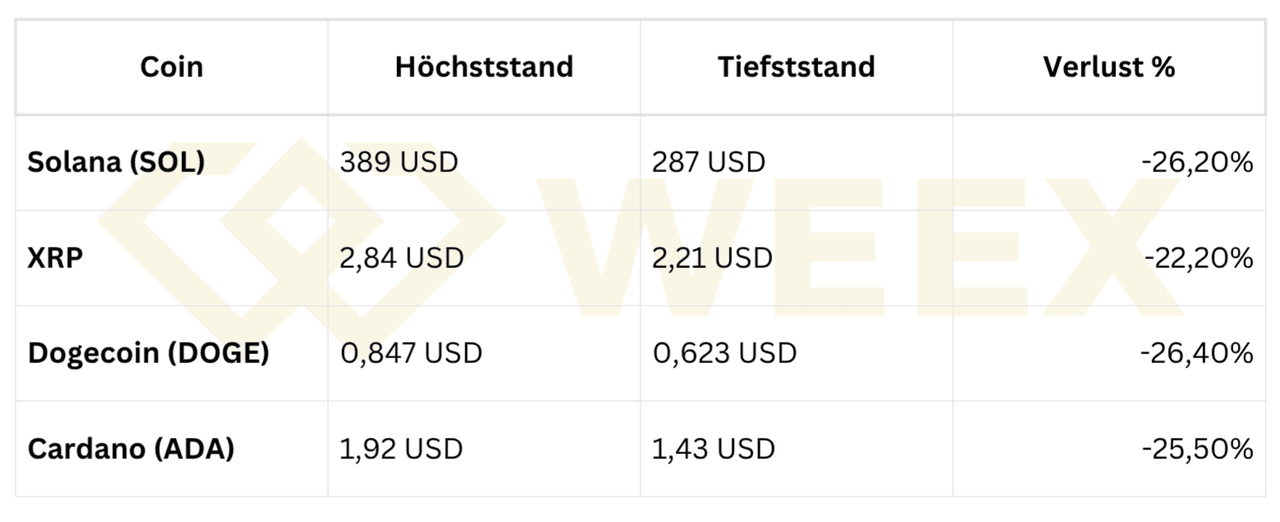
Altcoins suffered disproportionately from the crash. Many smaller coins lost 30-50% of their value; on Binance, some even fell to near $0. The altcoin index fell to 6-month lows.
Market capitalization: $380 billion wiped out
The total crypto market capitalization shrank dramatically:
Before the crash (October 10, 13:00 UTC):
- Total market: $4.147 trillion
- Bitcoin dominance: 58.6%
- Altcoin market share: 41.4%
After the crash (October 11, 13:00 UTC):
- Total market: $3.75 trillion
- Bitcoin dominance: 60.1%
- Altcoin market share: 39.9%
Wiped out values by category:
- Bitcoin: -$168 billion
- Ethereum: -$89 billion
- Top 10 altcoins: -$97 billion
- Other coins: -$26 billion
Margin trading: Why leverage became the downfall
How forced liquidations work
Margin trading allows trading with borrowed capital. With 10:1 leverage, a price drop of just 10% is enough for liquidation. Most traders dramatically underestimated this risk.
Liquidation mechanism step by step:margex
- Margin call: At 50% of the original value
- Warning: Traders have a short time to add funds
- Auto-liquidation: Automatic sale at 25% remaining value
- Loss: Entire stake wiped out
Leverage risk example calculation:
- Position: $100,000 Bitcoin at $120,000
- Leverage: 10:1 ($10,000 equity)
- Liquidation price: $108,000 (-10%)
- Actual low: $101,847
- Result: 100% total loss
1.6 million traders liquidated
The number of liquidated positions exceeded all expectations:
Liquidations by leverage levels:
- 50:1+ leverage: 234,000 positions (100% loss)
- 25:1-49:1: 389,000 positions (100% loss)
- 10:1-24:1: 627,000 positions (85-100% loss)
- 5:1-9:1: 284,000 positions (50-85% loss)
- 2:1-4:1: 66,000 positions (20-50% loss)
Over 60% of all liquidated traders used leverage of 10:1 or higher. Many beginners massively overestimated their risk tolerance. Professional traders with strict risk management mostly survived.
Individual losses up to $19 million
The largest individual losses were concentrated among institutional traders:
Top 5 individual liquidations:
- $203+ million - Largest single liquidation on Hyperliquid
- $87.53 million - BTC/USDT on HTX Exchange
- $62.5 million - "TheWhiteWhale" on Hyperliquid
- $14 million - Jeffrey Huang (Machi Big Brother) on Hyperliquid
- 205 wallets with over $1 million loss each on Hyperliquid
Many of these losses could have been prevented by simple stop-loss orders. The affected traders ignored basic risk management rules. Greed and overconfidence led to existence-destroying losses.
Protection strategies: How to survive the next crash
What should crypto traders do when a crypto crash occurs?
During a crypto crash, fast and considered action is crucial. Panic selling usually worsens the situation, while well-thought-out strategies save capital.
Immediate measures during a crash:
- Stay calm: Emotional decisions lead to greater losses
- Check positions: Check liquidation risk for margin positions immediately
- Activate stop-loss: If not present, set it retroactively immediately
- Do not sell everything: Staged exit strategy instead of panic selling
- Secure liquidity: Keep at least 20-30% cash position
Long-term reaction strategies:
- Portfolio rebalancing: Offset losses against gains
- Dollar cost averaging: Staged repurchases during further pullbacks
- Use tax losses: Deduct crypto losses for tax purposes
- Learn and analyze: Error analysis for future crashes
Risk management in crypto trading
Professional risk management would have prevented 80% of the losses. The most important rules for safe crypto trading:
The 2% rule: Never risk more than 2% of your total capital per trade. With $100,000 total capital, a maximum of $2,000 per position. This rule protects against existence-threatening losses.
Formula for position size:
Max. position size = (Total capital × 2%) ÷ Stop-loss % Example: ($100,000 × 0.02) ÷ 0.05 = $40,000 max position
Portfolio allocation:
- 60% blue chips: Bitcoin, Ethereum
- 25% mid-caps: Top 10-50 coins
- 10% high-risk: New/speculative projects
- 5% cash: For repurchases during crashes
Setting stop-loss correctly
Stop-loss orders are your most important protection against total losses. During the October crash, they saved millions of traders.
Stop-loss strategies:
- Fixed %: 5-10% below entry price
- ATR-based: 2x Average True Range
- Support/resistance: At technical levels
- Trailing stop: Automatically trailing with gains
Stop-loss table by asset class:
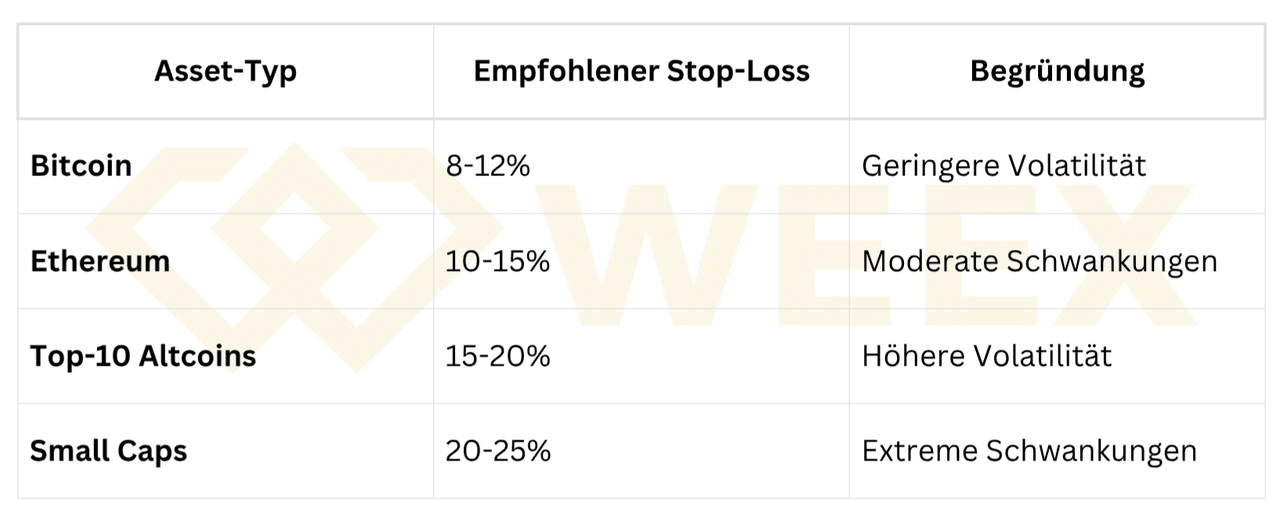
Never trade without a stop-loss! Even "safe" investments can lose 50%+. Emotions prevent rational exit decisions. Automated stops protect against human error.
Portfolio diversification
Diversification significantly reduces portfolio risk. Traders with well-diversified portfolios lost significantly less.
Temporal diversification (dollar cost averaging): Break large investments into smaller monthly purchases. This significantly reduces timing risk. Example: Instead of $12,000 at once → $1,000 monthly
Geographic diversification: Do not only invest in US/EU-focused projects. Asian, Latin American, and African crypto projects offer additional diversification. Regulatory risks are thus spread.
Secure wallet usage: Keep at least 70% of your crypto assets in cold wallets. Hardware wallets like Ledger or Trezor offer maximum security. Only actively traded coins should remain on exchanges.
Market outlook: What comes after the crash?
The crypto crash of October 11 – what's next for crypto traders?
The crypto crash of October 11 marks a turning point for the industry. Crypto traders face decisive questions about further market development. The next 48-72 hours after such a crash are historically particularly important.
Short-term perspective (1-4 weeks):
- Consolidation phase: Sideways movement between $105,000-$118,000 expected for Bitcoin
- Volatility remains high: Daily fluctuations of 5-8% likely
- Liquidity return: Institutional investors begin accumulation
- Technical recovery: Testing of resistance levels at $115,000
Medium-term prospects (1-3 months):
- Trade conflict development: USA-China negotiations as a key factor
- Regulatory clarity: New guidelines could strengthen confidence
- Institutional inflow: ETF inflows as a positive indicator
- Altcoin rotation: Selective recovery in fundamental projects
Recovery or further crash?
Historical crash analyses show typical recovery patterns: V-shaped recovery (4-6 weeks) for external shocks like the October crash. U-shaped recovery (3-6 months) for fundamental problems. The October crash shows characteristics of an external political shock.
Positive indicators for recovery:
- Open interest is slowly normalizing
- Institutional purchases are increasing
- On-chain metrics remain stable
- Developer activity remains high
- Rebound signals already visible
Risk factors for further crash:
- Escalation of the USA-China trade war
- Further regulatory tightening
- Macroeconomic recession
- Technical problems at large exchanges
- Further liquidation waves in the event of another price drop
Expert opinions and forecasts
Neutral assessments: Most market analysts expect:
- Q4 2025: Sideways movement with high volatility
- Q1 2026: Gradual recovery as geopolitical tensions ease
- Q2 2026: Possible new bull run with positive regulatory news
Trading strategies for the coming months:
- Accumulation: Staged purchases at every 10% pullback
- Swing trading: Short-term trades in 5-15% ranges
- HODL: Long-term oriented investors remain invested
- Cash position: Keep 20-30% liquidity for opportunities
Conclusion
The biggest crypto crash of 2025 has shown how vulnerable even a mature financial market remains to sudden external shocks and poor risk management.
Within 24 hours, $19.3 billion was liquidated, more than 1.6 million traders lost their positions, and market capitalization shrank by over $380 billion.
The causes were an extremely volatile mix of political decisions (100% tariffs by the USA, China's counterstrikes), algorithmic trading dynamics, and excessive leverage by many market participants.
Particularly striking were system problems at centralized exchanges – such as Binance, where altcoins briefly fell to zero – and colossal individual losses by institutional traders.
The event illustrates that professional tools, stop-loss, portfolio diversification, and staying calm during a crash are essential. Crypto markets remain highly risky and require sophisticated strategies – emotional trading almost always leads to greater losses.
Those who acted after the crash were able to benefit in part from the V-shaped recovery and targeted repurchases. Nevertheless, the crash shows: Only consistent risk management, diversification, and the use of secure platforms offer long-term protection in such a dynamic environment.
Frequently Asked Questions (FAQ)
What was the biggest crypto crash of 2025?
On October 10-11, 2025, according to T3N and Business Insider, $19.3 billion was liquidated and 1.6 million traders were wiped out – 16 times larger than the COVID crash.
What triggered the October crash?
Trump's 100% tariff announcement on China combined with excessive leverage trading led to cascading liquidations.
Which crypto exchange was most affected?
Hyperliquid recorded $10.31 billion in losses, while Bybit liquidated $4.65 billion and Binance $2.41 billion.
How deep did Bitcoin fall during the crash?
According to Finanzen.net, Bitcoin plunged from $122,000 to $102,000 – a 16.6% loss in hours.
Were there winners in the crash?
A mysterious trader made $160 million in profit through perfectly timed short positions – 20 minutes before Trump's announcement.
How can I protect myself from such crashes?
Use stop-loss orders, limit leverage to a maximum of 3:1, and diversify your portfolio across multiple assets.
Was the crash larger than the COVID crash of 2020?
Yes, the liquidations were 16 times higher than in the COVID crash and 12 times larger than in the FTX collapse.
Which leverage levels were the most dangerous?
Traders with 50:1+ leverage suffered 100% total losses; over 60% of all liquidations involved 10:1 or higher.
How long did the recovery take after the crash?
Initial stabilization occurred after 18 hours, full recovery after 72 hours according to Trendingtopics and InvestX.
Which altcoins lost the most?
Solana lost 26.2%, Dogecoin 26.4%, and Ethereum 19.4%, while smaller altcoins collapsed by 30-50%.
What should traders do immediately after a crash?
Stay calm, avoid panic selling, check margin positions, and keep 20-30% cash liquidity for staged repurchases.
What's next for the crypto market after October 11?
According to Finanzen.net, analysts expect a consolidation phase followed by a V-shaped recovery in 4-6 weeks, provided the trade conflict does not escalate.
WEEX | Rising star of crypto exchanges in the DACH region
WEEX combines security, innovation, and community with features for beginners and pros:
Security & Protection
- 1,000 BTC protection fund: Self-funded fund for fast loss protection in exceptional cases
Trading & Earning
- Auto Earn: Daily automatic USDT earnings without effort
- Copy trading: Follow elite traders automatically or apply as an elite trader for additional benefits
- WE-Launch: Early access to new projects – exclusive for WEEX users
Benefits & Rewards
- Promotions & rewards: Trading competitions and special bonuses for active users
- Affiliate program: Lifetime commissions from new users – details here
- VIP benefits: Lowest fees, market insights, and personal support for high-volume traders
- WXT token: Fee discounts, airdrops, and exclusive platform benefits
Discover current trends on WEEX Spot and start now: Register now
Disclaimer – Legal notice from WEEX exchange
WEEX and its affiliates offer services for the exchange of digital assets, including derivatives and margin trading, only where legal and to eligible users. All content is general information, not financial advice - seek independent advice before trading. Trading cryptocurrencies involves high risk and can lead to a total loss. By using WEEX services, you accept all associated risks and terms. Never invest more than you can afford to lose. Further information can be found in our terms of use and in the risk disclosure.