
X Space Review | BIO Listed on Binance Sparks New Craze, How Should We Pay Attention to Alpha in the "DeSci Season"?

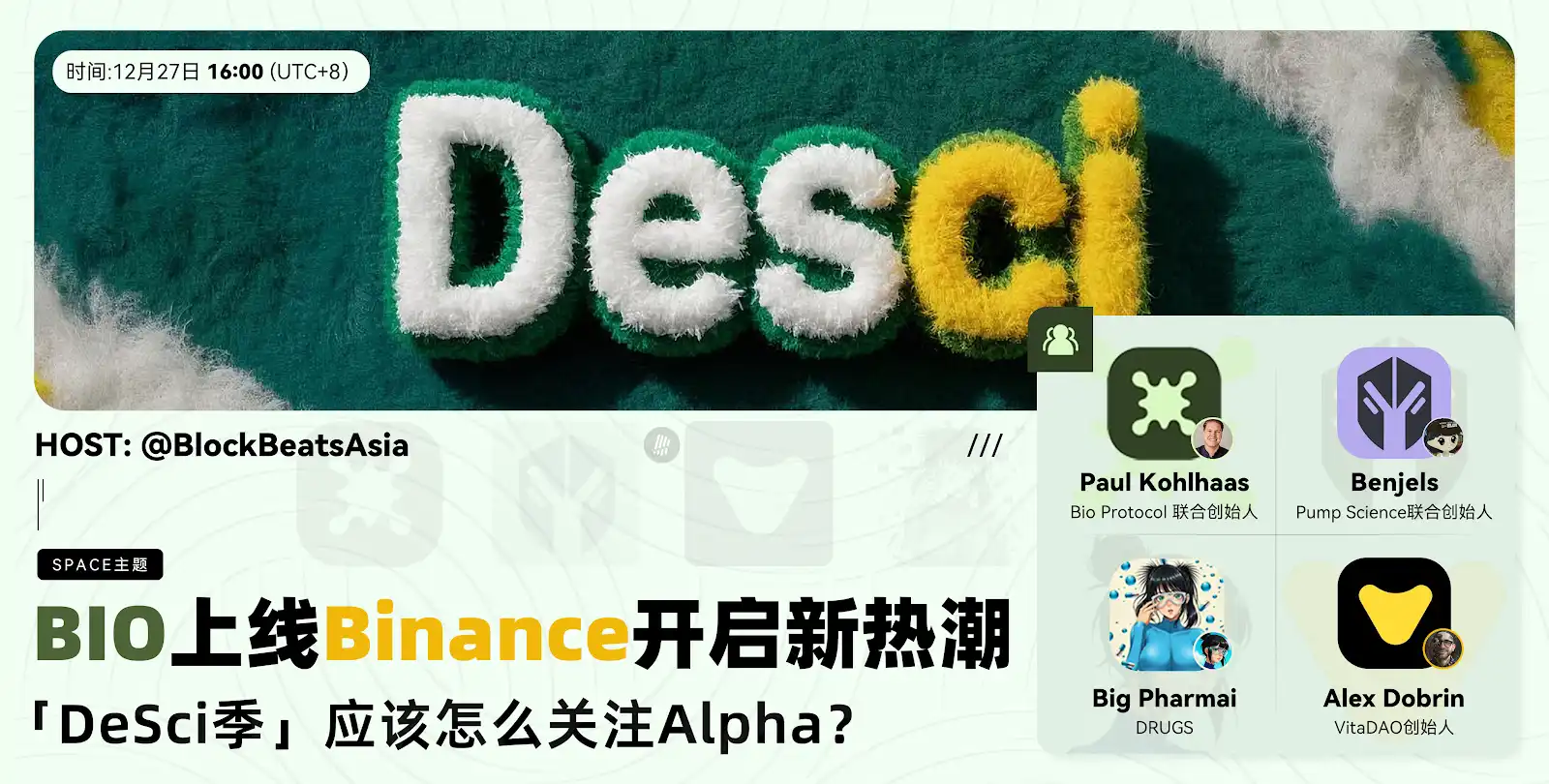
With Bio Protocol launching on Binance, the DeSci track is gradually receiving more attention. On December 27, BlockBeats invited key figures in the DeSci track, including Bio Protocol co-founder Paul Kohlhaas, Pump Science co-founder Benjels, VitaDAO founder Alex Dobrin, to discuss the topic "BIO Launches on Binance, How Should the DeSci Season Find Alpha," shedding light on how the DeSci track should focus on Alpha.
BlockBeats: First, please briefly introduce yourselves and share how you came into contact with and joined the DeSci track?
Paul Kohlhaas: Thank you for BlockBeats' invitation. I am delighted to share in this Space and deeply appreciate the welcome from the Chinese community and the broader Asian community. I am excited to chat with everyone about DeSci. I believe DeSci has great potential in the Asian community because many scientists at Asian universities are native Chinese, Japanese, or Korean speakers. Due to language barriers, their scientific research and innovations have not yet been discovered.
I have a background in science. During my youth, I spent a lot of time researching online biology communities, such as Reddit forums. Later, I focused on studying drugs that enhance intelligence, longevity, diabetes medication, etc., all of which I found fascinating. In college, I majored in economics, and during that time, I also traded biotech stocks. Biotech stocks are quite different from online biology communities because biotech data is very scarce and considered confidential information. Typically, I would trade based on the speed of a company's funding. These companies release positive or negative data every three to six months. When data is released, the stock can go up fivefold or drop 90% in a single day. This is very similar to the situation in cryptocurrency. But I think this system is really inefficient compared to an open-source community.
Around 2014, I discovered Bitcoin and later engaged in the online cryptocurrency community. In 2016, I began researching Ethereum. Subsequently, I founded my first company and went to work at ConsenSys in 2017. I got into cryptocurrency very early, around the time of the first ICO boom. During that time, I did a lot of work in encrypted data, such as how to encrypt data on-chain and attach it to a wallet. I remember when CryptoKitties emerged, I asked myself, what if we attached medical data or intellectual property to an NFT instead of just cat or monkey patterns?
In 2018, I helped launch VitaDAO and was also one of the whitepaper authors. Since then, I have always dreamed of making a mark in the DeSci field. VitaDAO is dedicated to creating an on-chain portfolio specifically for longevity research, particularly focusing on democratizing life extension methods. After launching VitaDAO, we realized this was a replicable framework. Many founders, patients, and entrepreneurs came to us saying, "Why don't we establish a DAO for hair loss research or fertility research?" We took the suggestion and took action in 2022 and 2023. This also gave rise to many DeSci DAOs we see today, and Bio.xyz and bio Protocol were born from this.
Benjels: I'm Benjels, and my background may be more traditional. I have a focus on the field of bioengineering and have always been very passionate about the intersection of biology and computer science. I believe there are many similarities between computer science and biology. Just as you program on a computer using a programming language, we are now increasingly able to program biology at the genetic level. So my interest in this intersection has always been significant because of its immense potential.
My first job was in the genomics field, where I worked in oncology focusing on cancer diagnostics. I found this field very fascinating and learned a lot there, especially about genomics. But I found an issue where much of the patient data we accumulated from doctors was being sold to large pharmaceutical companies, making hospitals a lot of money, but patients were not benefiting from it, which was very unfair.
I have always had some interest in cryptocurrency, and I came into contact with cryptocurrency around 2017, always looking for ways to combine blockchain and biotech. Initially, I thought this combination would manifest in the realm of health data. At that time, I hoped some projects could find ways to put health data on the blockchain, allowing people to own and even sell the data. However, most projects failed. So I continued down the more traditional path of biotech and later joined a biotech-related venture capital fund.
Later on, I discovered Molecule's Deck, which completely changed my perspective. I got to know DeSci and the concept of IPNFT, which is the tokenization of drug intellectual property, the most valuable part of the medical field, bringing value to patients that can be described as killer. The reason I truly decided to join this field was realizing that if any approved drug could be tokenized into an IPNFT, its value would undoubtedly surpass other NFTs.
As far as I know, the most expensive NFT should be the one created by Beeple, valued at $70 million. And $70 million is very cheap for a drug research. Realizing the huge opportunity in DeSci made me very excited. In 2022, I left a venture capital fund to join Molecule and work with the biology team.
Alex: I have spent almost my entire career working in the financial sector, starting out at a hedge fund, where I was responsible for applying machine learning techniques in the field of data science. When I first encountered blockchain in 2016, I was primarily doing tech-related work, trying to understand the potential impact of cryptocurrency on the companies we were investing in. A month later, I started putting my personal income into this field, went through the ICO craze and NFTs, and in 2020, I began focusing on venture capital. I worked at a small family office in Switzerland for a few months, then joined Switzerland's largest crypto asset management company, so for the past three and a half years, I have been involved in venture capital.
In 2022, if I remember correctly, I met Paul, who introduced me to the project. I was very interested in their mission and vision. Additionally, I have always been a biohacker for 10 years. The fusion of computer science, blockchain, and biohacking is very exciting to me. So I decided to dedicate all my energy to the DeSci field and joined VitaDAO.
BlockBeats: Asking Benjels, why did you choose to do Pump Science? What were your intentions?
Benjels: The main reason is that I wanted to return to the fundamentals of cryptocurrency, which also includes individual speculation. I believe the DeSci field is too focused on esoteric scientific research, which is very complex and understandable only to true scientists, while ignoring the pure speculative desires of many cryptocurrency users. In order to make science more accessible to ordinary crypto users, we created a speculative environment around a longevity experiment, not just an experiment that scientists can understand, but also one that ordinary users can understand. Our idea is to simplify research, make it easier to understand, more speculative and appealing to a wider audience of cryptocurrency users. This is a key reason why we launched this project.
Another reason is that we have seen other projects use Bonding Curves and successfully issue tokens, continually lowering the cost of launching a project. Just as someone can easily issue tokens using Pump.fun, we hope to make launching a scientific experiment just as easy. Science is very difficult for most people, and most people cannot launch a scientific experiment. This limits the opportunity for science to be discovered by the public. By simplifying the process of launching experiments, we believe that more and better ideas will be realized, scientific experiments will become simpler, accessible to anyone, and produce more high-quality research results. These are a few key reasons why we launched the project.
BlockBeats: What are the differences between the new BioDAO and the existing BioDAO, and what are the different ways to participate?
Paul Kohlhaas: When CZ and I met in Bangkok, he asked me a question. He asked how many BioDAOs already have access or how many of these DAOs typically appear each year. I said there are probably about 6 to 7 each year. He said, "So few." This made me think. Establishing a DAO is very difficult for a small team, but not hard if it's done by a large community of token holders. We now have DAO 1.5 or rather 2, some flagship DAOs like the upcoming Long COVID Labs launching in early January, as well as a Quantum Biology DAO that already has participation from former MIT scientists. We also have Curetopia, which has been featured on Bio Protocol's Launchpad.
The exchange with CZ was very inspiring to me. Fundamentally, there are already hundreds, even thousands, of scientific fields and different scientific communities in the world that we can build DAOs around. In the past, the limiting factors were setting up tokenomics, fundraising or Genesis auctions, assisting in branding the DAO, and building the community, although none of these are difficult, they are all manually done. However, in the design of the Bio Protocol with the Launchpad included, many steps and processes will become automated.
We currently have 3 flagship DAOs that follow a hybrid approach, between the Launchpad model and the old model. As we transitioned to the Launchpad, we already received applications from over 100 teams worldwide, and we are very confident in these teams, with in-depth investigations into 20 to 30 teams. Among these teams, there are already about 10 in a prepared acceptance status. People have not yet realized that as we move towards the Launchpad, the speed of these DAO launches will be faster than before. In addition to the three DAOs mentioned above, it is expected that around 10 new DAOs will go live on the Launchpad at the end of January. At least 10-20 DAOs will launch this quarter or the next. The design of the Launchpad is more like Virtuals Protocol, used for deploying AI Agents.
Many people are more familiar with Daos.fun, where you will see a leaderboard, and the various DAOs on the leaderboard will trade based on the Bonding Curve. Bio Protocol also has a leaderboard. The model of the Launchpad is that BIO token holders can unlock DAO by staking tokens to support the DAO's entry into the Launchpad. Once this DAO enters the Launchpad launch, their tokens will have liquidity and can trade along the Bonding Curve. The Launchpad is used to raise funds, consolidate the DAO's position on the leaderboard. Therefore, early-stage DAOs may be at the bottom of the leaderboard, and the higher-ranked DAOs will receive more traffic from Bio Protocol and the community. Once a DAO reaches the top of the leaderboard, Bio Protocol will automatically deploy a liquidity pool, which is jointly owned by Bio Protocol and the DAO.
At this point, it is a fully autonomous system. Previously, establishing a DAO through the bio.xyz incubator we built would typically take 3 to 6 months, sometimes even up to 9 months, as the incubator's approach was rate-limited. With this new design, the speed of setting up a DAO is very fast, usually a DAO can go through Launchpad and reach the top of the ranking in 3 to 4 weeks.
In the weeks following the TGE, we will start announcing some new DAOs, which the team has actually been actively building. If you are a BIO token holder, around the end of January, you will be able to officially start funding these DAOs, where you can stake BIO tokens to support them. In summary, Bio Protocol is moving towards a decentralized Launchpad, and the user experience may be more like that of Virtuals Protocol. This innovative design creates more liquidity between different DAOs. For example, as a BIO token holder, you can support four, five, six different DAOs, maybe you are a community member of one DAO and perhaps another DAO you are in has not yet created a certain tool or framework.
I think what these DAOs need most right now are people with rich experience in Web3, people who can design economic models, and people who can build communities. Because many users are scientists or patients new to Web3, they may be using Bio Protocol for the first time, downloading a wallet for the first time, or even using Discord for the first time.
BlockBeats: What are the graduation criteria for BioDAO on Launchpad? What role does the BIO token play in it?
Paul Kohlhaas: I believe the "graduation" market cap of the Bio Protocol ecosystem's DAO token will definitely be higher than that of other systems like the Pump.fun token. When a Meme is successfully deployed on Pump.fun, once the token's market cap reaches $69,000, Pump.fun's liquidity will automatically be added to Raydium. Pump science will actually build a similar system as well. Taking Bio Protocol as an example, the "graduation" market cap of the token is approximately between $10 million and $20 million, and it could be even lower, around the range of $6 million to $12 million.
Our tokenomics team is currently designing the tokenomics and it is almost finalized. The Launchpad code is also in full development and is expected to enter the audit phase in about two weeks. The tokenomics is also in its final stages of determination. In general, we are considering a "graduation" market cap range for the token between $6 million and $12 million, possibly up to $20 million. We are also conducting some experiments, hoping to create a low slippage system.
On one hand, the DAO on Bio Protocol is actually funded through a Bonding Curve. All funds raised by Pump.fun are used to provide liquidity to the AMM pool. Unlike Pump.fun, part of the funds raised by Bio Protocol will be used to support some scientific research. We believe that Bio Protocol actually plays an important role in protecting users. If you quickly deploy an AMM pool, users may not be well protected. Through this innovative design, we aim to ensure that funds from any user in a BioDAO are protected. I think for DeSci, avoiding excessive pumping is quite important. That's why we believe that reaching a higher market cap over a longer period through a Bonding Curve can actually prevent excessive pumping. If you join our community, you can participate in discussions on many governance proposals and tokenomics design topics. In about one to two weeks, we will release the final design of the Launchpad.
How does Bio Protocol increase liquidity? In fact, the mechanism of Bio Protocol is very similar to that of Virtuals Protocol. BIO will also operate as a trading pair for the AMM. For example, in the new Launchpad design mechanism, once Bio Protocol starts minting tokens, we will gradually begin to pair assets like VITA with BIO, and we will also pair many other BioDAO tokens. The result of this is increased on-chain liquidity for the tokens. So, we believe that Bio Protocol will have very deep liquidity. A significant amount of funds raised in the Genesis will be used to create a very deep Ethereum liquidity pool in the Bio ecosystem. Of course, Bio also has the partner Binance, so the depth of liquidity is remarkable.
In reality, many BioDAOs do face the issue of liquidity depth. For example, HairDAO or AthenaDAO, or some other DAO tokens, have relatively small market caps, and they lack major liquidity providers or market makers. So Bio takes on this role, acting as a friendly market maker. By pairing the BIO token with various DAO native tokens, very deep liquidity can be provided. This liquidity is very effective, and we also have very deep liquidity for BIO-ETH and BIO-USDT pairs on other platforms.
BlockBeats: How was the tokenomics of Pump Science designed and considered?
Benjels: Let me first explain what Pump Science is. The original intention of Pump Science was to become a launchpad for scientific experiments, just like Pump.fun is a launchpad for memes. Similar to how Bio Protocol is the curator of BioDAO, Pump Science is the curator of experimental research.
We have a mechanism similar to Pump.fun because our experimental costs are very low in the early stages, with experiments costing around $300 to $500. Our tokenomics are also similar to Pump.fun, with the token's initial market cap being around $5000, reaching approximately 85 SOL when the token "graduates." We retain these mechanisms because users are very familiar with them, and we can afford it since the funding for each experiment is actually very low. However, we have differences from Pump.fun as well.
First is token migration. We do not migrate all 85 SOL to the AMM to increase liquidity; instead, we retain 3 SOL to fund experiments. When liquidity is migrated from the Bonding Curve to the AMM, for Pump.fun, 80% of the tokens are issued on the Bonding Curve, and 20% are migrated to the AMM for liquidity. What we do is issue 80% of the tokens on the Bonding Curve, migrate 15% to the AMM, and retain 5% for Pump Science token holders.
The first two tokens issued by Pump Science are RIF and URO, and more tokens will be launched in February 2025. Our idea is to reward users holding the old tokens with 5% of the new tokens launched on the Launchpad in the future. The purpose of this is to create a loyal user base, make them excited about the new tokens launched on the platform, and incentivize users to continue exploring valuable tokens on Pump Science. By incentivizing users to hold more tokens, each time a new token is launched, holders of the old tokens will receive a reward. This is another significant difference between us and Pump.fun.
Finally, two points are crucial. A brilliant move by Pump.fun is the burning of LP tokens, a mechanism that prevents liquidity from being drained from the AMM. Essentially, you cannot drain liquidity from the AMM pools created by Pump.fun. Another AMM liquidity provider on Solana, Meteora, allows for LP tokens to be locked but not burned, a mechanism that ensures liquidity cannot be drained, and gas fees can be used to fund productive activities. For us, that productive activity is scientific research. Therefore, what we are doing is providing funding for scientific research without any fundraising, with approximately 0.25% of the fees going towards scientific research.
The final distinction is how to deal with bots. There are many different ways to build a token issuance platform to mitigate the risk of bots buying a large amount of tokens. Daos.fun's approach is to create a whitelist, where having whitelist status allows you to acquire a large amount of tokens, thus combating bots. On the other hand, what we have done is initially set a very high fee that decreases gradually after token issuance. The fee is set high initially to deter bot sniping, but then decreases over time. Although the fee reduction is relatively fast, it is still slow for users so that regular users can compete with bots. We believe this is a fairer mechanism that allows users to compete with bots on the token issuance platform. Users of Pump.fun are well aware that bots are a significant issue.
In summary, I believe that what most users care about is the continuous yield of holding RIF and URO. Our concept is that the more RIF and URO tokens you hold, the longer you hold them, the more airdrops you will receive in the future, with a 5% airdrop allocation for each new token launch.
BlockBeats: How is the weighting of future airdrops allocated? For example, will users holding RIF or URO potentially receive more airdrops than holders of other tokens?
Benjels: It is based on the weighted average holding amount, specifically the time-weighted average holding amount. However, we are still deciding on the duration, which may be around 60 days. For holders of RIF and URO (the earliest issued tokens), they will receive more airdrops compared to holders of other tokens, resulting in greater benefits for these holders. Everything is based on the token's holding value and is a time-weighted average value. This continuous incentive mechanism will create loyal users, motivating them to constantly seek out new projects.
BlockBeats: Pump Science and VitaDAO have collaborated, are there any noteworthy experiments within the ecosystem? Will there be more collaborations or interactions between Pump Science and Bio Protocol in the future?
Benjels: Around February, we will be launching approximately 10 to 20 new drugs and related tokens, which are part of a drug list curated by the VitaDAO community. The "Longevity Prize Fund," also organized by the VitaDAO community, has garnered support from Vitalik and many prominent figures in the crypto space, primarily rewarding researchers working on defeating aging-related diseases. These drugs are also within the scope of research funded by the "Longevity Prize Fund." These are all community-planned and proposed methods that may extend life expectancy. We have selected some from the full list they submitted and are launching some of these compounds as tokens on Pump Sciences. Users and anyone interested can directly fund these experiments on Pump Science.
Not only can people participate financially, but if there are scientists or longevity enthusiasts in the community, or compound developers, they can also apply to join our drug testing experiment. We believe decentralization is very important, as Paul said, to prevent FOMO behavior in the DeSci field. We want to ensure that at least the first batch of projects launched is of high quality, with professional developers and founders supporting them.
In fact, Pump Science and Bio Protocol systems have a lot in common. Bio Protocol focuses on building a community around different research areas, such as the longevity community. Bio Protocol plays a crucial role in the DeSci ecosystem, acting like a funnel attracting talent. Pump Science is akin to the execution layer of scientific experiments, aiming to be a global laboratory and data network supporting these communities in conducting independent experimental research.
Using a sports analogy, I think Bio Protocol is like creating a team, while Pump Science is akin to the television network, broadcast services, scoring system, and sports betting market. Without a team, there is no sports game, similarly, without scoring and broadcasting, sports cannot exist. Therefore, both need to coexist to make the entire ecosystem more complete. Our goal is to create two interdependent and highly collaborative systems, which are essential parts of attracting more scientists into the DeSci field.
BlocBeats: As a community at the elder level in the DeSci field, VitaDAO has recently partnered with many communities. What other attempts will VitaDAO make in the future, and how will it attract more attention?
Alex: VitaDAO has recently established close collaborations with CUDIS and Pulse, bringing wearable devices to mind. When you think of wearable devices, these two projects may come to mind. I think the collision between DeSci and DePin will produce many interesting chemical reactions and applications. The community can use these wearable devices to collect user data, which can then be used for some experimental research, and the community can conduct research using biological marker data.
I see DeSci and DePin as a synergistic dynamic relationship. Pump Science can be seen as a global laboratory network, imagine anyone contributing data, anyone can conduct experiments with this data. In my view, this is decentralized science, it is self-conducted scientific research.
One of VitaDAO's current focuses is to attract more top scientific talent. While we have successfully attracted cutting-edge talents like Michael, we still need more individuals to pass on their expertise to a wider community. Additionally, improving user experience is an aspect we need to address, and further enhancing the research quality of these projects is also one of our key priorities. Next year, we may conduct human experiments, and we are also advancing animal experiments or worm experiments, which are related to Pump Science and are also our main goals for 2025.
We also plan to collaborate with Pump Science to conduct some experiments to test drugs developed in the lab. These drugs have shown initial effectiveness in inducing autophagy. We will later test the drugs in worms, and the results will be shared with the community. Finally, I want to talk about the product. VitaDAO has already released VD001, which is a longevity product. Although it has not been officially launched yet, the product has been produced and will be shared with the community at this year's Devcon conference. We plan to presale this drug early next year and first open it to community members.
BlockBeats: Earlier, there was mention of the DeSci community needing more high-quality scientists, especially from the Asian community. I would like to take this opportunity to discuss everyone's views on the Asian community.
Paul Kohlhaas: In fact, we have previously invited scientists from the Asian region to submit research proposals directly to Molecule. Molecule provides funding for DAO's scientific research, and we partnered with Sora Ventures to launch over $50,000 in grant awards specifically for Asian scientists. However, we received almost no applications, but the situation has since improved. We are also very willing to have Korean scientists join as Korea has many excellent drug development projects. Of course, there are also many outstanding scientists in China and Japan. So far, we have received very few applications from the Asian community. If you know any researchers in universities seeking funding support, please contact us. We also hope to see more Asian scientists and even patients get involved.
Space Link: https://x.com/i/spaces/1lDGLlpDmbaGm
You may also like

Blaming the desolation of the cryptocurrency world on the rise of AI is a form of intellectual laziness
The impact of OUSD on Circle, Tether, and Paxos: not a single negative factor, but a more complex reshaping of competition
A valuation of 8 billion dollars, doubling in 8 months! What makes the crypto-friendly bank Erebor Bank stand out?
340 billion valuation: Li Yanhong's largest IPO, a seat in Kunlunxin's shares is hard to come by
Stablecoins are the "royalists" of the crypto world: Open USD brings the old currency system into play
Cape Verde 2-3 Argentina: The Underdog Team That Stunned the World in Defeat
Cape Verde's run ended in a 3-2 defeat to Argentina, but their journey — three unbeaten draws, one heroic goalkeeper, and a fight that pushed the defending champions to the brink — is the kind of story markets recognize too: small caps can rattle blue chips long before anyone expects it.
Semiconductor stocks plummet, yet Anthropic wants to create a 2nm chip
Where is Zhao Changpeng's billion-dollar investment going? YZi Labs' investment landscape fully revealed
Ethereum Foundation Report: A Basic Guide to Ethereum for Governments and Financial Institutions
A pre-announced harvesting case: After the cryptocurrency price dropped by 99%, the public chain Saga exited to transform into AI
When American giants collectively "defect" from Chinese AI models
BIS Report Compliance Observation: The Real Risks of Stablecoins, Not Just "Depegging"
Portugal 2-1 Croatia: Ronaldo's 20-Year Knockout-Stage Drought Ends With a Debt Finally Collected
Portugal beat Croatia 2-1 in the 2026 global football championship's knockout rounds as Ronaldo scored his first-ever knockout-stage goal, Gonçalo Ramos struck a stoppage-time winner, and VAR ruled out a late equalizer for offside.
Bitcoin Price Prediction July 2026: Will BTC Recover to $70K or Drop Below $55K?
A South Korean company that learned the strategy of hoarding coins, from a bull market to delisting?
WEEX API Broker Program: Turn Your Trading Platform Into a Revenue Engine
How to choose between buying discounted ETH, Bitmine, and SharpLink?
Wosh: Inflation has cooled in recent weeks, AI is reshaping the economy, and forward guidance has lost its necessity
Blaming the desolation of the cryptocurrency world on the rise of AI is a form of intellectual laziness
The impact of OUSD on Circle, Tether, and Paxos: not a single negative factor, but a more complex reshaping of competition
A valuation of 8 billion dollars, doubling in 8 months! What makes the crypto-friendly bank Erebor Bank stand out?
340 billion valuation: Li Yanhong's largest IPO, a seat in Kunlunxin's shares is hard to come by
Stablecoins are the "royalists" of the crypto world: Open USD brings the old currency system into play
Cape Verde 2-3 Argentina: The Underdog Team That Stunned the World in Defeat
Cape Verde's run ended in a 3-2 defeat to Argentina, but their journey — three unbeaten draws, one heroic goalkeeper, and a fight that pushed the defending champions to the brink — is the kind of story markets recognize too: small caps can rattle blue chips long before anyone expects it.
Popular coins
Latest Crypto News


