
 Buy Crypto
- Markets
 Futures
- Spot
- Copy Trade
- Earn
- More
When an AI Company Goes on a Wild Hiring Spree for Asian Female Coders, Attention Shifts to Winning the World

Original Title: ABG CMO is eating the world.
Original Author: @0xJuliechen, Content Creator
Original Translation: Lila, Richie, BlockBeats
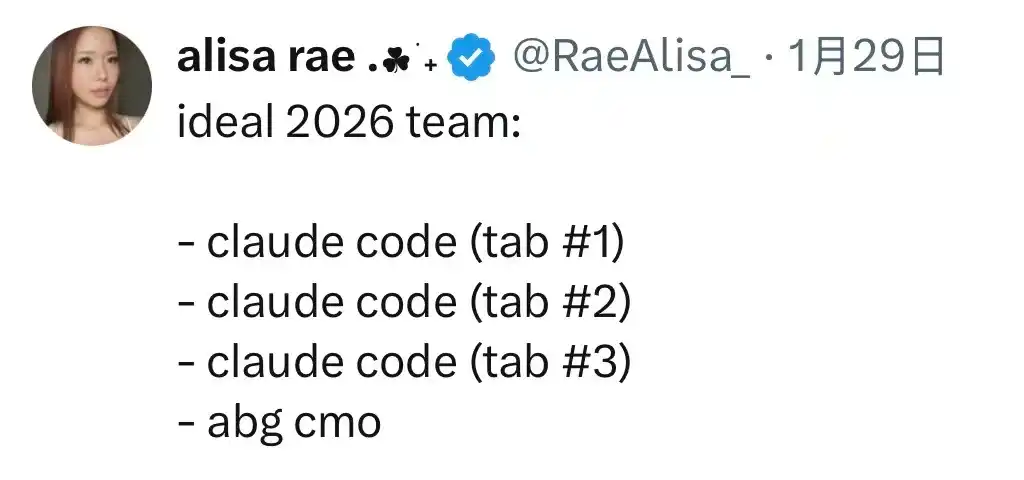
「If your startup is not a YC-backed B2B SaaS + GPT shell company, and you haven't hired an ABG as your Chief Marketing Officer, then you're pretty much screwed.」
Dance Note:
· YC: Short for Y Combinator, widely considered the world's top startup accelerator
· B2B SaaS: Subscription-based cloud software sold to businesses
· ABG = Asian Baby Girl
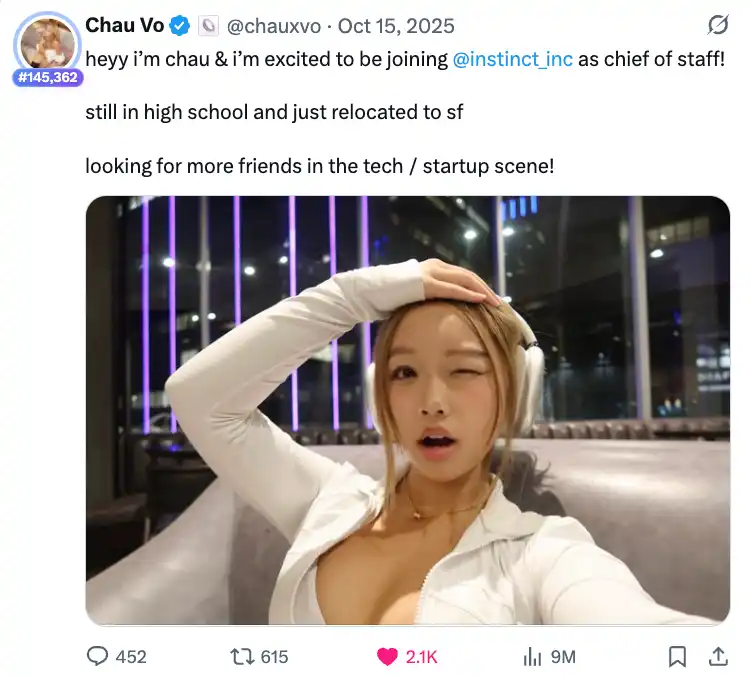
I've heard similar statements from countless AI company founders, each dreaming of finding the next Cluely: easily garnering millions of views, always in the spotlight. (Dance Note: Cluely is a highly controversial AI startup that pioneered a new paradigm of "viral marketing," as detailed later in the text.)
ABG = Asian Baby Girl. In Silicon Valley, it has become synonymous with young Asian women who excel in social media marketing. They are particularly skilled at creating eye-catching content, publishing viral articles, and marketing in a distinctively personal way. Suddenly, all AI startups are scrambling to hire them as Chief Marketing Officers.
Why? Because one viral post is much more effective than spending $50,000 on an advertising campaign.
A "thought leader" persona carefully cultivated on LinkedIn for months is no match for a "hot take" posted on X or a selfie for gaining more attention and engagement.
Are Asians naturally born marketers?
No, let me clarify: This is not about race (everyone of every race has an equal ability). This reveals some deeper issues in the evolution of the startup market.
The Feedback Loop of the Tech Market
From past viral breakout cases (such as @cluely), it can be seen that VCs chasing "traffic signals" have outweighed traditional financial metrics, leading to more funds flowing into more personality-driven, socially oriented projects.
Nowadays, more college students choose to be content creators rather than taking a $200k/year job at a big tech company, so more startups hire "ABGs" for marketing, raising the overall tech marketing standards, allowing creators to access higher-quality marketing resources.
Social media interaction data has become the sole standard for marketing effectiveness.
And this feedback loop is accelerating: More attention means more funds, creating higher barriers to entry, attracting more talent shifts, until it forms a stronger attention monopoly.
Likes, views, and shares are no longer just vanity metrics; they have become the new standard for due diligence.
The core is not in ABG, but in the attention economy.
How to Capture Hearts? Cluely Delivered the Perfect Answer Sheet
· Narrative: "Cheat on Everything" — perfectly aligned with founder @im_roy_lee's story (expelled from Columbia/Harvard). This is not just a slogan but a carefully crafted rags-to-riches story.
From "an utter failure" to "cheating with AI, ramping through big tech, YC, and A16Z." This kind of underdog narrative often simultaneously ignites people's aspirations and anger.
· Industrial Virality Machine: They recruited over 700 "editors" — mostly small creators on TikTok/Instagram. The model is: pay for performance. $1 per 1k views. Zero upfront cost.
· Content Formulization: Gibberish tweets + Edging on attractiveness + Lifestyle flaunting. Party videos (like the halted "1.5M Rager"), founder Roy Lee's persona as a "genius intern," flaunting wealth, disdain for traditional education. This marketing makes you think, "I really want to join this cool kids club"
· Total Platform Domination: X is responsible for creating a thought leader persona (150K+ followers), with TikTok/Instagram as the main battleground, and LinkedIn/Reddit used to spark native controversies.
What were the results? Daily average views of 10M+, 10B views in 3 months, at a cost much lower than traditional advertising. Traditional CPM (cost per mille) is $4, but they only need around $1.
But the fatal flaw is: The marketing investment far exceeds the product; they never actually developed a decent market-ready product. Viral spread is not a byproduct, but their only product.
When Cluely pivoted to an "AI Note Tool," the entire web ridiculed them. People wondered where all that money went.
Some even suggested: since they are so good, why not just be a marketing agency for other AI companies?
But most astonishingly: they did capture a certain truth. In an age of scarce attention, "controversy is still attention."
Truly ironic: everyone mocks Cluely, everyone wants to be Cluely.
(If you hate me but keep following my updates, you are my fan.)
What is the truth?
Attention is conquering the world.
Capital is flowing to companies that own consumer mindshare rather than just market share. Today, the best product doesn't necessarily win; the product with the best story does.
Every founder must also be a CMO, owning their IP. While the product is crucial, without marketing, your product will go unnoticed.
The next wave of successful startups will not be built by the most exceptional engineers. They will be created by those who are "code-literate and marketing-savvy."
Welcome to the new game.
You may also like

The 17-Year Mystery Will Be Solved, Who is Satoshi Nakamoto?

5 Minutes to Make AI Your Second Brain

Uniswap is trapped in an innovation dilemma

What is the key to competition in crypto banking?

The flow of stablecoins and the spillover effects in the foreign exchange market

After two years, Hong Kong's first batch of stablecoin licenses finally issued: HSBC, Standard Chartered make the cut
The person who helped TAO rise by 90% has now single-handedly crashed the price again today

3-Minute Guide to Participating in the SpaceX IPO on Bitget

Top 5 Cryptos to Buy in 2026 Q1: A ChatGPT Deep Dive Analysis
Explore the top 5 cryptos to buy in Q1 2026 including BTC, ETH, SOL, TAO, and ONDO. See price outlooks, key narratives, and institutional catalysts shaping the next market move.

How to Earn $15,000 with Idle USDT Before Altcoin Season 2026
Wondering if altcoin season is coming in 2026? Get the latest market update, and learn how to turn your idle stablecoins waiting for entry into extra rewards up to 15,000 USDT.
Can You Win Joker Returns Without Large Trading Volume? 5 Mistakes New Players Make In WEEX Joker Returns Season 2
Can small traders win WEEX Joker Returns 2026 without huge volume? Yes—if you avoid these 5 costly mistakes. Learn how to maximize card draws, use Jokers wisely, and turn small deposits into 15,000 USDT rewards.

Altcoin Season 2026: 4 Stages to Profit (Before the Crowd FOMO In)
Altcoin Season 2026 is starting — discover the 4 key stages of capital rotation (from ETH to PEPE) and how to position before the peak. Learn which tokens will lead each phase and avoid missing the rally.

Will Alt season come in 2026? 5 Tips to Spot the Next 100x Crypto Opportunities
Will altcoin season arrive in 2026? Discover 5 rotation stages, early signals smart traders watch, and the key crypto sectors where the next 100x altcoin opportunities may emerge.

The bear market has arrived, and cryptocurrency ETF issuers are also getting involved

The richest man had a quarrel with his former boss

BTC Firm Above 70K! Saylor’s "Institutional Logic" vs. Moon’s "Retail Faith": Who is Really Harvesting the Market?
Bitcoin is holding firm above the $70,000 support level following a massive short squeeze that liquidated $427 million. As the "Four-Year Cycle" narrative shifts, the market is split: Michael Saylor’s cold, institutional "indiscriminate stacking" vs. Carl Moon’s high-energy retail "hopium." This article decodes these two polar-opposite strategies for the 2026 bull run and reveals how WEEX’s institutional-grade liquidity and AI trading tools empower every type of investor to convert market volatility into profit.

The Girl Who Created the SBTI Test: A Story of a Doomed Cyber Love, an E-Widow Ratfolk



 App
App