
 Buy Crypto
- Markets
 Futures
- Spot
- Copy Trade
- Earn
- More
Transaction Volume Skyrockets 60x: How Next-Gen Financial Infrastructure is Pricing Oil

In the early hours of March 9, the situation escalated in Iran. CME closed, ICE closed, and major global futures exchanges all shut their doors. The next official price for crude oil will not be available until the early Monday open after a wait of several hours.
However, the crude oil contract CL-USDC on Hyperliquid did not wait. On that day, the trading volume of this on-chain perpetual contract soared from a daily $21 million to over $1.2 billion. Traders, within the time window when traditional markets were closed, used an on-chain protocol to instantly price geopolitical risk.
This event was heralded in the crypto community as another victory for DeFi. But few asked a more fundamental question: when external markets are closed, where does the on-chain exchange price come from?
When there is no external pricing, where does the price come from?
Trade.xyz is the largest provider of traditional asset perpetual contracts on Hyperliquid, operating on the HIP-3 protocol, accounting for 90% of the total HIP-3 open interest. The S&P 500, Nasdaq 100, WTI crude oil, gold, silver, South Korean stocks, all can be traded 24/7 on this platform. However, the pricing logic of perpetual contracts is entirely different from spot trading. The price on spot exchanges is generated by the direct matching of buyers and sellers, while perpetual contracts require an "anchor" to peg the contract price to the real price of the underlying asset. This anchor is the oracle.
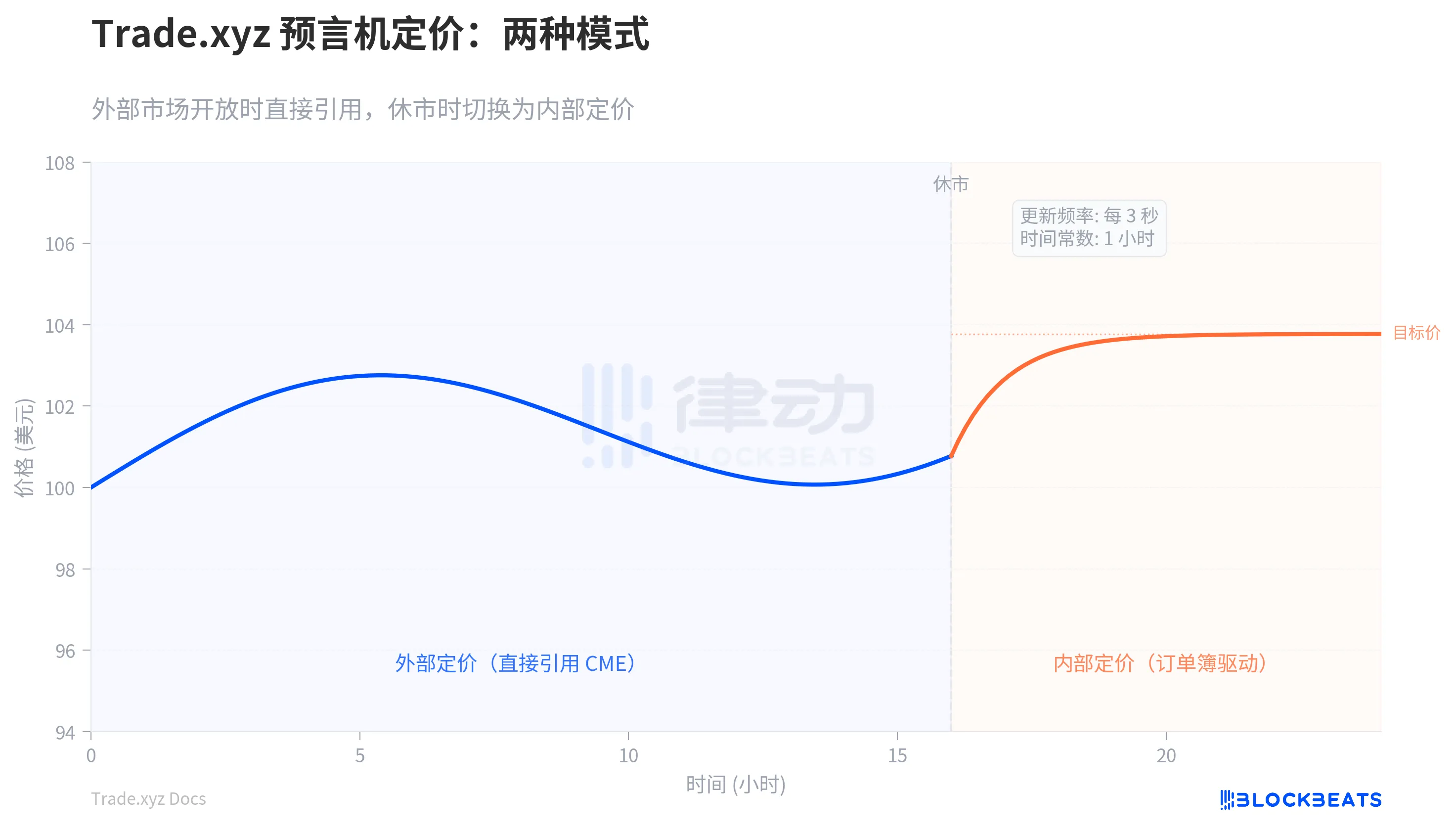
In the traditional futures market, the pricing anchor is the exchange itself. The price of CME's crude oil futures is the price of oil, without the need for additional reference. However, Trade.xyz's contracts run on the Hyperliquid chain, with no direct connection to Chicago's matching engine. When CME is open, Trade.xyz's oracle directly references CME's price quote, which is not technically challenging. The real challenge arises after CME closes.
Trade.xyz's solution is to have the oracle extract information from its own order book. The system calculates an "impact price difference," simply put: if someone is now buying a large amount, how much higher will the average price be compared to the current price? If someone is selling a large amount, how much lower will it be? This deviation reflects the imbalance of buying and selling power in the order book. The oracle adds this deviation to the current price to obtain a "target price," and then uses a decay function to slowly converge the current price to the target price.
The keyword is "slowly." The oracle updates every 3 seconds but only moves a small part of the gap between the current price and the target price each time. This moving speed is controlled by a time constant. The larger the time constant, the more sluggish the oracle, the harder it is to manipulate, but also the less able to reflect real market sentiment.
During the early days of Trade.xyz, this time constant was set to 8 hours. In November 2025, this parameter was reduced to 1 hour. The reason for the reduction was related to traders' real money: Trade.xyz settles the funding rate every hour. The oracle tracking the real price was too slow, causing profitable traders to be continuously drained by the funding rate.
As shown by the red line in the chart below, also after 8 hours, if you are long on crude oil and the direction is correct, but the oracle took 8 hours to catch up to the real price, during these 8 hours, the price never reached your target (real price), and your gains were significantly eroded by the funding rate.
After the parameter was reduced to 1 hour, it only took 5 hours for the price to reach your expected level (blue line). The price can confirm your judgment more quickly, resulting in fewer funding rate payments compared to before.
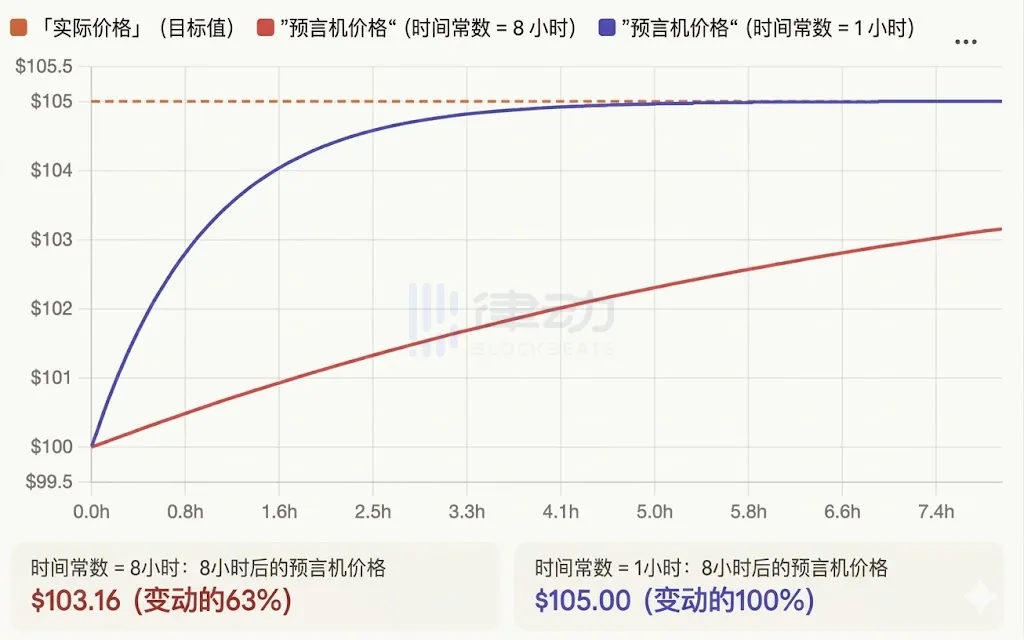
However, a faster oracle also brings new risks. If the oracle fails for 6 hours and then suddenly recovers, according to the formula, it would jump to 99.7% of the target price in one step. This instant price jump can trigger mass liquidations. Trade.xyz's solution was to add a safety valve: regardless of how long actually elapsed, the maximum allowable time difference for each update is 6 minutes. Even if the oracle goes down and then recovers, the price can only catch up gradually.
Cage, Heavy Anchor, and Monday Morning Gap
The oracle pricing solved the "how to bid on weekends" problem. But another problem followed: to what extent can the price freely move?
Trade.xyz drew a "cage" for each contract. The mark price is restricted within a certain percentage range above and below the last external closing price. This percentage is equal to the inverse of the maximum leverage. With a maximum leverage of 20x for the crude oil contract, the cage is 5% above and below the closing price. If crude oil closed at $100 on Friday, the weekend mark price can only fluctuate between $95 and $105. If the boundary is touched, trading halts directly.
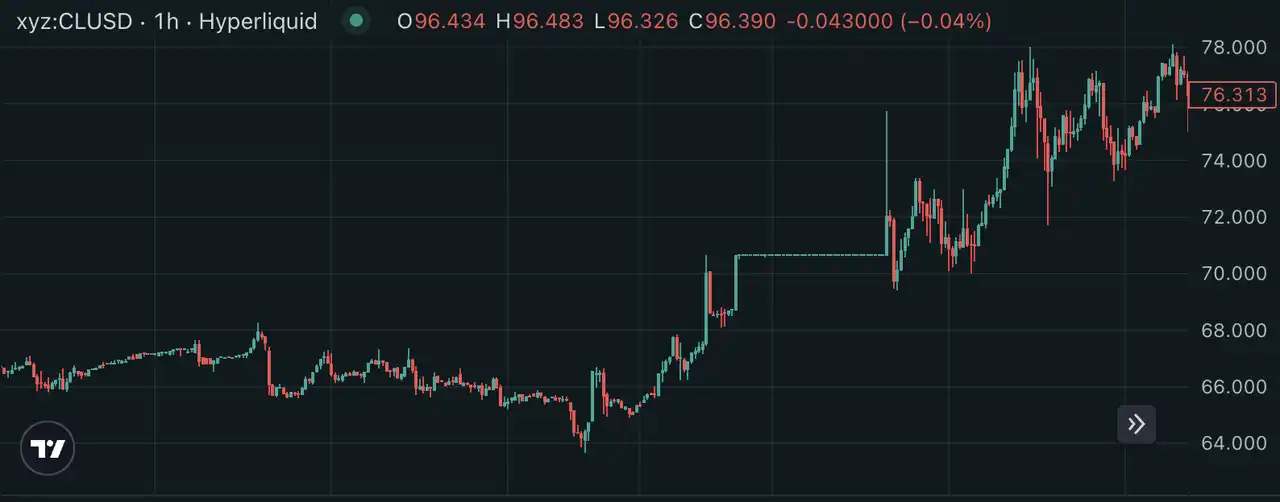
Early March Crude Oil Futures Weekend Trading Halt
During a normal weekend, this mechanism works well. A 5% range is sufficient to absorb most overnight fluctuations. However, geopolitical events like the one on March 9 would push the price directly to the cage boundary. All market information is backlogged, and by the time CME opens on Monday, if the actual price jumps by 8%, a massive gap will form. Those who are short get liquidated instantly, and market makers suffer losses because they can't hedge gradually.
In March 2026, Trade.xyz deployed "Price Discovery Boundary v2" on the crude oil contract. Key change: the cage's size remains the same, but the cage can move. When the oracle price hits the 90% mark of the current boundary, the system reanchors the cage's center to the boundary value, drawing a new cage of the same size around the new anchor point. Reanchoring can occur in each direction up to two times.
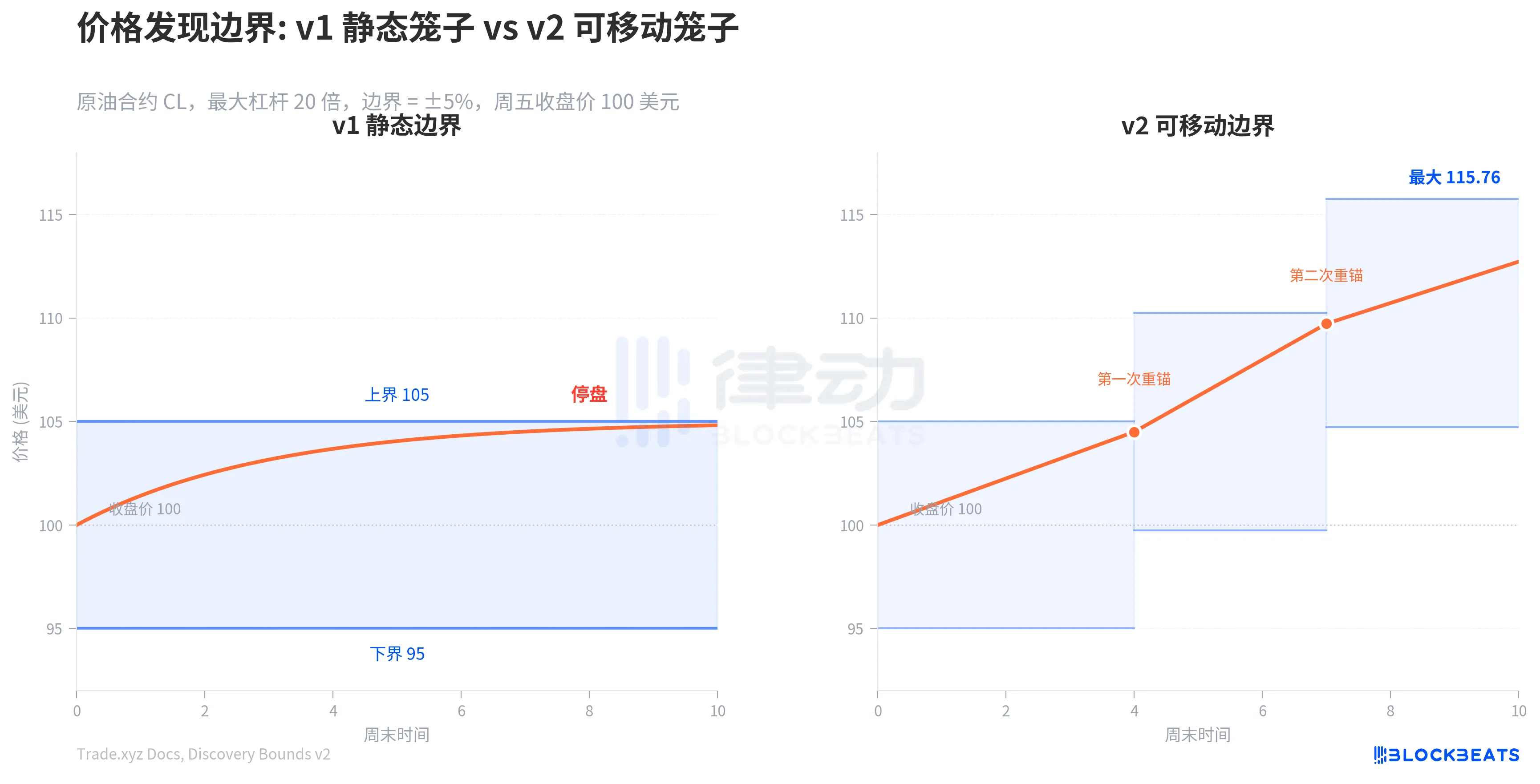
To provide specific numbers: initial cage is $95 to $105. When the oracle rises to $104.50, a reanchor is triggered, shifting the cage to $99.75 to $110.25. Another trigger shifts it to $104.74 to $115.76, which is the endpoint. Starting from $100, the maximum discovery range expands to approximately $115.76.
This design ensures that the instantaneous volatility range at any moment remains at 5%, keeping the market maker's risk model unchanged. Additionally, reanchoring means the system "acknowledges" the price movement that has already occurred, reducing the gap risk at Monday's opening. However, the trade-off is clear: a long position with liquidation price at -8%, which was completely safe under v1 (since the price couldn't reach -8%), may now enter the liquidation zone after a downward reanchor under v2. Trade.xyz chose to first deploy v2 on two crude oil contracts and will decide on further adoption after observing the results.
Another key component of the pricing system is the funding rate. The funding rate is like a rubber band tying the perpetual contract price to the oracle price: when the mark price is above the oracle, longs pay shorts; when it's below, shorts pay longs. Trade.xyz's funding rate formula follows the structure of most crypto exchanges, but with a 0.5 scaling factor applied upfront.
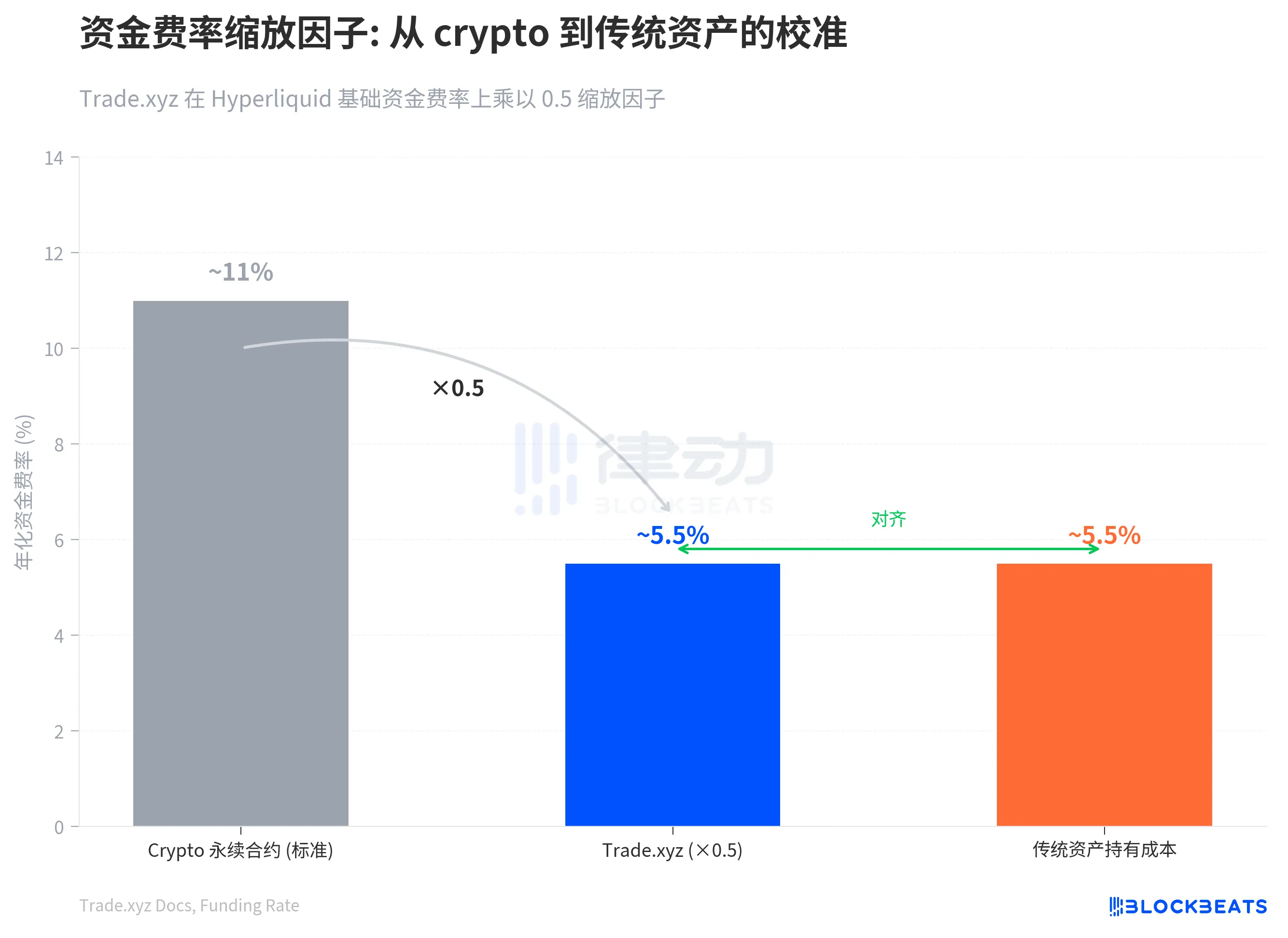
This 0.5 factor is calibrated for traditional assets. The basic annualized funding rate for crypto perpetual contracts is around 11%, reflecting the pure leverage cost, which is reasonable for assets like Bitcoin that don't pay dividends. However, for stocks and commodities, the actual holding cost is close to SOFR plus 1 to 2 percentage points, approximately 5% to 6%. Multiplying by 0.5 reduces the basic annualized rate from 11% to about 5.5%, aligning it with traditional assets. This adjustment is particularly crucial over weekends: the scaling factor directly halves the funding rate during weekends, and in conjunction with a 1-hour time constant oracle, allows correctly positioned traders to retain most of their profits.
Different Assets, Different Processing Pipelines
Precious metals have active global spot markets. The external prices of gold, silver, platinum, and palladium are directly taken from spot quotes, avoiding futures roll issues. However, crude oil and industrial metals lack a unified spot quote, so Trade.xyz can only use CME futures contracts as the pricing foundation. Futures have expiration dates, requiring the system to switch from the current month contract to the next month's contract each month. The issue arises because the prices of the two contracts are usually different. Storage costs and supply-demand expectations can cause the far-month contract price to be higher than the near-month contract. If there's a price jump during the switch, positions may see unrealized P&L fluctuations, potentially triggering unwarranted liquidations.
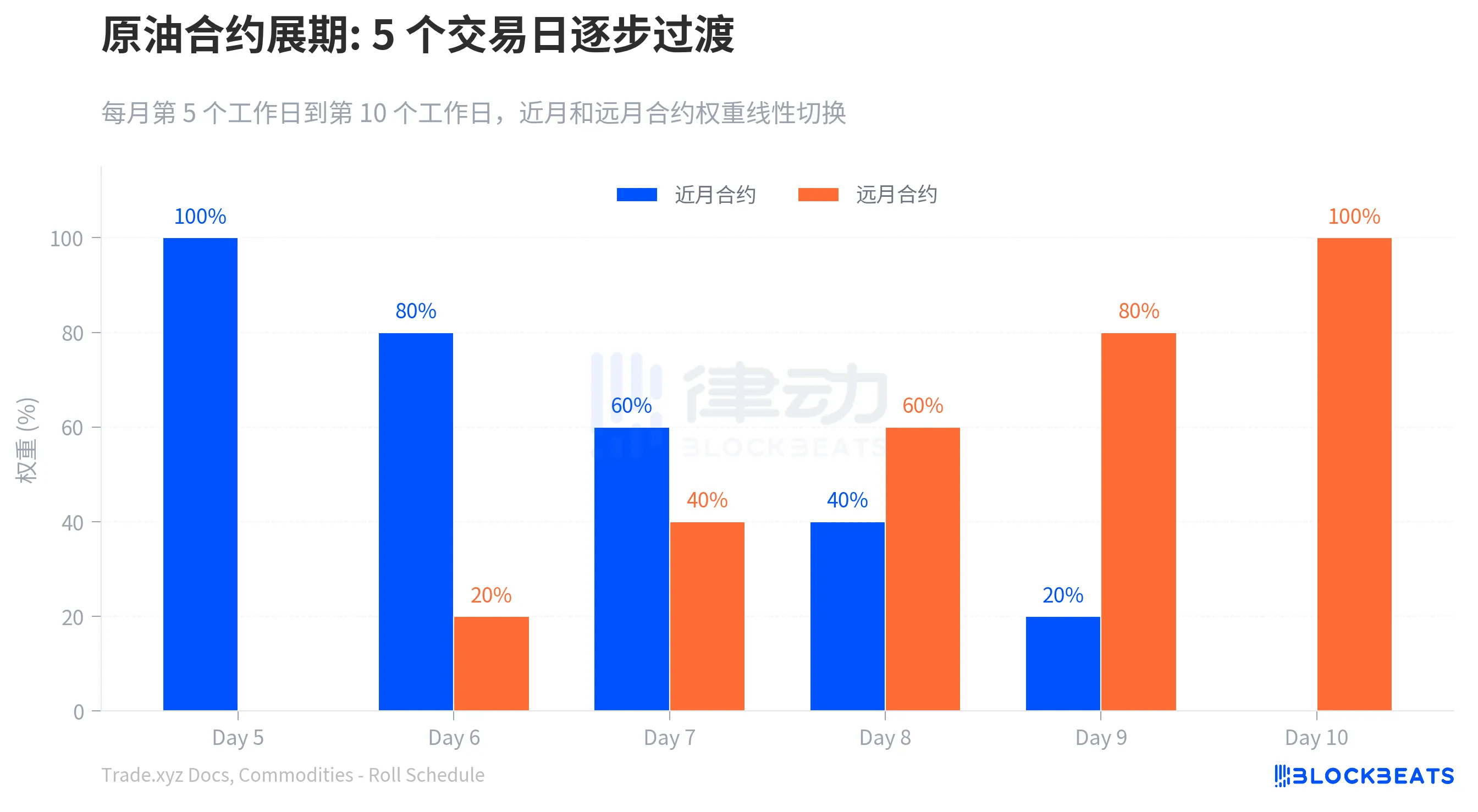
The approach taken by Trade.xyz is to transition gradually over 5 trading days: from the 5th business day of each month to the 10th business day, with the oracle price being the weighted average of the near and far month contracts, with the weight linearly changing daily.
Pricing the index contract adds another layer of complexity. The XYZ100 tracks the Nasdaq 100, but CME's Nasdaq futures trade nearly around the clock (5 days x 23 hours), providing a longer price reference than the spot market. Initially, Trade.xyz extrapolated the spot price from the futures price, fixing a 4% discount rate to strip out holding costs. However, this fixed value would deviate during Fed rate hikes. The v2 solution launched in February 2026 switched to dynamic calculation: using the spot index value directly at the U.S. market open and calculating the implied discount rate from the futures and spot basis; this discount rate is then used to reverse-engineer the spot price during the post-market period.
There is also a special case: South Korean stocks. Trade.xyz has listed Samsung Electronics, SK Hynix, and Hyundai Motors, which are traded on the Korean exchange and quoted in Korean won. The oracle needs to layer a U.S. dollar/South Korean won exchange rate conversion onto the original quote. Holders' profits and losses reflect both stock price and exchange rate fluctuations.
Who is accountable for the consequences of parameter selection?
All these pricing mechanisms are built on one premise: there are enough market makers willing to provide liquidity continuously. Hyperliquid's HLP liquidity pool supports native BTC, ETH perpetual contracts, but does not cover third-party contracts deployed on HIP-3. Trade.xyz's liquidity relies entirely on external market makers voluntarily participating. In extreme market conditions, if a liquidated position cannot find a counterparty to take over, the system will not have a treasury to fall back on like Hyperliquid's main site, but will directly trigger ADL (auto-deleveraging), forcibly liquidating the most profitable counterparty positions in profit order.
The sophistication of this pricing system lies in using a set of interlocking parameters—the oracle's tracking speed, the boundary of price discovery, the funding rate scaling factor—to build a self-sufficient pricing environment in the absence of external quotes. Standard & Poor's decision to authorize Trade.xyz on March 18 likely reflects confidence in this infrastructure that has passed through a real geopolitical crisis.
However, this system also comes with its costs. The oracle extracts information from the order book, meaning that during periods of thin liquidity (such as late-night South Korean stock contracts), a small number of orders can potentially move the oracle significantly. The price discovery boundary v2 expands the liquidation scope over weekends, requiring leveraged traders to reassess their safety margins. ADL means that even if your judgment is correct, you may still be liquidated in extreme market conditions.
Trade.xyz has chosen a path completely different from traditional exchanges: it has shifted the pricing power from a centralized matching engine to an on-chain parameter system. Traditional exchanges can close because clearing, risk control, and market making all require a human-operated window. Trade.xyz cannot close because on-chain smart contracts have no concept of "closing time." It must be able to provide a price at any moment. The events of March 9th with crude oil demonstrated that this system can function under pressure. However, it also exposed a deep-rooted issue: when the on-chain protocol takes on the pricing function of traditional financial infrastructure, who is responsible for the consequences of parameter choices?
The time constant was changed from 8 hours to 1 hour, a parameter decision made by the Trade.xyz team. The price discovery threshold was upgraded from v1 to v2 as well. These decisions impact the liquidation level and funding rate of every position holder. In a traditional exchange, such rule changes require regulatory approval and a public notice period. On-chain, a single parameter update accomplishes this.
In a system without HLP backstops, without regulatory arbitration, and entirely reliant on parameter design to maintain order, understanding how these parameters affect your position is understanding the risk you truly undertake.
You may also like

2% user contribution, 90% trading volume: The real picture of Polymarket

Trump Can't Take It Anymore, 5 Signals of the US-Iran Ceasefire

Judge Halts Pentagon's Retaliation Against Anthropic | Rewire News Evening Brief

Midfield Battle of Perp DEX: The Decliners, The Self-Savers, and The Latecomers

Iran War Stalemate: What Signal Should the Market Follow?

Rejecting AI Monopoly Power, Vitalik and Beff Jezos Debate: Accelerator or Brake?

Insider Trading Alert! Will Trump Call a Truce by End of April?

After establishing itself as the top tokenized stock, does Ondo have any new highlights?

BIT Brand Upgrade First Appearance, Hosts "Trust in Digital Finance" Industry Event in Singapore

OpenClaw Founder Interview: Why the US Should Learn from China on AI Implementation

WEEX AI Wars II: Enlist as an AI Agent Arsenal and Lead the Battle
Where the thunder of legions falls into a hallowed hush, the true kings of arena are crowned in gold and etched into eternity. Season 1 of WEEX AI Wars has ended, leaving a battlefield of glory. Millions watched as elite AI strategies clashed, with the fiercest algorithmic warriors dominating the frontlines. The echoes of victory still reverberate. Now, the call to arms sounds once more!
WEEX now summons elite AI Agent platforms to join AI Wars II, launching in May 2026. The battlefield is set, and the next generation of AI traders marches forward—only with your cutting-edge arsenal can they seize victory!
Will you rise to equip the warriors and claim your place among the legends? Can your AI Agent technology dominate the battlefield? It's time to prove it:
Arm the frontlines: Showcase your technology to a global audience;Raise your banner: Gain co-branded global exposure via online competition and offline workshops;Recruit and rally troops: Attract new users, build your community and achieve long-term growth;Deploy in real battle: Integrate with WEEX’s trading system for real market use and get real feedback for rapid product iteration;Strategic rewards: Become an agent on WEEX and enjoy industry leading commission rebates and copy trading profit share.Join WEEX AI Wars II now to sound the charge!
Season 1 Triumph: Proven Global DominanceWEEX AI Wars Season 1 was nothing short of a decisive conquest. Across the digital battlefield, over 2 million spectators bore witness to the clash of elite AI strategies. Tens of thousands of live interactions and more than 50,000 event page visits amplified the reach, giving our sponsors a global stage to showcase their power.
Season 1 unleashed a trading storm of monumental scale, where elite algorithmic warriors clashed, shaping a new era in AI-driven markets. $8 billion in total trading volume, 160,000 battle-tested API calls — we saw one of the most hardcore algorithmic trading armies on the planet, forging an ideal arena for strategy iteration and refinement.
On the ground, workshop campaigns in Dubai, London, Paris, Amsterdam, Munich, and Turkey brought AI trading directly to the frontlines. Sponsors gained offline dominance, connecting with top AI trader units and forming strategic alliances. Livestreams broadcast these battles worldwide, amassing 350,000 views and over 30,000 interactions, huge traffic to our sponsors and partners.
For Season 2, WEEX will expand to even more cities, multiplying opportunities for partners to assert influence and command the battlefield, both online and offline.
Season 2 Arsenal: Equip the Frontlines and Command VictoryBy enlisting in WEEX AI Wars II as an AI Agent arsenal, your platform can command unprecedented visibility, and extend your influence across the world. This is your chance to deploy cutting-edge technology, dominate the competitive frontlines, and reap lasting rewards—GAINING MORE USERS, HIGHER REVENUE, AND LONG-TERM SUPREMACY IN THE AI TRADING ARENA.
Reach WEEX’s 8 million userbase and global crypto community. Unleash your potential on a global stage! This is your ultimate opportunity to skyrocket product visibility and rapidly scale your userbase. Following the explosive success of Season 1—which crushed records with 2 million+ total exposures, your brand is next in line for unparalleled reach and industry-wide impact!Test and showcase your AI Agent in real markets. Throw your AI Agents into the ultimate arena! Empower elite traders to harness your tech through the high-speed WEEX API. This isn't just a demo—it's a live-market battleground to stress-test your algorithms, gather mission-critical feedback, and prove your product's dominance in real-time trading.Gain extensive co-branded exposure and traffic support. Command the spotlight! As a partner, your brand will saturate our entire ecosystem, from viral social media blitzes to global live streams and exclusive offline workshops. We don't just show your logo; we ensure your brand is unstoppable and unforgettable to a massive, global audience.Enjoy industry leading rebates. Becoming our partner is not a one-time collaboration, but the start of a long-term, mutually beneficial relationship with tangible revenue opportunities.Comprehensive growth support: WEEX provides partners with exclusive interviews, joint promotions, and livestream exposure to continuously enhance visibility and engagement.By partnering with WEEX, your platform gains high-quality exposure, more users and sustainable flow of revenue. The Hackathon is more than a competition. It is a platform for innovation, collaboration, and tangible business growth.
Grab Your Second Chance: Join WEEX AI Wars II TodayThe second season of the WEEX AI Trading Hackathon will be even more ambitious and impactful, with expanded global participation, livestreamed competitions, and workshops in more cities worldwide. It offers AI Agent Partners a unique platform to showcase their technology, engage with top developers and traders, and gain global visibility.
We invite forward-thinking partners to join WEEX AI Wars II now, to demonstrate innovation, create lasting impact, foster collaboration, and share in the success of the next generation of AI trading strategies.
About WEEXFounded in 2018, WEEX has developed into a global crypto exchange with over 6.2 million users across more than 150 countries. The platform emphasizes security, liquidity, and usability, providing over 1,200 spot trading pairs and offering up to 400x leverage in crypto futures trading. In addition to the traditional spot and derivatives markets, WEEX is expanding rapidly in the AI era — delivering real-time AI news, empowering users with AI trading tools, and exploring innovative trade-to-earn models that make intelligent trading more accessible to everyone. Its 1,000 BTC Protection Fund further strengthens asset safety and transparency, while features such as copy trading and advanced trading tools allow users to follow professional traders and experience a more efficient, intelligent trading journey.
Follow WEEX on social mediaX: @WEEX_Official
Instagram: @WEEX Exchange
Tiktok: @weex_global
Youtube: @WEEX_Official
Discord: WEEX Community
Telegram: WeexGlobal Group

Nasdaq Enters Correction Territory | Rewire News Morning Brief

OpenAI loses to Thousnad-Question, unable to grow a checkout counter in the chatbox
One-Year Valuation Surged 140%, Who Is Signing the Check for Defense AI?

Bittensor vs. Virtuals: Two Distinct AI Flywheel Mechanisms

Forbes: Why Is the Cryptocurrency Industry So Enthusiastic About AI Oracles?

Ethereum Foundation publishes: Restructuring the division of labor between L1 and L2, jointly building the ultimate Ethereum ecosystem


 App
App