
 Buy Crypto
- Markets
 Futures
- Spot
- Copy Trade
- Earn
- More
The DAO Makes a Comeback Ten Years Later, Establishes $220 Million Security Fund

Original Article Title: "The Most Epic Hack in Ethereum History Leads to $220 Million Security Safety Net"
Original Article Author: KarenZ, Foresight News
In Ethereum's development history, nothing has been more iconic than the 2016 "The DAO" event. It was not only the most epic crowdfunding project in Ethereum's history, but also the protagonist of the hack that led to the Ethereum community split and the birth of "Ethereum Classic (ETC)."
A decade later, the name that once almost destroyed Ethereum—The DAO—is making a comeback in a different way, launching "TheDAO Security Fund" to convert the remaining over 75,109 Ether (worth over $220 million) from the event into a long-term fund focused on Ethereum security development.
Historical Retrospective: A Crowdfunding Myth Turned Ecosystem Crisis
Let's rewind to 2016. Back then, The DAO set a crowdfunding record with a fundraising amount of $150 million, attracting up to 14% of the Ethereum supply.
The vision of this decentralized autonomous organization excited the entire crypto ecosystem, but soon encountered a catastrophic attack. A hacker exploited a recursive call vulnerability in the smart contract to steal a large amount of funds, prompting the Ethereum community to make a highly controversial decision—to implement a hard fork to recover the stolen assets. This move also directly led to a split in community ideology, giving birth to Ethereum Classic (ETC).
However, fund recovery was never straightforward. While the hard fork resolved the redemption issue of the standard DAO tokens, it could not address all edge cases. As a result, a group of senior Ethereum community members voluntarily formed the "TheDAO Curator Multisig Wallet" to take on the responsibility of addressing these complex legacy issues.
TheDAO Security Fund Emerges
Griff Green, former The DAO community manager and now co-founder of Giveth, was one of the key members of the "TheDAO Management Multisig Wallet" back then. According to an official announcement, as early as August 2016, these core administrators clearly stated an important intention: if the legacy funds of these edge cases remained unclaimed after January 31, 2017, they would be used to support Ethereum smart contract security development.
Subsequently, these funds quietly "slept" for nearly a decade. Griff Green said in an interview with Unchained, "As of today in 2026, we have never touched this fund, and the rise in Ethereum's price has significantly increased its value. It's a dramatic turn—what was once 'leftover funds' is now worth far more than The DAO's initial $150 million crowdfunding total."
The DAO Fund Goal: Safeguarding Ethereum Security
According to the official announcement, TheDAO Security Fund's funds mainly come from two parts, totaling over 75,109 ETH (worth $220 million):
· Around 70,500 ETH in the ExtraBalance contract, which can still be claimed by eligible individuals.
· Around 4,600 ETH and some DAO tokens in TheDAO Curator Multisig, worth around $13.5 million, with no clear claimants.
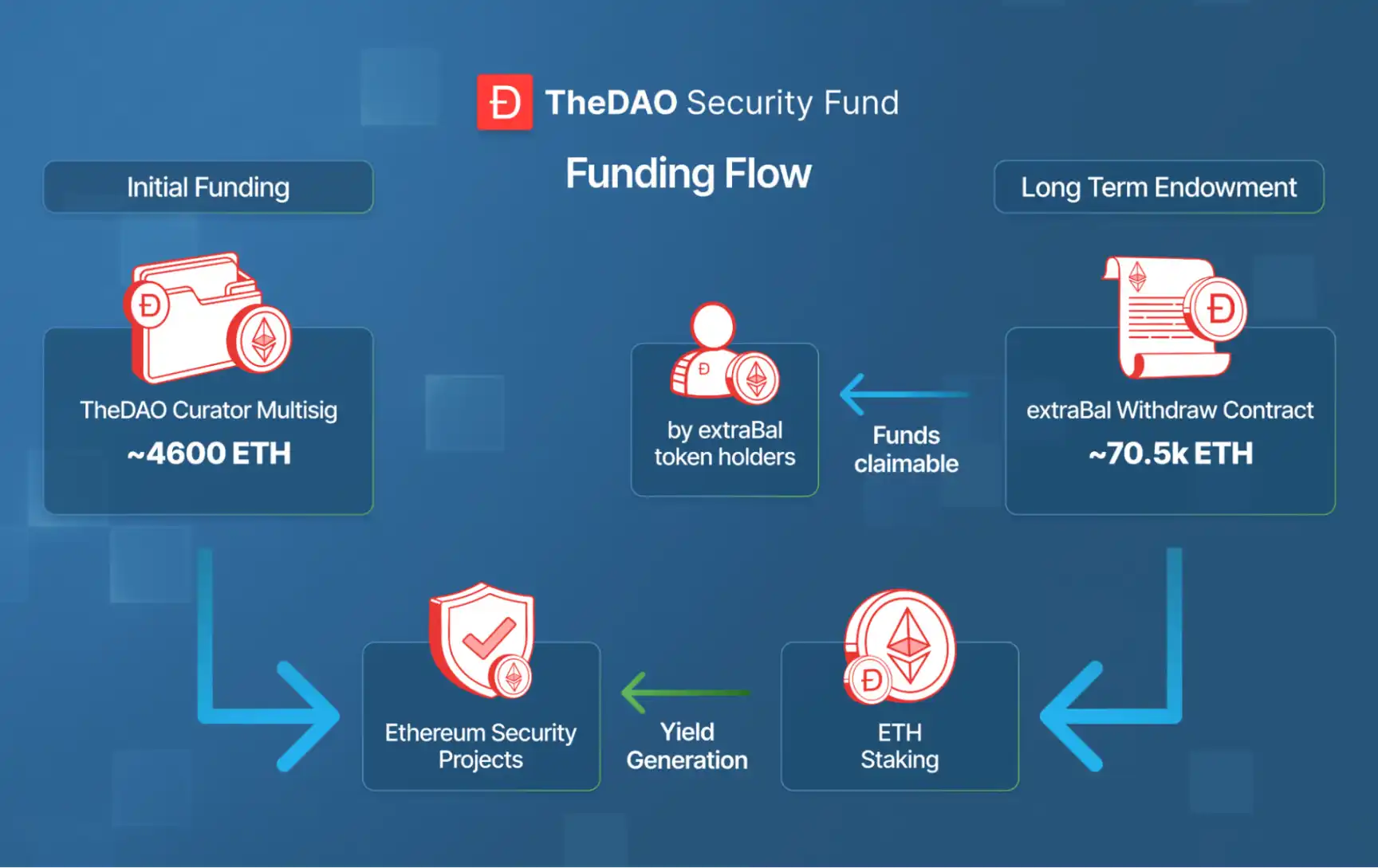
TheDAO Security Fund's fund operation and usage plan are clearly defined: 69,420 ETH withdrawn from the ExtraBalance contract will be staked to form a perpetual donation fund through staking rewards, providing long-term financial support for Ethereum security development; the staking rewards will be combined with the 4,600 ETH in TheDAO Curator Multisig to fund various Ethereum security-related projects. Meanwhile, a portion of the ExtraBalance withdrawal contract will retain some ETH to ensure legitimate claimants' rights are not affected.
In terms of funding scope, the core goal of TheDAO Security Fund is very clear—to prioritize Ethereum's overall ecosystem security, covering the full spectrum of security development scenarios: from wallet user experience optimization, smart contract security audits, to security incident emergency response, Ethereum core protocol security upgrades, and security protection for Layer 2 networks and cross-chain bridge ecosystems. All efforts to enhance Ethereum's security posture are included in the fund's funding scope.
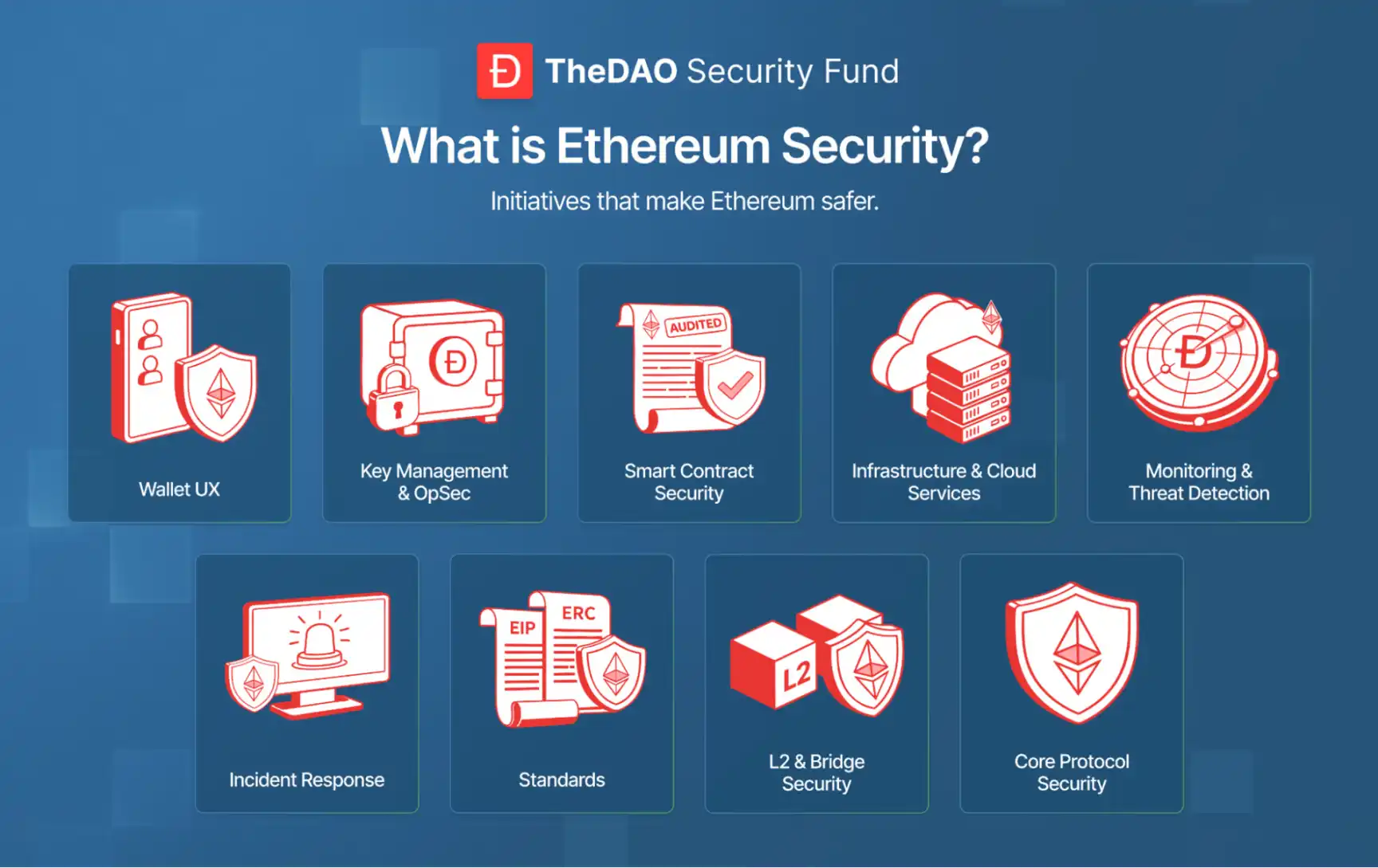
Furthermore, the fund will rely on the optimization directions and opportunities in the current security field outlined by the Ethereum Foundation's Trillion Dollar Security, combined with ongoing communication with ecosystem partners, to determine the specific scope and focus of each round of funding.
In terms of fund allocation mechanisms, TheDAO Security Fund adheres to the principles of open and bottom-up governance. It will employ diverse methods such as quadratic funding, retrospective funding, and sorting by Request for Proposals (RFP) to conduct funding rounds, allowing ecosystem participants to collectively participate in fund allocation decisions.
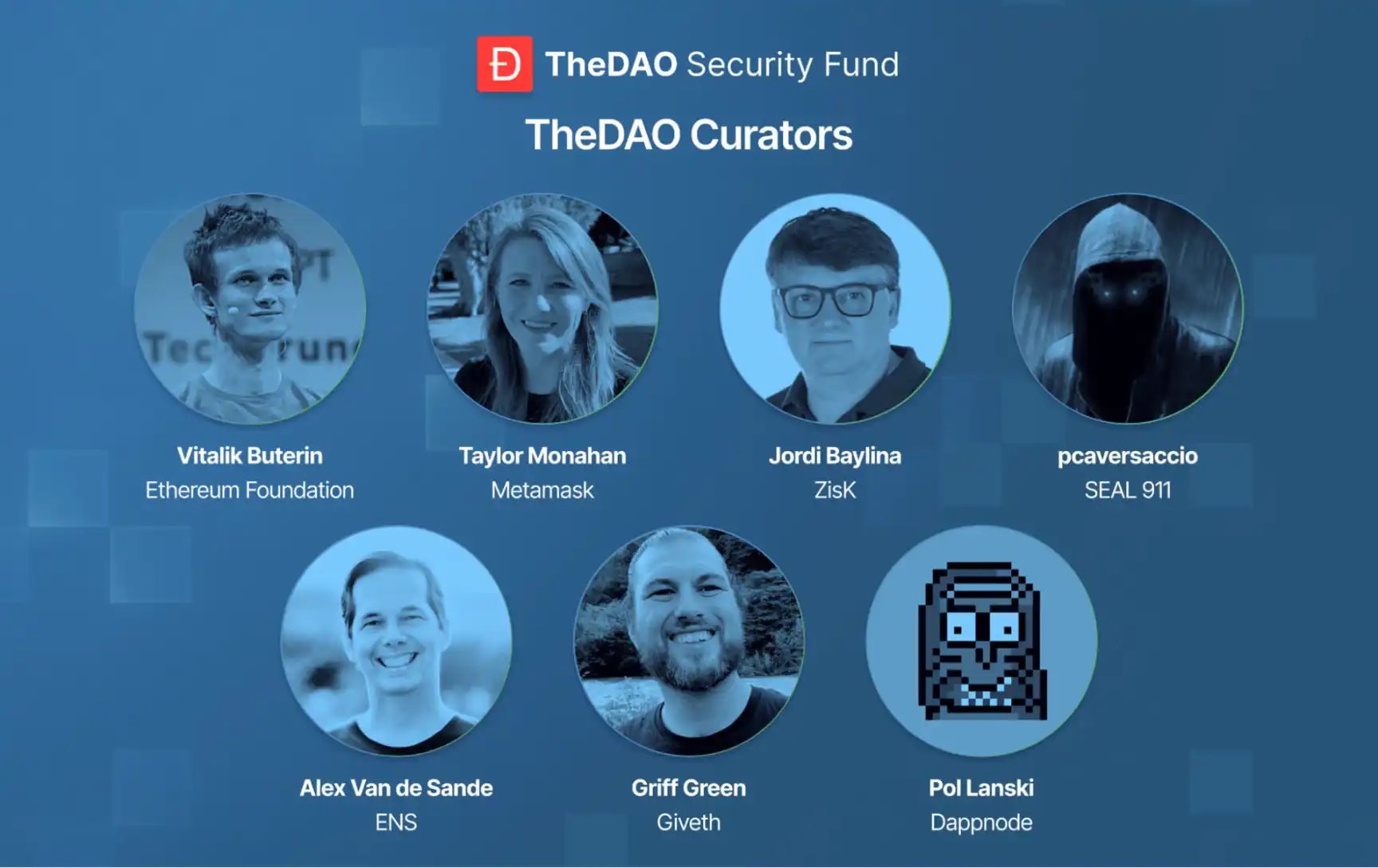
Currently, the fund has formed a professional Curator team to provide expert guidance and supervision for fund operation and funding decisions. Team members are experienced practitioners and security experts in the crypto ecosystem, including Ethereum founder Vitalik, MetaMask security engineer Taylor Monahan, Zisk, Giveth co-founder Jordi Baylina, security expert pcaversaccio, ENS co-founder Alex Van de Sande, and Dappnode CEO Pol Lanski.
Conclusion
TheDAO Security Fund is not without controversy, with the core debate still revolving around two key issues: the "legitimacy of use" of these remaining funds for the security fund and the "decentralization level" of the fund's governance.
Whether this substantial asset should be considered as "private property" belonging to all original token holders or has been identified as unclaimed property used for the "public good" is still a point of contention.
These controversies not only continue the Ethereum community's ideological divide sparked by The DAO incident in 2016 but also reflect the deep-seated governance contradictions in the current crypto ecosystem. Balancing decentralization principles with operational efficiency and asset disposal compliance remains a topic that the entire industry needs to continuously explore.
Setting aside the controversy, from the crowdfunding myth and ecosystem crisis of 2016 to the security fund and ecosystem guardianship of 2026, the decade-long cycle of The DAO itself is a microcosm of Ethereum's ecosystem development. It has witnessed Ethereum's journey from infancy to maturity and confirmed the resilience of the crypto ecosystem and the power of community.
Sources:
<1>https://en.wikipedia.org/wiki/The_DAO
<2>https://www.gemini.com/cryptopedia/the-dao-hack-makerdao
<3>https://unchainedcrypto.com/exclusive-thedao-to-become-new-220-million-ethereum-security-fund/
<4>https://paragraph.com/@thedao.fund/thedao-security-fund-activating-75000-eth-for-ethereum-security
<5>https://medium.com/curator-multisig-phf-official-channel/thedao-curator-multisig-a-decade-later-572796549d70
You may also like

Uniswap is trapped in an innovation dilemma

What is the key to competition in crypto banking?

The flow of stablecoins and the spillover effects in the foreign exchange market

After two years, Hong Kong's first batch of stablecoin licenses finally issued: HSBC, Standard Chartered make the cut
The person who helped TAO rise by 90% has now single-handedly crashed the price again today

3-Minute Guide to Participating in the SpaceX IPO on Bitget

Top 5 Cryptos to Buy in 2026 Q1: A ChatGPT Deep Dive Analysis
Explore the top 5 cryptos to buy in Q1 2026 including BTC, ETH, SOL, TAO, and ONDO. See price outlooks, key narratives, and institutional catalysts shaping the next market move.

How to Earn $15,000 with Idle USDT Before Altcoin Season 2026
Wondering if altcoin season is coming in 2026? Get the latest market update, and learn how to turn your idle stablecoins waiting for entry into extra rewards up to 15,000 USDT.
Can You Win Joker Returns Without Large Trading Volume? 5 Mistakes New Players Make In WEEX Joker Returns Season 2
Can small traders win WEEX Joker Returns 2026 without huge volume? Yes—if you avoid these 5 costly mistakes. Learn how to maximize card draws, use Jokers wisely, and turn small deposits into 15,000 USDT rewards.

Altcoin Season 2026: 4 Stages to Profit (Before the Crowd FOMO In)
Altcoin Season 2026 is starting — discover the 4 key stages of capital rotation (from ETH to PEPE) and how to position before the peak. Learn which tokens will lead each phase and avoid missing the rally.

Will Alt season come in 2026? 5 Tips to Spot the Next 100x Crypto Opportunities
Will altcoin season arrive in 2026? Discover 5 rotation stages, early signals smart traders watch, and the key crypto sectors where the next 100x altcoin opportunities may emerge.

The bear market has arrived, and cryptocurrency ETF issuers are also getting involved

The richest man had a quarrel with his former boss

BTC Firm Above 70K! Saylor’s "Institutional Logic" vs. Moon’s "Retail Faith": Who is Really Harvesting the Market?
Bitcoin is holding firm above the $70,000 support level following a massive short squeeze that liquidated $427 million. As the "Four-Year Cycle" narrative shifts, the market is split: Michael Saylor’s cold, institutional "indiscriminate stacking" vs. Carl Moon’s high-energy retail "hopium." This article decodes these two polar-opposite strategies for the 2026 bull run and reveals how WEEX’s institutional-grade liquidity and AI trading tools empower every type of investor to convert market volatility into profit.

The Girl Who Created the SBTI Test: A Story of a Doomed Cyber Love, an E-Widow Ratfolk

B.AI Officially Launched: Building AI Agent Financial Bedrock Platform, Driving AGI Era Business Underlying Logic

B.AI Officially Launched: Breaking Down A2A Collaboration Barriers to Unlock the Smart Body Economy's Full Potential


 App
App