
- Buy Crypto
- Markets
 Futures
- Spot
- Copy Trade
- Earn
- More
Solana's Big 4 DEX Battle: Raydium, Jupiter, Orca, and Meteora - Who Will Come Out on Top?

Original Title: Introduction: Solana's Evolving DeFi Landscape
Original Author: vik0nchain, Researcher at Cyber Capital
Original Translation: Luffy, Foresight News
From the fourth quarter of 2024 to the beginning of 2025, Solana's DeFi ecosystem's competitive landscape has gradually emerged, mainly reflected in the rise of aggregators, user experience (UX) abstraction, major integrations, and evolving tokenomics standards. Although these changes were not initially apparent, recent data has clearly shown their impact, particularly in the redistribution of liquidity, fee generation, and shifts in market share.
This analysis delves into the liquidity positioning of Solana-based major decentralized exchanges (DEXes) — Raydium, Jupiter, Orca, and Meteora, focusing on discussing their advantages, disadvantages, and potential investment impacts compared to existing and emerging competitors.
Investment Analysis Framework
Raydium (RAY) Bullish Outlook: Deep Liquidity and Buyback Advantage
· Liquidity and Trading Volume Dominance: Raydium remains the most liquid and frequently used decentralized exchange in the Solana ecosystem. Over 55% of trades routed through Jupiter settle on Raydium. Additionally, Raydium holds a market-leading position in all decentralized exchanges across blockchains, sometimes even surpassing Uniswap, with its fully diluted valuation (FDV) and market cap being only about a third of Uniswap's.
· Raydium/Uniswap Fully Diluted Valuation Ratio: $28.72 billion / $91.02 billion = 31.5%
· Raydium/Uniswap Market Cap Ratio: $15.06 billion / $54.66 billion = 27.5%
· Pump.fun Integration: Key partnerships, including the integration with Pump.fun, have boosted trading volume and protocol stickiness due to all new Meme pools migrating to Raydium.
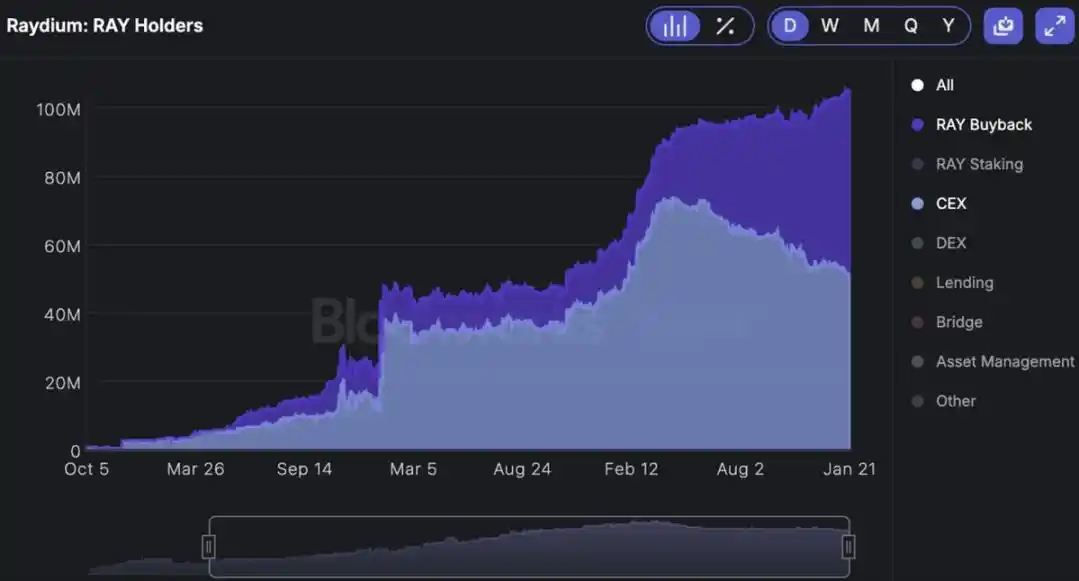
· Token Buyback: Raydium's 12% fee buyback plan has repurchased over 10% of the total token supply, significantly alleviating selling pressure. It is noteworthy that Raydium's buyback amount far exceeds that held by centralized exchanges.
Jupiter (JUP) Bullish Outlook: Market-Leading Aggregator
· Liquidity Aggregation Advantage: Jupiter, as a leading aggregator on Solana, plays a key role.
· Moonshot Acquisition: The acquisition of Moonshot enables Jupiter to integrate on/off-ramps within its decentralized exchange, enhancing competitiveness by simplifying the user experience.
· Unlocking Pressure: Due to token unlocking, Jupiter faces a 127% supply expansion, bringing mid-term inflation risk. Although a buyback mechanism has been recently announced, the internally estimated annual buyback rate is 2.4%, providing some support to the token economy but having limited impact in the competition with Raydium.
· Business Model: As aggregator fees are charged additionally on top of underlying protocol fees, in a low-fee environment, the aggregator model faces challenges.
· Lack of Competitors: Being the pioneering aggregator on Solana, Jupiter lacks strong competitors.
Meteora Bullish Outlook: Emerging Liquidity Aggregator
· Aggregated Liquidity Efficiency: Unlike standalone decentralized exchanges, liquidity aggregators like Meteora inherently have lower downside risk and more stable capital efficiency.
· Token Issuance Catalyst: A successful token launch for Meteora could shift liquidity preferences, providing long-term momentum for its market positioning. Unlike industry LP leader Kamino, MET points are not publicly displayed on the user interface. Furthermore, since the announcement of the MET points system over a year ago, there has been no official statement regarding airdrops. While liquidity providers can earn higher yields elsewhere in the ecosystem (such as lulo.fi), market positioning and airdrop expectations may be the primary drivers for liquidity providers.
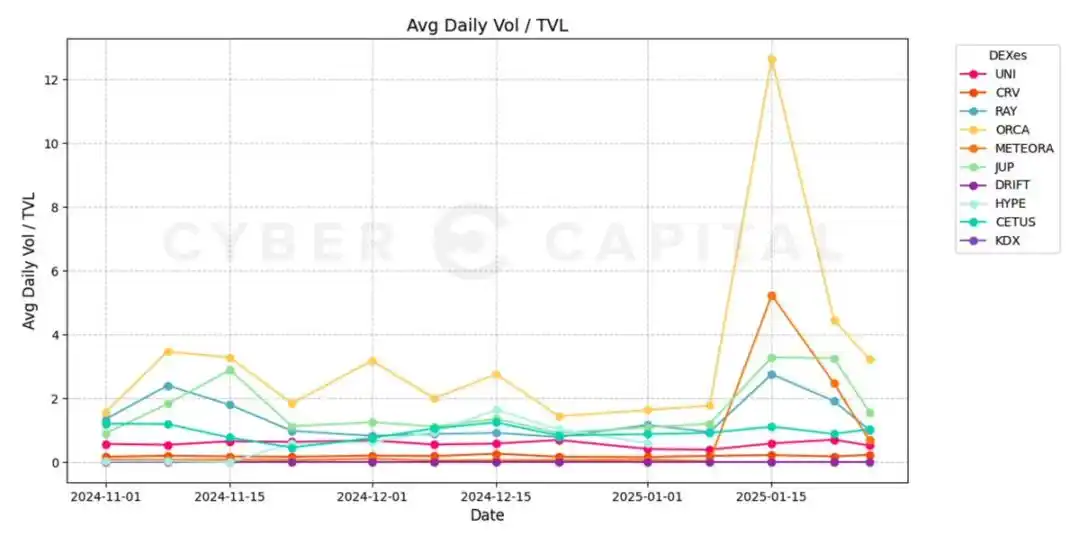
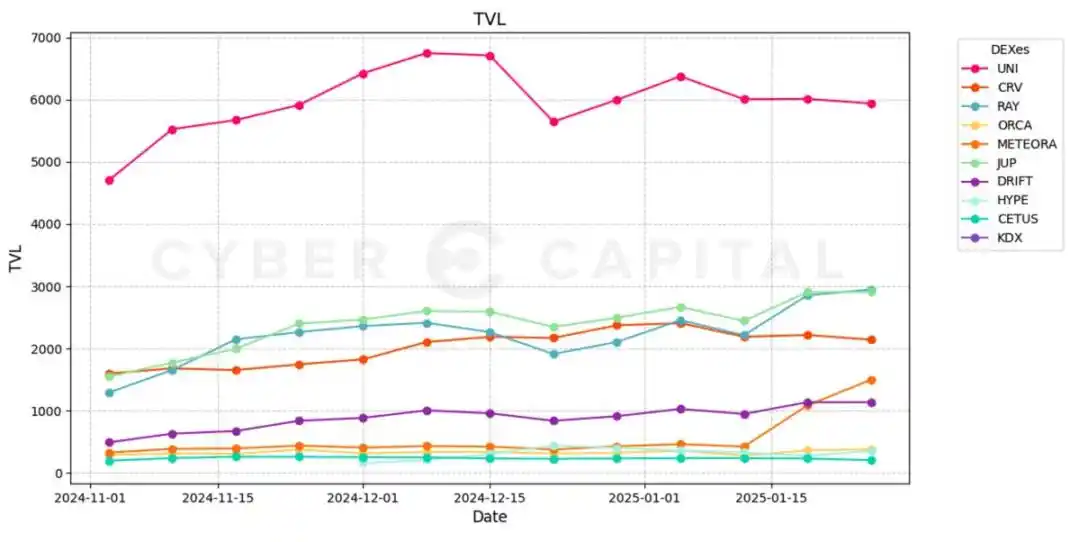
· Total Value Locked (TVL) Retention: With the Pengu airdrop and significant events like the Trump and Melania-related Memecoin launch, Meteora has made strides. Although during the Memecoin launch, the trading volume / Total Value Locked (Vol/TVL) ratio of many pairs rose due to temporary demand, Meteora's TVL continued to grow post-event, demonstrating good retention.
· Integration Development: Virtuals migrated to Solana in the first quarter of 2024 and announced integration with the Meteora liquidity pool.
Orca Bleak Outlook: Insufficient Liquidity Retention
· Insufficient Liquidity Depth: Despite high efficiency, Orca's pool size is significantly smaller than Raydium's, resulting in higher slippage for large trades.
· Market Positioning Issue: Jupiter's routing mechanism prioritizes exchanges with deeper liquidity, making emerging low-liquidity decentralized exchanges and liquidity pools unattractive. The emergence of Meteora as a liquidity aggregator further limits the competitive survival of non-leading decentralized exchanges in the routing framework, as routing only occurs when the slippage cost is lower than Meteora's fee premium, a situation that is very rare beyond the surge in market demand.
· Limited Liquidity Provider Incentives: Orca lacks a robust liquidity mining strategy, leading to a lower long-term liquidity provider retention rate.
· Inefficient Capital Allocation: Unlike Meteora, Orca has not yet implemented automated yield optimization, requiring manual LP management, resulting in a more cumbersome user experience.
· Unpromising Liquidity Trend: The upcoming Meteora token launch may divert liquidity providers completely from Orca, making its situation even more challenging.
· Insufficient Integration: Failure to reach a partnership with Pump.fun at the beginning of 2024 followed by a recent missed opportunity with Virtuals highlights its competitive disadvantage in acquiring orders from emerging retail-driven applications. Without upcoming catalysts to reverse this trend, the liquidity migration may continue. These factors have prevented Orca from retaining the additional user volume gained during network demand peaks.
Key Catalysts and Risks
Critical Catalysts to Watch
· RAY Buyback vs. Centralized Exchange Holdings Comparison: RAY's buyback rate now exceeds the total RAY held by centralized exchanges, reinforcing the token's scarcity.
· Total Locked Value Growth Trend: The continued dominance of Raydium, Jupiter, and Meteora indicates the sustainability of long-term liquidity. In high-pressure market conditions, the performance of emerging protocols deserves attention and should not be overlooked.
· Partnership Dynamics: Just as Pumpfun's integration brought significant liquidity to Raydium, Meteora's integration with Virtuals could have a similar effect. Given the impact of such partnerships on liquidity and total value locked, collaborations with lesser-known players are closely watched.
· Meteora's Token Issuance: This event could mark a turning point in the decentralized exchange liquidity distribution on Solana.
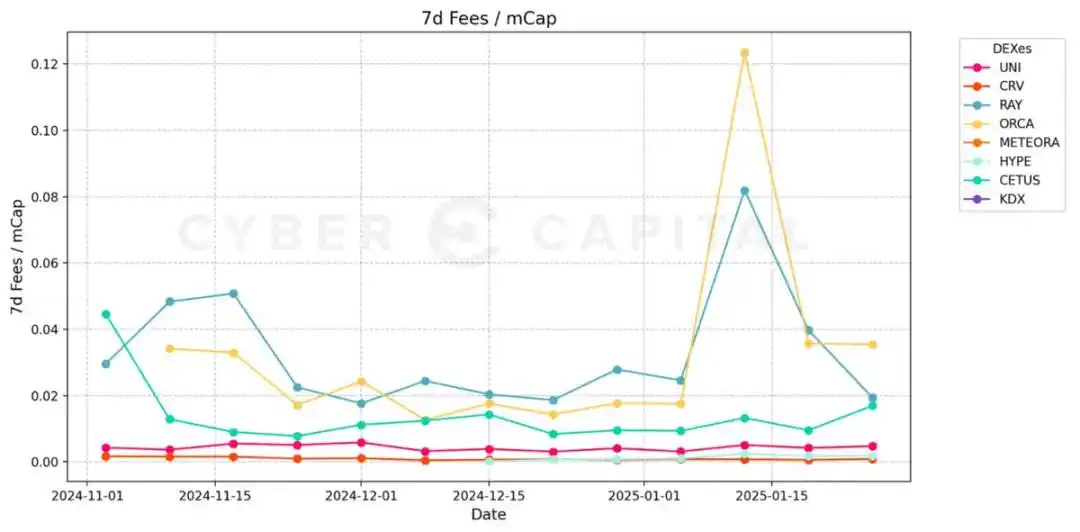
· Fee-to-Market Cap Ratio: Orca demonstrated high efficiency during a month of strong demand, but its retention of liquidity fell short, hindering long-term competitiveness. On the other hand, JUP faced the opposite situation due to constraints in its business model. Compared to the latest "hot project" Hyperliquid, Raydium generated ten times the fee with an eighth of the fully diluted valuation.
Risks
· JUP Inflationary Pressure: Despite Jupiter's aggregator position being solid, its large token supply could create short-term price pressure. Orca Market Share Erosion: If the trend of liquidity providers migrating continues, Orca may face ongoing liquidity drain. Meteora Airdrop and Tokenomics Implementation Risk: While early total value locked growth has been strong, its tokenomics and incentive structure remain untested.
Conclusion and Investment Outlook
Solana's decentralized exchange landscape is moving towards higher efficiency and deeper liquidity concentration. Raydium's outstanding liquidity positioning, active buyback mechanism, and market leadership make it a decentralized exchange with strong investment confidence. Jupiter's aggregator role remains critical and provides a competitive barrier, but token supply dilution poses a short-term challenge. Orca was once a competitive player, but faces serious challenges in liquidity retention and capital efficiency, becoming an increasingly fragile asset, indicating the dilemma of missing key integrations and struggling to compete head-on with established players. Meteora is poised to rise upon the successful launch of its upcoming token.
Based on our current theory, investment positions in decentralized exchanges should focus on the leading decentralized exchanges, decentralized exchange aggregators, and liquidity aggregators within a given ecosystem, while holding a small position in emerging participants that meet catalyst criteria.
You may also like

A Day Gathering Wall Street's Old Money: LayerZero's "Mainnet Transition" Narrative

Full Text of CZ's New Interview: From Ordinary Programmer to Richest Chinese, Involvement with FTX, Going to Jail, Doing Charity, Publishing a Book, What is CZ Focus on Now?
Mr. Beast is officially entering the world of finance, the Gen Z's new banker

SBF Appeals from Prison, Files 35-Page Motion Accusing Trial of "Collusion"

Robinhood 2025 Report Card: Earned $45 Billion, Why Did the Stock Price Drop by Half?

$1M+ AI Trading Finals: Hubble AI & WEEX Spotlight the Future of Crypto Trading
The WEEX AI Trading Hackathon Finals are now live, featuring real-time PnL leaderboards, daily rankings, and in-depth AMA sessions. Explore how top AI trading strategies perform under real market volatility and follow the competition as it unfolds.

WEEX Alpha Awakens Final Round Has Officially Begun
Day 1 of the WEEX AI Trading Hackathon Final Round is now live! Watch top algorithmic trading strategies compete with real capital. Follow the action from Feb 3–16, 2026, with $880K+ in prizes. Tune in live now. #AITrading #TradingHackathon

WLFI Team Meeting, Ally Meeting, Seaside Villa Cryptocurrency Business Kickoff

OpenClaw Hackathon, What are some projects worth checking out

The Bithumb 2000 BTC Mistake: The Fundamental Issue with CEX Ledgers

LayerZero releases L1 chain Zero, CZ appears on the All-In podcast, what's the overseas crypto community talking about today?

Binance Alpha has turned the airdrop into a "blind box" game

AI Wars: WEEX Alpha Awakens - The Global AI Trading Hackathon Redefining Financial Markets
Compete in WEEX's global AI trading hackathon with $880K+ prize pool. Build & test algorithms in live markets. Bentley & crypto prizes await top AI trading strategies. Join now!

Kyle Samani's Exit Scam, Is There More to the Story?

February 10th Market Key Intelligence, How Much Did You Miss?

Tokenomics New Paradigm? When Backpack Starts Enabling VCs to "Deferred Gratification"

BankrCoin Achieves New Milestones as YZi Labs and ETH Investors Make Significant Moves
Key Takeaways BankrCoin (BNKR) hit a new all-time high with significant market activity. YZi Labs executed a major…

Bitcoin Tests $75K Amid Market Predictions
Key Takeaways Bitcoin shows a 47% chance to test the $75,000 mark this February, contrasting with a potential…
A Day Gathering Wall Street's Old Money: LayerZero's "Mainnet Transition" Narrative
Full Text of CZ's New Interview: From Ordinary Programmer to Richest Chinese, Involvement with FTX, Going to Jail, Doing Charity, Publishing a Book, What is CZ Focus on Now?
Mr. Beast is officially entering the world of finance, the Gen Z's new banker
SBF Appeals from Prison, Files 35-Page Motion Accusing Trial of "Collusion"
Robinhood 2025 Report Card: Earned $45 Billion, Why Did the Stock Price Drop by Half?
$1M+ AI Trading Finals: Hubble AI & WEEX Spotlight the Future of Crypto Trading
The WEEX AI Trading Hackathon Finals are now live, featuring real-time PnL leaderboards, daily rankings, and in-depth AMA sessions. Explore how top AI trading strategies perform under real market volatility and follow the competition as it unfolds.


 App
App