
In-Depth Article Exposing the BTCFi TVL Scam, Nubit's "Proof of TVL" Report Explained


Original Authors: Nubit and Nebra
In the Bitcoin ecosystem, Total Value Locked (TVL) is a key metric that measures the scale and security of BTCFi (Bitcoin Finance) projects. However, as BTCFi expands, the controversy surrounding the authenticity of TVL data continues to escalate. False statistics, double counting, fake locking, and other phenomena are eroding user trust, challenging the transparency and credibility of the Bitcoin ecosystem.
In response to this phenomenon, leading Bitcoin ecosystem projects such as Nubit, Nebra, Bitcoin Layers, and Alpen Labs released the "Proof of TVL" report on January 5, 2025, addressing the opaque nature of the BTCFi field. They called for the establishment of a higher standard asset transparency verification mechanism and proposed an open-source TVL verification tool to provide strong support for the transparency of the Bitcoin ecosystem.
The following is the original text of the report:
Special thanks to Bitcoin Layers and Alpen Labs for their review and valuable feedback on this article.
The Evolution of BTCFi and Liquid Staking Tokens (LSTs)
Bitcoin has long been the cornerstone of the digital asset ecosystem.
However, over the years, its utility has been primarily limited to serving as a store of value and a medium of exchange. It wasn't until 2023 when protocols like Babylon introduced the concept of Bitcoin staking, allowing users to lock up their BTC in a self-custodial manner and participate in a Proof-of-Stake consensus mechanism to earn rewards.
This innovation ushered in a new era for Bitcoin, now commonly referred to as BTCFi. This movement has empowered Bitcoin with unprecedented capabilities. Since then, Bitcoin is no longer just a passive holding asset but is able to actively participate in the decentralized finance (DeFi) ecosystem.
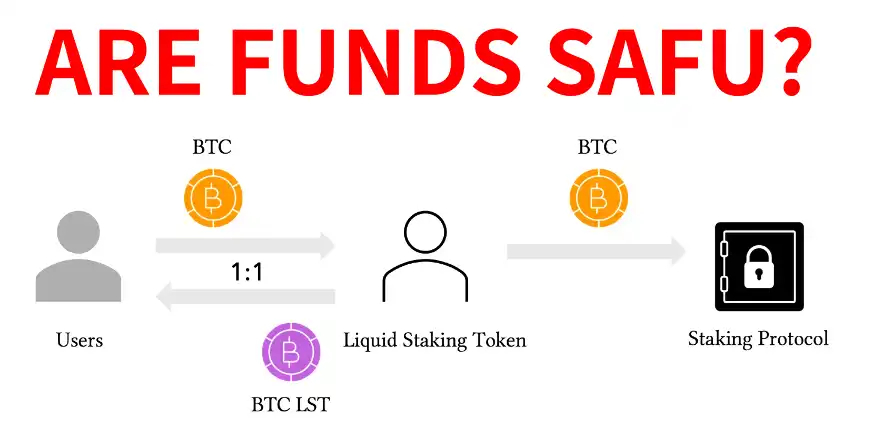
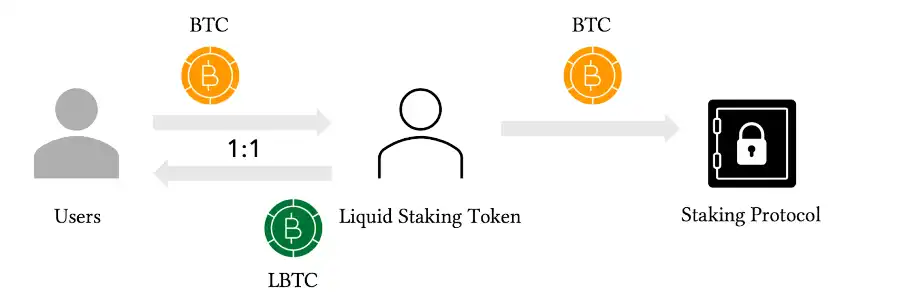
To enhance the usability and liquidity of staked Bitcoin, a wave of Bitcoin Liquid Staking Tokens (LSTs) emerged. These protocols act as custodians, allowing users to stake their BTC and receive tokenized credentials in return. These LSTs can be freely used in DeFi applications, including lending, trading, yield farming, and more. This model allows Bitcoin stakers to have the best of both worlds: earning staking rewards while engaging in a wide range of DeFi opportunities.
These LST protocols have rapidly gained user acceptance, with the total value locked (TVL) of related protocols reaching billions of dollars. TVL is typically seen as a key metric to measure user activity and protocol success.
However, we want to pose a critical question for the industry: How reliable is the TVL data reported for Bitcoin LST protocols?
Specifically, for BTC that the protocol cannot effectively custody or slash, should these assets be counted in TVL?
If the TVL data is inflated, it could potentially provide users and investors with a false sense of security. Inflated TVL data may mask the protocol's true liquidity and risk exposure, leading all parties involved to make incorrect decisions and potentially suffer losses.
Why is Tracking TVL for Bitcoin Liquid Staking Protocols Challenging?
In the context of Bitcoin staking, Bitcoin's unique UTXO model adds complexity that makes interpreting Total Value Locked (TVL) data challenging. This complexity erodes trust in Bitcoin Liquid Staking protocols (LST) and raises concerns about the sustainability of the entire BTCFi ecosystem.
Let's examine the reasons in detail.
Bitcoin adopts the UTXO model (Unspent Transaction Output), where each transaction creates a unique "Bitcoin unit" with specific spending conditions. For example:
Some UTXOs may require a private key signature to be spent.
More complex UTXOs may include multi-signature (multisig) requirements or timelocks.
Unlike Ethereum's account-based model, Bitcoin's UTXO model does not aggregate balances, making tracking and locking funds more complex—though not entirely infeasible. Therefore, TVL data for LST protocols is usually self-reported by the protocols. To validate this reported data, we need to start with a simple question:
How should the TVL of Bitcoin Liquid Staking protocols be calculated?
The goal of Bitcoin staking protocols is to provide economic security for layer 2 protocols (such as Rollups, Data Availability Layers (DAs), etc.). From this perspective, economic security is effective only when the staked Bitcoin is under the custody of the staking protocol and is slashable. Therefore, one thing is clear:
Unstaked or non-slashable BTC held in protocol custody should not be counted towards TVL.
How is Bitcoin Double-Staked TVL Faked?
Many Bitcoin yield farming protocols, in their pursuit of a high TVL (Total Value Locked), spare no effort to strike agreements with large holders (whales) to artificially inflate their TVL through "data washing."
Here is how they operate:
1. Whale Staking: A large BTC holder (whale) is incentivized to move their BTC to an address controlled jointly by the whale and the protocol, under the guise of "staking."
2. Whale Retains Control: After staking, the whale still retains ultimate control over the Unspent Transaction Outputs (UTXOs). The protocol cannot force redemption or enforce penalties (including slashing penalties), meaning that this capital was never truly at risk.
3. False TVL Inclusion: The protocol includes these UTXOs in its TVL, even though these funds are not meaningfully locked, and the whale can withdraw or reuse these funds at any time.
The reality is:
Users (whales) maintain full control over the funds: Whales can spend these BTC at any time or stake them in another protocol.
Non-slashable Pseudo-Staking: This "staking" process has no mandatory slashing conditions, making it essentially meaningless.
The essence of staking lies in safeguarding network security by incentivizing benign behavior and penalizing malicious behavior. Slashing ensures that participants face real financial loss risk when not complying with protocol rules or engaging in dishonest behavior. Without this mechanism, staking devolves into a farce of "staking for the sake of staking," serving no practical purpose.
Ask yourself: What is the true purpose of staking? It is not to inflate TVL data or make symbolic gestures but to safeguard the protocol's security through slashing mechanisms.
This brings to mind FTX's painful lesson. In the FTX collapse, the disconnect between reported figures (IOUs) and actual reserves (redeemable assets) ultimately led to a complete breakdown of user trust. If a protocol inflates its TVL data, can you truly believe it won't misuse your reserves behind the scenes? A protocol that distorts facts even on fundamental issues like reserves likely has strayed from the trustless principles that Bitcoin embodies.
This inflated TVL data has raised a larger question: Is the reported "staked" Bitcoin truly locked up? Or is this merely a ploy to attract attention and inflate the digital false metric?
The Risk of False TVL
In theory, Liquidity Staking Tokens (LSTs) are designed to represent Bitcoin staked in protocols like Babylon, allowing holders to earn staking rewards while maintaining asset liquidity. The premise of this mechanism is that each LST is fully backed by real Bitcoin reserves at a 1:1 ratio.
However, some staking arrangements that seek high TVL numbers may undermine these commitments. If some of the staked BTC remains under the control of the original owner while the protocol reports it as fully locked up, this directly threatens the fundamental assumption on which LSTs rely. The results could be:
The actual locked collateral is less than the reported amount.
The staking model fails to provide the expected security guarantees.
There is a significant gap between the reported TVL and the actual amount of BTC participating in staking.
Ultimately, these actions cast doubt on whether LSTs are truly backed by verifiable reserves and raise concerns about the economic security these tokens can provide, such as:
1. Lack of 1:1 Support Guarantee
Because the protocol counts untruly locked or staked Bitcoin as "staked," it cannot guarantee that the assets supporting LSTs actually exist or are under the protocol's control. Users holding these tokens can only rely on the protocol's unilateral statement. Additionally, if these assets do not exist, users face real financial loss risks when redeeming the underlying assets.
2. Unverifiable Staking Rewards
Staking rewards should come from real contributions to network security or Proof of Stake (PoS) consensus. However, when the underlying Bitcoin is not truly engaged in staking, where do these rewards come from? Are they sustainable?
This poses a systemic risk to the entire BTCFi ecosystem. As trust weakens, liquidity may rapidly dissipate, not only undermining a specific protocol but also potentially affecting the stability of the entire BTCFi ecosystem based on Bitcoin staking.
What Happens When a Bitcoin Staking Protocol Becomes No Different from a Centralized Entity? In such a scenario, users are unable to audit the reserve, having to rely solely on the operator's statement. This situation severely threatens the credibility of BTCFi.
The current state of affairs poses a survival threat to BTCFi's credibility. To avoid falling into the same trap of centralized systems and false TVL, we must address the root cause of the issue: the lack of a trustless and verifiable mechanism to prove the reserve and staking activities.
This is where Proof of TVL (PoTVL) comes into play. Only by establishing a scientific, transparent, and cryptographically based reserve verification standard can we rebuild trust in Bitcoin LSTs and ensure the long-term sustainability of the ecosystem.
Core Solution: Transparent TVL Computation
In the context of Bitcoin staking, Taproot addresses play a crucial role in implementing staking locking scripts (e.g., Babylon). These locking scripts define explicit rules for staking, tracking, and eventual withdrawal of BTC. Babylon is a prime example as it directly links staking behavior to verifiable protocol-level rules on the Bitcoin UTXO model.
When stakers engage in the staking protocol, they construct specific transactions to send BTC to the protocol's designated Taproot address. These transactions typically include:
1. Staking Output: A UTXO used to send BTC to the Taproot address for staking.
2. Ownership Proof Output: A second UTXO containing the staker's and protocol's public keys. These public keys prove ownership of the staked BTC.
Using the Babylon staking protocol specification as an example:
The specification requires stakers (or the LST protocol) to construct transactions as follows:
· The first UTXO sends BTC to the Taproot address bound to Babylon's staking locking script.
· The second UTXO contains the staker and Babylon's public key to ensure ownership verification.
This design ensures that the staking behavior can be fully traced on-chain, with clear ownership proof and transparent rules.
Case Study: Lombard Finance
To demonstrate the application of this approach in practice, we used the open-source Proof of TVL tool to validate Lombard Finance.
Here is the complete verification process:
1. Identify User Deposit Wallet
The process starts from user depositing BTC into Lombard's wallet. These wallets represent the initial fund flow into the system.
2. Trace Transactions to Staking Wallet
Track BTC from the deposit wallets to the staking wallet controlled by Lombard. Based on Babylon's staking specification, identify all staking transactions.
3. Verify Ownership
Use Babylon's protocol rules to confirm if the staking transactions include the required public key for ownership verification. Ensure that the transactions comply with the staking locking script.
4. Calculate True TVL
Aggregate the BTC output amounts in the validated staking transactions to calculate on-chain collateral. Compare the collateral to the total LBTC supply, and calculate the collateralization ratio.
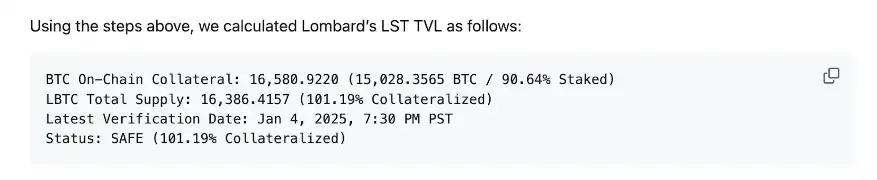
Through the above steps, we calculated Lombard's LST TVL as follows:
· BTC On-chain Collateral: 16,580.9220 (15,028.3565 BTC / 90.64% staked)
· Total LBTC Supply: 16,386.4157 (101.19% overcollateralized)
· Latest Validation Timestamp: January 4, 2025, 7:30 PM PST
· Status: Secure (101.19% overcollateralized)
Validation Details:
· 90.64% Staked
Out of a total on-chain collateral of 16,580.9220 BTC, 15,028.3565 BTC is actively staked according to the Babylon standard.
· 101.19% Overcollateralized
The total supply of LBTC is 16,386.41, while the on-chain collateral is 16,599 BTC.
· Full On-chain Transparency
Each staking transaction can be directly traced back to the deposit address of the Lombard protocol, and ownership verification complies with the staking rules.
The validation process was completed on January 4, 2025, at 7:30 PM Pacific Time (at the time of writing), and this data is fully reproducible without any manual intervention. Through our open-source tool Proof of TVL, anyone can independently verify LBTC's TVL data in real-time.
This is true transparency.
While this solution provides a high level of transparency, it has a key drawback: it relies on a trust protocol to accurately calculate and report TVL.
So, is there a way to eliminate this reliance and allow anyone to confidently independently verify the results? Zero-knowledge proofs (ZKPs) offer a potential solution path.
Using Zero-Knowledge Proofs for TVL Verification
One major advantage of Zero-Knowledge Proofs (ZKPs) is their encrypted trust mechanism, with extremely low validation costs, allowing users to directly verify ZKPs on client-side devices such as smartphones or browsers. This significantly reduces the friction and trust assumptions in TVL verification. Now, users don't even need to trust a third party running the TVL verification protocol.
The Zero-Knowledge Proof specifically designed for validating LST TVL is expressed as follows:
Reserve Proof from BTC + LST Wallet on Babylon above LST Total Supply
Reserve Proof from BTC on Babylon above LST
· According to Babylon's transaction specification: To have a transaction considered a valid staking transaction, the following conditions must be met:
· The transaction must have a Taproot output with key path spend disabled and committed to a script tree consisting of three scripts: a timelock script, an unbonding script, and a slashing script. This output is referred to as a staking_output, and its value is referred to as the staking_amount.
· The transaction must include an OP_RETURN output containing the following: global_parameters.tag, version, staker_pk (staking provider's public key), finality_provider_pk (finality provider's public key), staking_time (staking time).
To verify the LST on Babylon above BTC, we first need to validate the staking transaction. For example, verifying if the Taproot output and OP_RETURN contain the same public key.
Reserve Proof of LST Wallet
We can adopt a standard reserve proof protocol, such as the one proposed by Vitalik Buterin: Proof of Solvency Protocol.
In addition, Shumo et al. have proposed a slightly improved version.
Further reading: SNARKed Merkle Sum Tree: A Practical Proof of Solvency Protocol Based on Vitalik's Proposal.
The only technical detail is that we need to replace the signature algorithm used by Ethereum with the one used by Bitcoin. For example, while both Bitcoin and Ethereum use ECDSA, Bitcoin chose SHA instead of Keccak as the secure hash algorithm.
LST Total Supply
This is a user-provided public input.
By using zero-knowledge proofs for TVL verification, the counterpart risk can be effectively minimized, while reducing the barrier to entry for any user verification results.
The Future Roadmap of BTCFi
Bitcoin has always represented trust, decentralization, and transparency. However, with the proliferation of fake TVL data in the Bitcoin staking field, these core principles are at risk of erosion.
The solution is very clear: TVL verification through zero-knowledge proofs provides a clear path to achieving true accountability.
By eliminating reliance on trust and enabling reserves to be verified by anyone, we can rebuild user confidence in Bitcoin LST and ensure that BTCFi thrives on a "real" basis.
Ongoing Engagement
We believe in the power of collective progress. Here are ways you can help drive this process:
· Provide more TVL verification analyses: Help expand the tool's applicability, and contribute transparent analyses to other BTCFi protocols. Transparency is a collective effort across the entire ecosystem.
· Contribute PR: Improve the tool or propose new feature suggestions (e.g., implementation of zk-proofs).
· Develop industry standards: Collaborate with us to create open, verifiable BTCFi transparency standards.
· Spread the word: Share this article to raise awareness of the need for trustless TVL verification.
Attachment: Full report and verification tool open-source link
ReportOriginal Article Link
You may also like

The U.S. government prohibits foreigners from using Fable 5, Anthropic issues a rebuttal

The other side of Musk's trillion-dollar fortune: 85% cannot be sold

Citibank releases "2030 Asset Tokenization Market Outlook": 6 major trends may create a $8.2 trillion market

The trillion-dollar valuation test: Are the three major super IPOs a celebration for tech stocks or a nightmare for the crypto market?

Morning Report | Digital Asset completes $355 million financing led by a16z Crypto; Meta completes operational separation from Manus

a16z Crypto Partner: Cash flow is the moat

Cryptocurrency market makers collectively seek change as it becomes increasingly difficult to make money

How TradeXYZ, xStocks, and Alpaca break down the SpaceX IPO into three different strategies

$75 billion in risk asset redistribution: How will SpaceX's IPO affect U.S. stocks and Bitcoin?

Why Is BlackRock Investing $5 Billion in the SpaceX IPO?
Morning News | CME Group launches Nasdaq Cryptocurrency Index futures; Asset management giant Janus Henderson strategically invests in Ethena

Bitcoin Layer 2 Network Botanix: Why Did We Choose to Dissolve?

Why did Oracle deliver the strongest financial report in history, yet its stock price fell?
When the P2P illicit funds from ten years ago turned into 60,000 bitcoins
Dialogue with OmenX Founder: Why does the prediction market need an evolution from "spot" to "derivatives"?
Galaxy in-depth report: Is Solana still worth paying attention to?
Young people in South Korea make a "final effort" in the epic bull market
The pricing controversy of Trade.xyz exposes the fatal weakness of Pre-IPO perpetual contracts
The U.S. government prohibits foreigners from using Fable 5, Anthropic issues a rebuttal
The other side of Musk's trillion-dollar fortune: 85% cannot be sold
Citibank releases "2030 Asset Tokenization Market Outlook": 6 major trends may create a $8.2 trillion market
The trillion-dollar valuation test: Are the three major super IPOs a celebration for tech stocks or a nightmare for the crypto market?
Morning Report | Digital Asset completes $355 million financing led by a16z Crypto; Meta completes operational separation from Manus
a16z Crypto Partner: Cash flow is the moat


