
How to Become a Smart Money?




Original Article Title: Breaking Down Popular Price Action Strategies (Smart Money Concepts and ICT Trading)
Original Article Author: abetrade, Crypto Kol
Original Article Translation: zhouzhou, BlockBeats
Editor's Note: This article primarily explains that market trading is not entirely controlled by "smart money" as some popular trading theories suggest, but rather is based on the interaction of market depth and order flow. Large traders execute orders by selecting areas with sufficient liquidity to avoid additional trading costs. Traders should focus on the actual market structure and participants' behaviors rather than overly mystifying market operations.
Below is the original content (reorganized for easier reading comprehension):
If you've been in the trading circle for a while, you may have noticed that there is always a "flavor of the month" strategy, in other words, the widely discussed trading system. Apart from the countless direct messages I receive on Twitter inquiring about the smart money concept, you can see the presence of these "SMC" traders on various platforms.
Instagram, YouTube, Twitter, and other social media are filled with those retrospective TradingView charts showing 1-minute timeframe trades with returns of 10-20R (risk-reward ratio). I'm writing this article to reveal some of the real reasons behind market movements, why the market fluctuates, as I am really tired of hearing these claims of "market makers manipulating the market."
Strategy Concept
First, what is the Smart Money Concepts (SMC)?
SMC trading is a derivative form originating from Inner Circle Trader (ICT) teachings. Simply put, his trading methodology is based on smart money constantly manipulating prices to trigger retail traders' stop losses and create liquidity in the market.
ICT refers to these individuals as "market makers," a term I will mention again later.
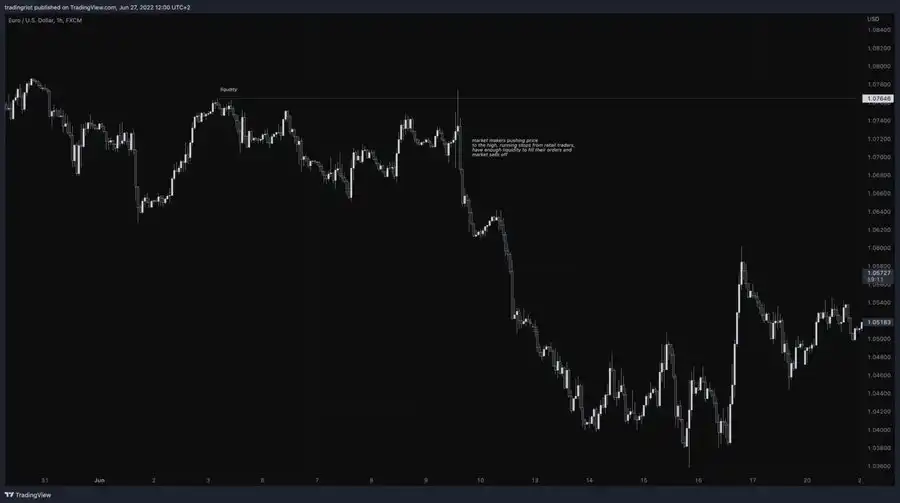
The reason these concepts have become very popular is mainly because they are "cool."
Traders from around the world, sitting at home, facing losses on MetaTrader 4, suddenly came across terms like "Smart Money" and "Manipulation," and felt like they were no longer retail traders. They now fully understand how the financial markets operate because they can see behind the scenes of those secretive operations happening every day.
However, the reality is that the "ICT Concepts" are indeed effective, but the reasons behind their effectiveness are far more mundane than they may appear on the surface.
One very popular thing that ICT and SMC traders do is rename things and make them overly complex to make them sound more appealing, making you feel like you now have insider information that others don't know.
If you watch this clip of Chris Lori's video, which is over a decade old, Chris Lori is one of the students of ICT, you might understand the origins of these concepts.
Over the years, these concepts have expanded into other markets such as cryptocurrency and still heavily rely on the concepts of "Manipulation" and "Market Makers." I leave it to you to judge; just ask yourself one question: who do you think would sit in a bank, staring at a 1-minute USD/CHF chart or a chart of some cryptocurrency all day, whose sole purpose is to take stop-losses from retail traders?
You don't need to be a genius to realize how silly that sounds, but as I mentioned, these concepts do work; the market often breaks past previous highs/lows and reverses from there, coming back to the "order block" and continuing in the intended direction.
Let's delve into why this happens.
Reality Check
Before we dive into the strategy itself, you need to understand some basic concepts and why most online "SMC" traders fail to make money in actual trading.
It is also worth mentioning that this is entirely an "SMC trader thing" because as I researched for this article, I skimmed through some of ICT's content, and he doesn't actually endorse this type of trading; I also found some of his videos on risk management, which had some very practical advice.
So, why can't you make 10R from every trade like those people on Instagram?
If you are still relatively new to trading, R represents the risk unit you take.
If you see someone online talking about a 3R trade, it means they achieved a threefold Risk-Reward Ratio; in other words, if their risk was $1000, then they made $3000.
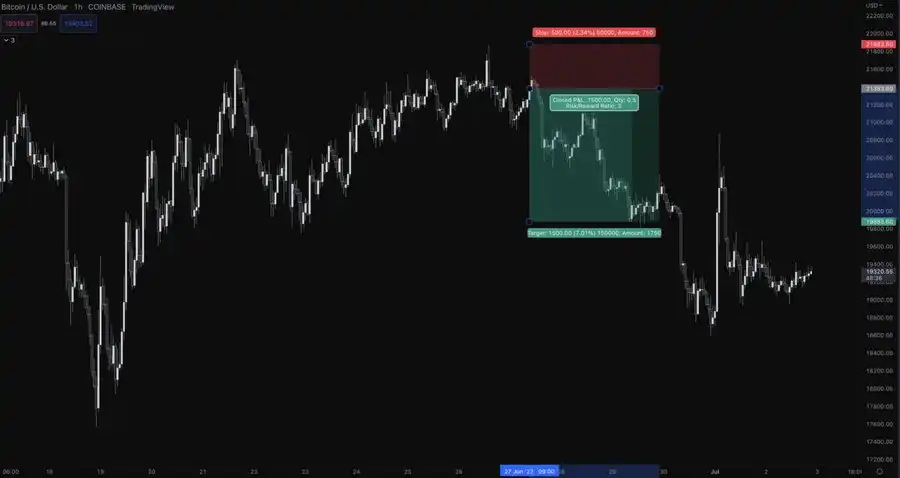
A very simple concept, which I believe most of you are familiar with, has been discussed many times online and on this website. If you want to learn more details, remember to read the article on risk management.
One common issue with most SMC traders you see online is that they always tend to place stop losses just a few ticks away but aim for huge rewards.
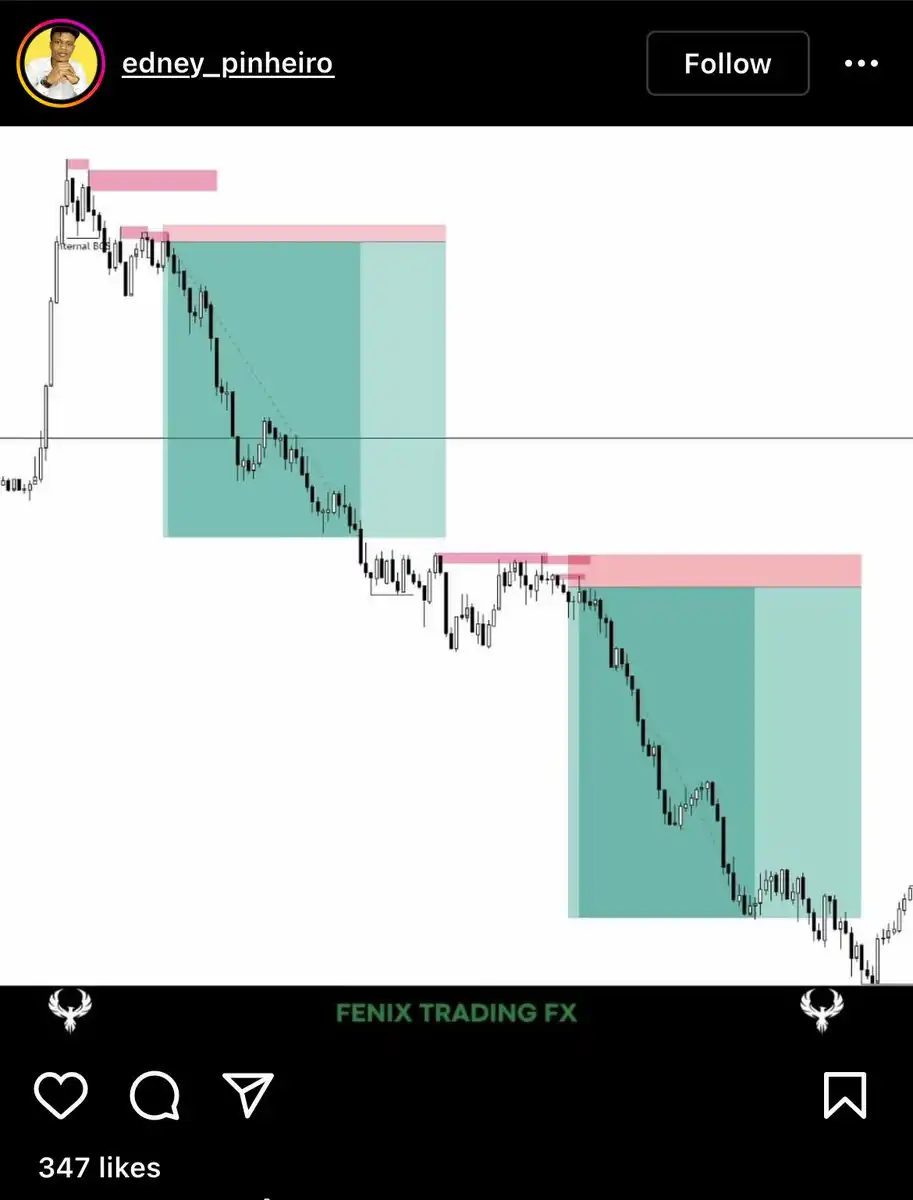
Why is it said that doing a 10R trade is not realistic? The simplest explanation is that if we momentarily assume it is realistic.
Trading on a 1-minute chart offers quite a few trading opportunities every day, assuming you are simultaneously monitoring 2 to 3 markets, and most days will have at least two trading setups.
Following this logic, there are approximately 250 trading days in a year, so let's assume you would be taking 500 trades throughout the year. Each trade has a Risk-Reward Ratio of 10:1, and you are correct 50% of the time.
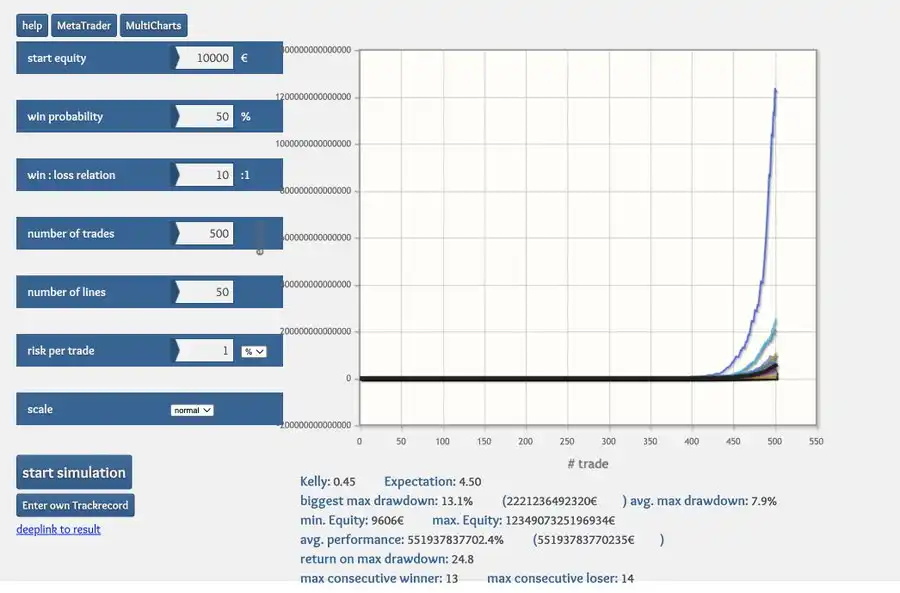
Starting with an account of 10,000 euros, by the end of the year, you would gain a 13-digit profit, and now you are the richest person in the world. Congratulations.
An opinion I saw online is that these high-return trades have a very low win rate, around 20-30%, but due to the very large Risk-Reward Ratio, it is still a profitable strategy.

Indeed, adopting a strategy with a 10:1 Risk-Reward Ratio, a 20% win rate is profitable in the long run. However, if you look below, you will find a equity curve with 38 consecutive losses.
Imagine, can you endure 38 consecutive losses in front of your computer without being emotionally affected, without violating any rules, avoiding making larger losses?
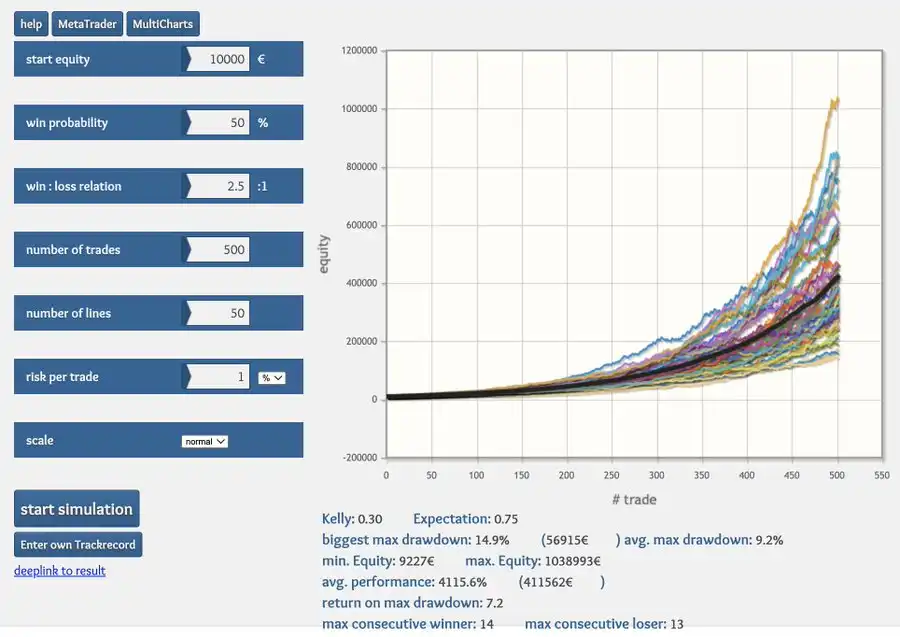
If we conduct another simulation, considering a strategy with a 50% win rate and a 2.5 risk-reward ratio, which is much more realistic than the previous assumption, you will see that you may still experience 13 consecutive losses.
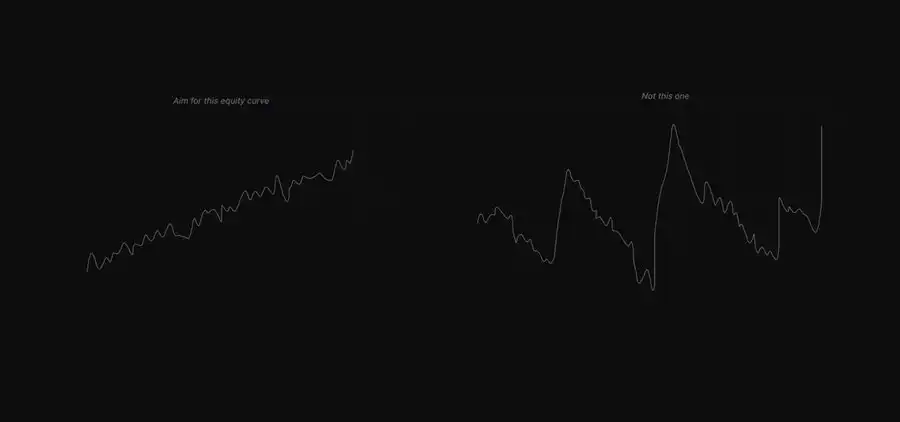
Even so, it would be very difficult to endure, but if you have built a strong trading record and have confidence in your system, you will find that tolerating these continuous losses is not as hard as sitting in losses all the time, hoping for that one "jackpot" trade that will give you a 10x return on risk.
Well, in the end, whether you focus on steadily building your equity curve or whether you want to hit a "home run" on every trade is your choice.
If you are trading on a lower time frame, such as a 1-minute chart or tick chart, you will be using a fairly large position size and setting very tight stop losses.
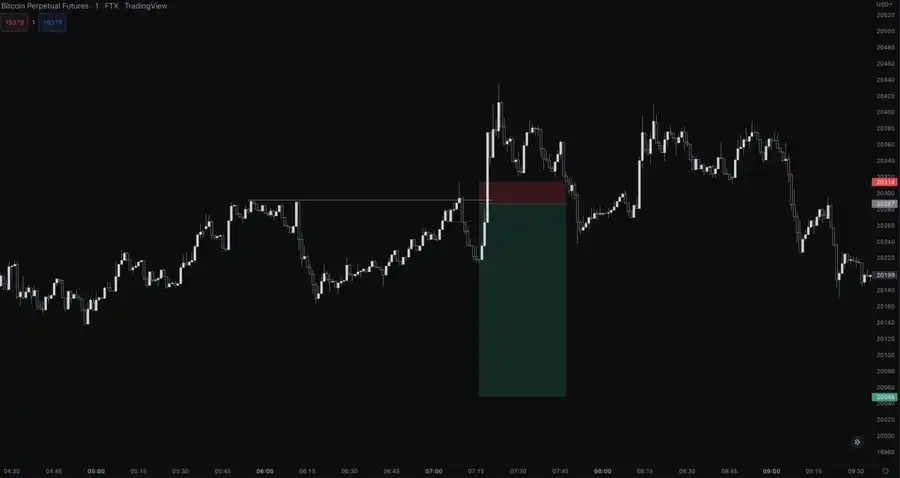
This is a common trade setup for an SMC trader; the market breaks through the resistance level to "grab liquidity" and then experiences a breakdown of the downward structure.
The idea of this trade is to place a short order on the last 1-minute candle before the selling pressure, with the target being the previous low.
In this example, the trade was not successful, and that's completely fine because not all trades will be profitable, but we need to have a deeper understanding of the risk management of this setup to comprehend the issues within.
I know most of you are trading with a smaller account, but of course, everyone hopes to one day "succeed" and be able to trade with a large account; therefore, assuming in this scenario you are trading with a $100,000 account and have set the risk to be 1%.
Since your stop loss is only $27, which is 0.13% away from the entry price, to make this $27 move worth $1,000, you need to short a significant amount of Bitcoin; specifically, you would need about $750,000 or 37 BTC.
To illustrate this better, suppose you short 37 BTC at a price of $20,287, with a total value of $750,619. If the BTC price moves back up to $20,314, the value of the 37 BTC becomes $751,618, which means you now owe the exchange $1,000 because you borrowed money to short Bitcoin.
Of course, the whole process is automated, and if you have set a $20,314 stop-loss, the exchange will automatically liquidate your position. You will lose that $1,000, and then you can move on to the next trade, or... can you really move on?
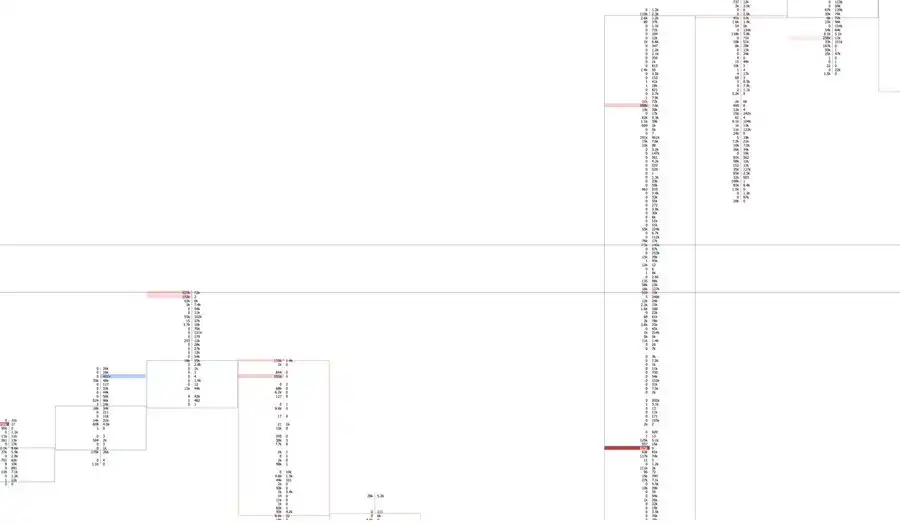
As you can see, this is a footprint chart, which succinctly shows that the numbers on the left represent sell orders, and the numbers on the right represent buy orders.
For more information on footprint charts, you can read this article.
You may have heard of this trading view: for every seller, there must be a buyer, and vice versa. So, if you sell $750,000 worth of Bitcoin and want to close your position, you need to find someone willing to buy it.
In the chart above, the red line represents your stop-loss set on the exchange, while the blue line above it shows where you would actually be liquidated, as the market must first fill the gap of those 37 BTC. This is known as slippage, and in this scenario, you would experience approximately a $10 slippage.
If your initial stop-loss was under $30, this slippage would be quite significant, ultimately resulting in an additional 0.3% loss (i.e., $300), not including fees. This example illustrates that when trading on very low timeframes, your 1% risk rarely stays at 1%, especially when trading with a larger account.
Furthermore, this example is from a regular trading day; during high-impact news events, market makers may withdraw liquidity prior to the event, making the situation even worse.
I discuss this in the video below: Video Link
Trading on a 1-minute chart is not realistic, especially in most cases when trading in well-liquid markets. However, you still need to be aware of liquidity, spreads, and fees. Targeting a 10R goal on every trade and treating it as a normal trading target is unrealistic.
Even if you find a strategy where you can trade at 10R with a 20% win rate, at some point, you will face a prolonged losing streak that you may not be able to withstand, especially when trading more significant funds.
The transaction itself is already stressful enough and requires a great deal of focus and dedication. If you know these are low-probability trading opportunities, there is no need to make it even harder for yourself by trying to hit a "home run" on every trade. Making money in trading is about long-term accumulation, not relying on a lucky one-time trade.
Liquidity Provider
The core idea of the entire strategy largely relies on "market manipulation," specifically the "manipulation" caused by market makers.
The advantage of this strategy lies in the market maker being an "evil entity" that manipulates the market all day and triggers retail investors' stop losses. However, in reality, this is not the market maker's job. A market maker's role is to provide market liquidity, not to influence market trends through malicious manipulation.
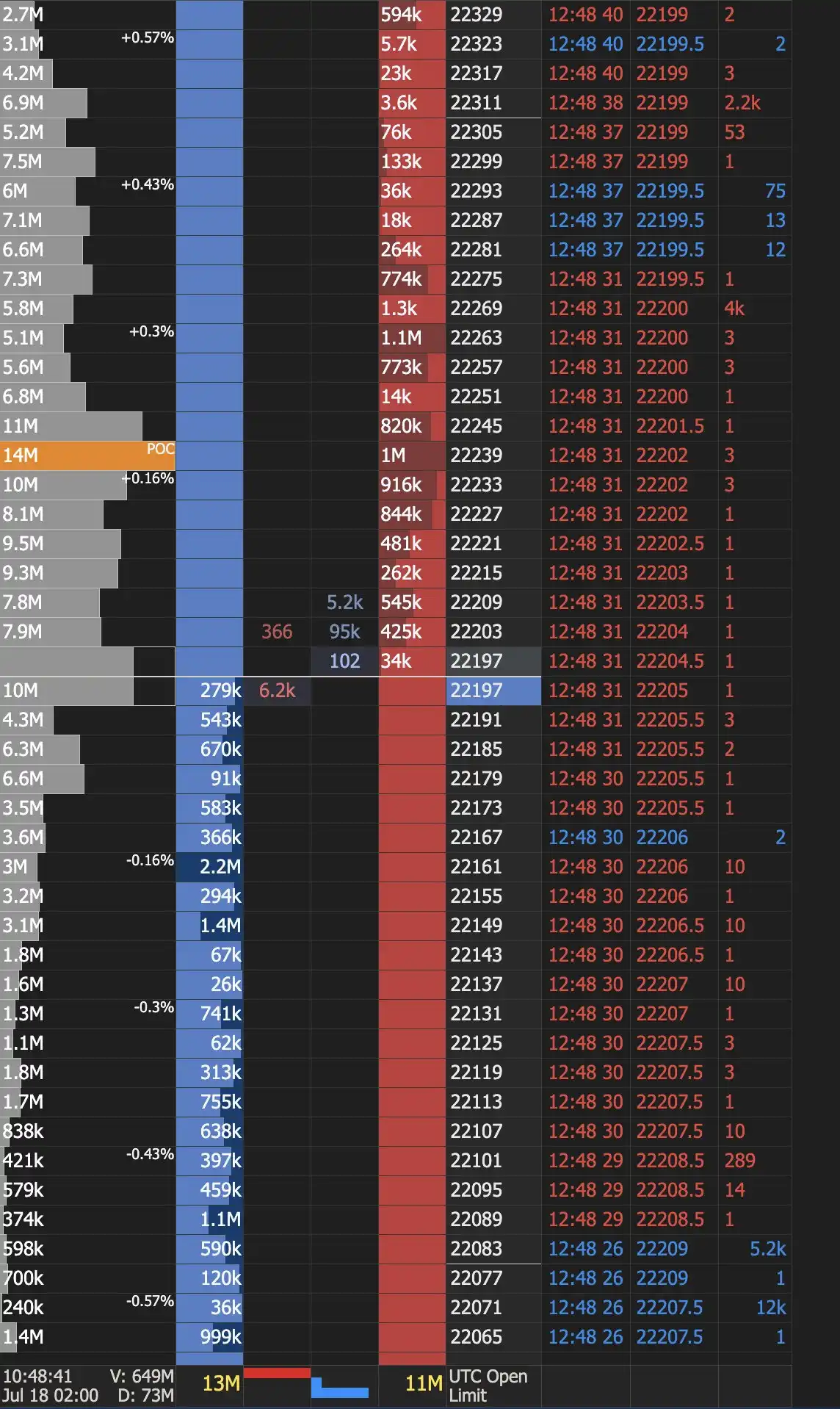
If you look at the market depth of any trading instrument, you will see bids and offers on the bid and ask sides.
As the market depth of popular markets like Bitcoin, E-mini S&P500, Nasdaq, Gold, Crude Oil, or currencies is usually provided by market makers, in most cases, you can easily enter and exit these trades without much difficulty.
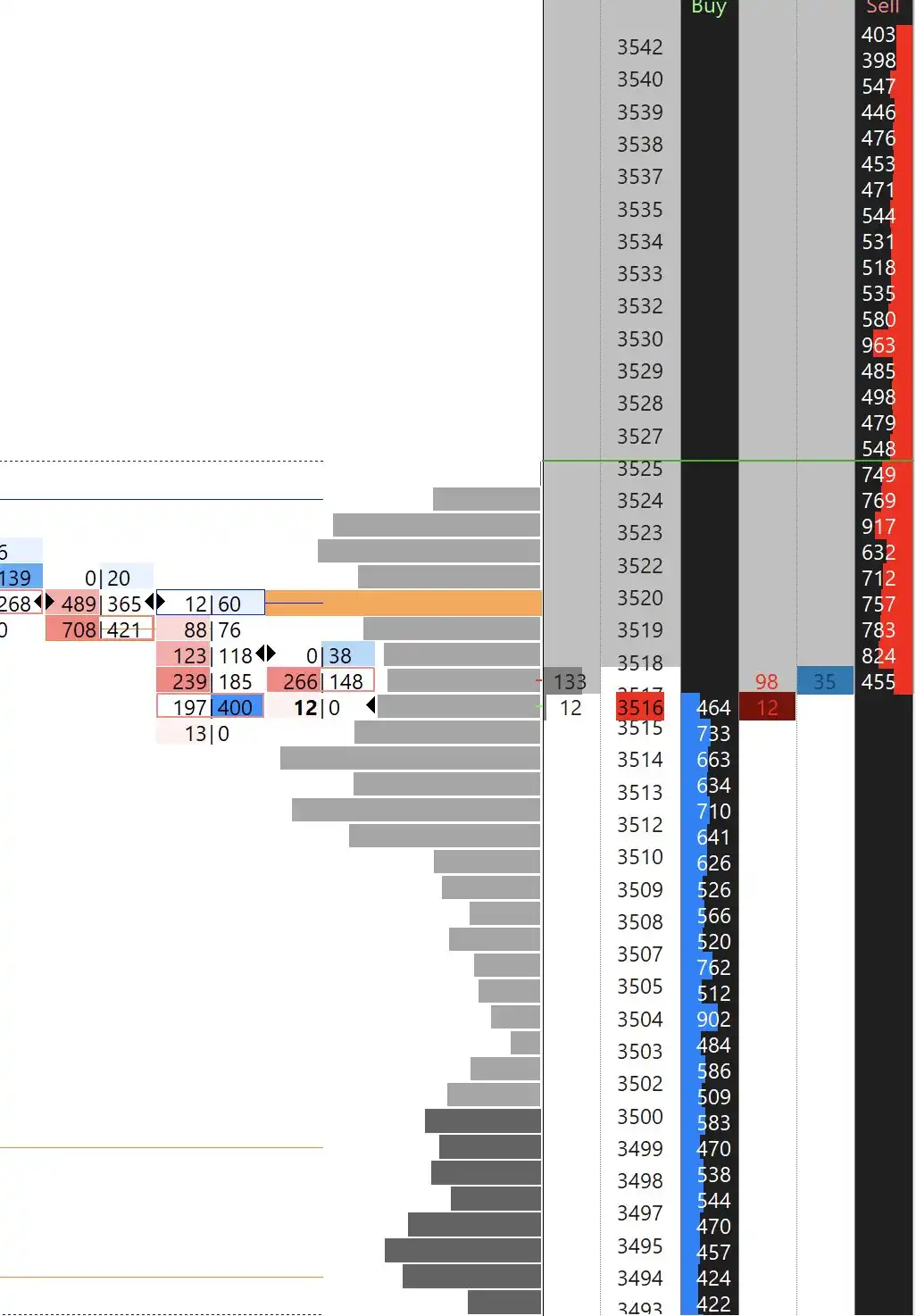
The chart above shows the market depth of the Euro Stoxx 50, which is a popular market traded on the Eurex exchange.
You can see that currently, there are 464 contracts bid at 3516 points and 455 contracts offered at 3517 points.
If you want to enter the market with a long position, you have two options:
1. Market Order: This would result in crossing the spread, and you would immediately enter the trade at 3517 price, while the market is actually trading at 3516, so you would immediately lose 1 tick.
2. Limit Order: You can place a limit order at 3516 points, but if you only place 1 contract, this order will be queued behind, and the market depth will show 467 contracts on the buy side, requiring you to wait for the order to be filled.
If you are only trading 1 contract, in this market, a 1 tick spread means a cost of 10 euros. Many retail traders often overlook this point, and they directly use market orders because they want to enter the trade immediately. And this is where market makers come into play.
The market maker's strategy is called a "delta-neutral strategy." In other words, the market maker does not care about the market's price direction but focuses on providing liquidity on bid/ask quotes and earns profits by collecting the spread.
Because if I use a market order to buy at a price of 3516, and the execution happens at 3517, then someone on the other side is shorting at 3517, immediately making a profit of 1 tick.
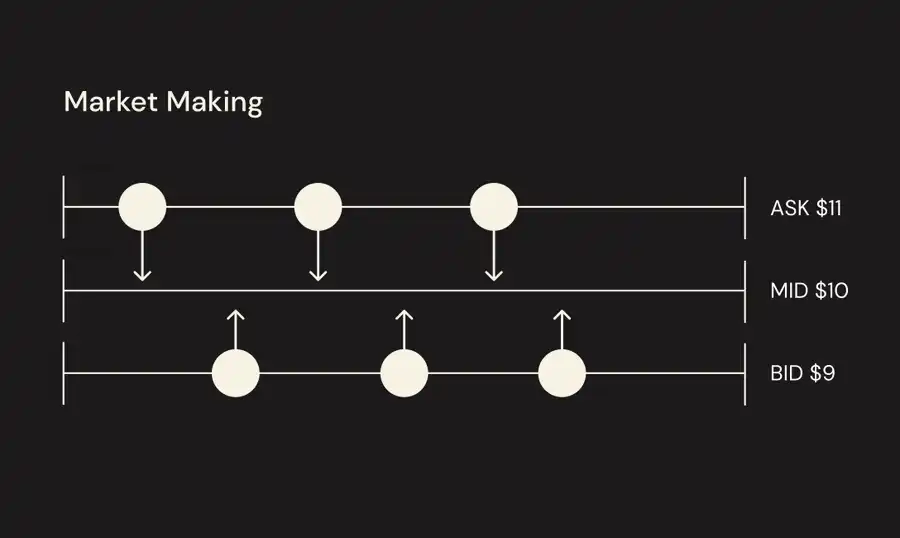
The image above shows a very simplified example of market making.
In this example, the market maker sells 1 contract at a price of 11 dollars, collecting a 1 tick spread, but now he/she holds a short position of 1 contract.
As I mentioned earlier, the market maker's strategy is a delta-neutral strategy. Therefore, the market maker does not want to hold a position in the underlying asset. So now they need to buy 1 contract at a price of 9 dollars to offset the short position and once again earn profit through the spread.
Of course, in the real world, the market may experience rapid fluctuations in a short period, so market makers may accumulate more long or short positions than they actually intend, and they need to manage these positions accordingly.
Today, market makers are usually operated through algorithms, and many companies specialize in market-making.
Of course, there is indeed manipulation in the financial markets. For example, in the forex market, some brokers may widen the spread, while in the cryptocurrency market, many operations rely on "insider information," similar to the stock market.

In the forex market, there are also many manipulative behaviors, such as some brokers engaging in "front running" before customer orders. However, these manipulative behaviors are different from the manipulation that ICT/SMC traders believe, where "someone is constantly triggering stop losses every day."
Liquidity and Order Flow
Order Flow
When it comes to ICT and SMC, the terms "liquidity" and "order flow" are frequently mentioned.
First and foremost, it is important to clarify that this strategy is entirely based on price action. SMC traders do not use any Level 2 data or other order flow tools, apart from pure price action. So when you hear them refer to "order flow," they are simply referring to the market's liquidity direction or overall trend.

This is not the true meaning of order flow. While it may appear in the vocabulary of ICT/SMC traders, overall, "real order flow" refers to what I previously showed, the DOM (Depth of Market).
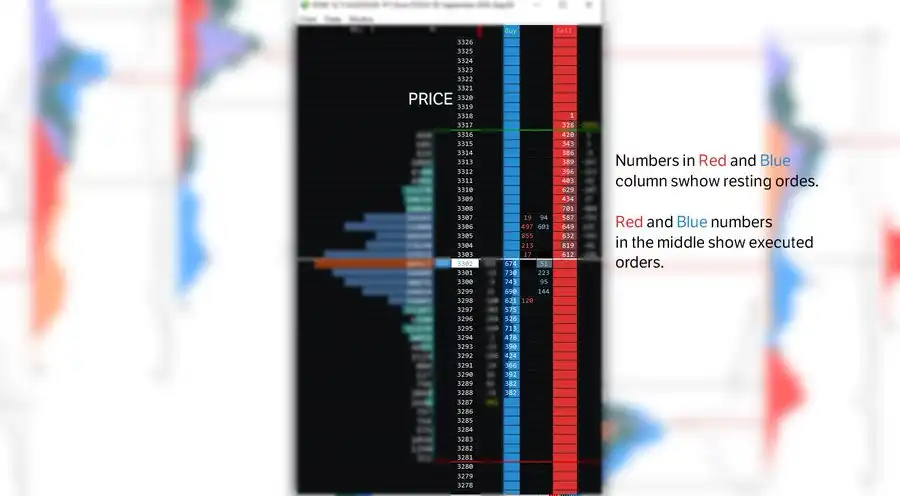
Order flow examines the relationship between limit orders (liquidity) and market orders. It is the most raw form of price action that you can observe in the market.
The purpose of this article is not to explain the unique relationship between limit orders and market orders; I have already covered this in my article on order flow trading.
For the purposes of this article, you should understand that order flow is the most granular view of the market, where traders can extract important information from tools such as DOM, Footprint, Time and Sales, among others.
Liquidity
The concept of liquidity plays a key role in ICT/SMC trading.
Liquidity areas are usually located above and below horizontal/diagonal levels.
These areas are where retail traders place their stop losses, which are often exploited by "smart money."
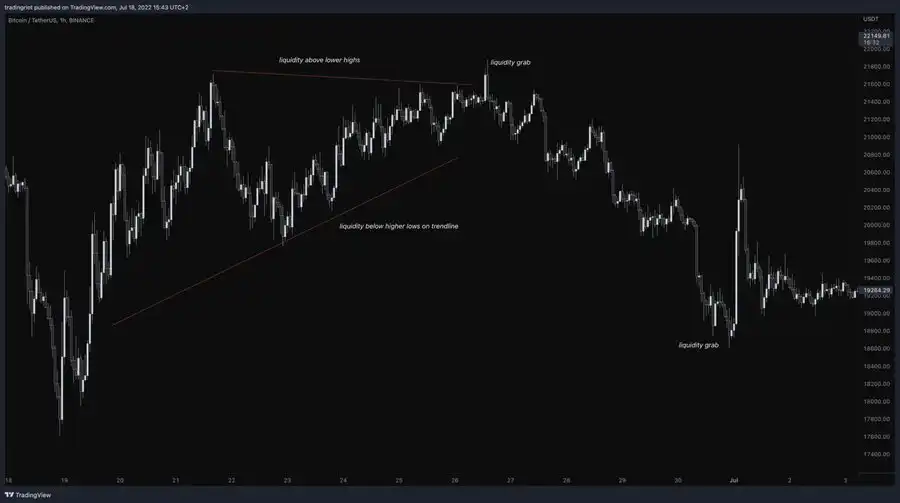
Again, why these price movements occur is actually much more boring than attributing them to some hidden force.
It all comes down to order flow and the interaction of market participants at specific price levels.
Of course, simpler is better. If you are trading with highly subjective strategies like Elliott Waves, Gann Boxes, or others, you will struggle to find price levels with dense market interaction.
However, for those using simple horizontal or diagonal lines, or even common moving averages (50, 100, 200), you will find strong interaction at these levels.
All financial markets operate in a double auction, meaning behind every buyer, there must be a seller, and vice versa. When the market touches a similar level of support/resistance (S/R), it typically triggers two types of events.
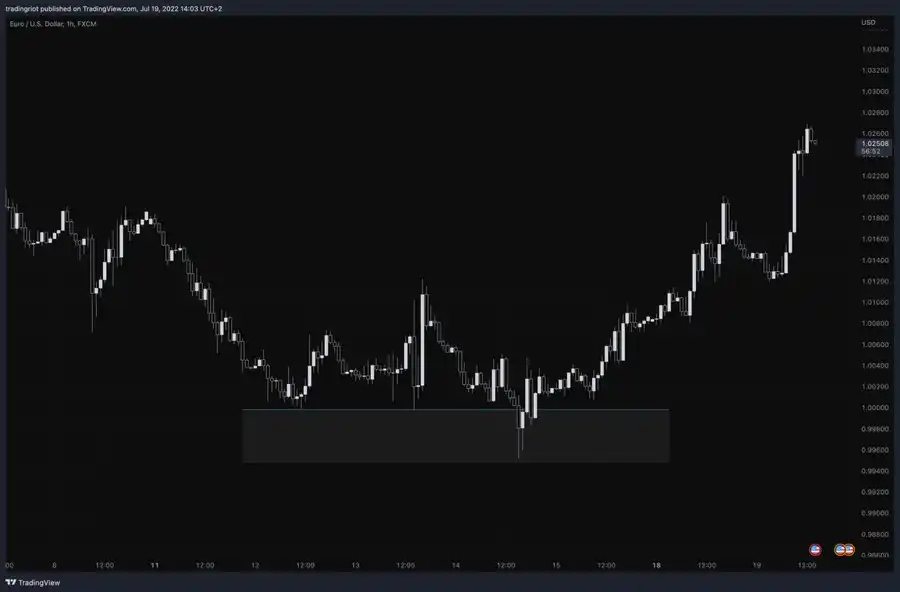
Of course, stop losses are indeed triggered, but in many cases, there are also traders and algorithms attempting to break through that level, pushing the price further.
If you look at the EUR/USD chart above, when the price broke below the support line, it triggered stop-loss orders from long positions, which are sell orders. Additionally, there were new sell orders entering the market, coming from traders attempting trend continuation trades.
Because behind every buyer, there must be a seller (and vice versa), this intense selling pressure creates the perfect environment for large players to enter long positions.
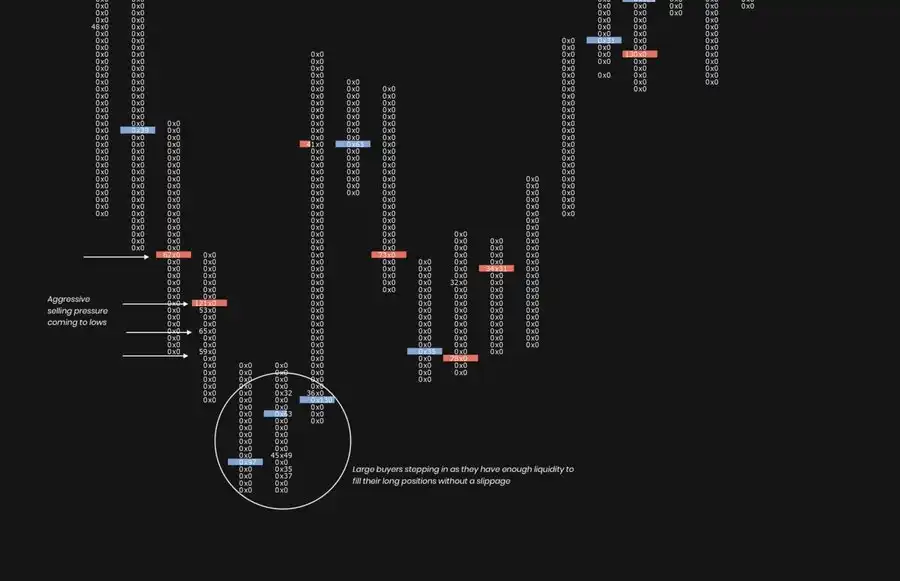
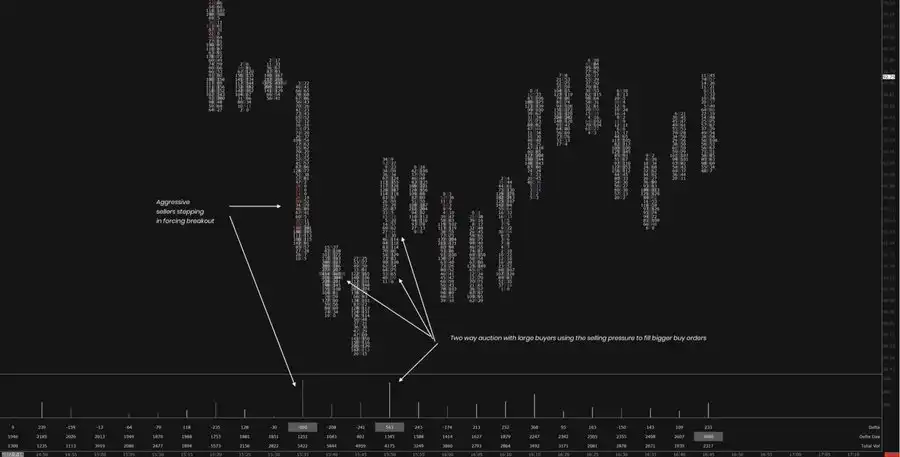
As you can see from the chart above, this is the footprint chart of EUR/USD (6E futures contract), where you can clearly observe this dynamic.
When the price breaks below a low point, selling activity (including stop-losses and new orders flooding in) significantly increases, but once the market reaches the low point, large buying activity suddenly enters and starts filling their long orders.
Why does this happen exactly here?
This goes back to the example of the Euro Stoxx trading DOM mentioned earlier. If you use a market order, you essentially leap over the bid-ask spread, instantly entering at a 1-tick drawdown. In these European futures contracts, trading one contract would make you lose $6.25, which is one tick of that product.
If you are only trading 1-2 contracts, this loss is bearable; but what if you want to buy 100, 500, or even 1000 contracts?
As you can see on the footprint chart, there was a buyer who filled 130 contracts at a single price; if they were to trade only in illiquid areas, they might incur losses within a few ticks due to the bid-ask spread, easily exceeding $1,000.
However, if they are savvy enough to choose to trade in areas with higher market participation, they can execute their order without slippage.
When sellers see their new short positions being absorbed by large buyers and the price no longer dropping, they start covering their positions, which turns the sellers into buyers, driving the price up.
From an order flow perspective, each scenario is different, sometimes with significant limit orders placed above and below, indicating new market participants looking to enter, not stop-loss orders since you cannot see stop-loss orders on the DOM; this is a common misconception among many novice traders.
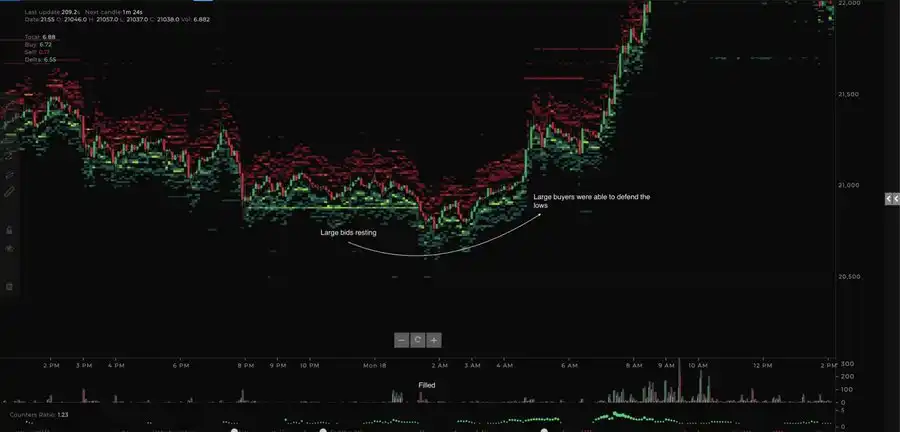
These heatmaps are often the tool of choice for many novice traders, believing them to be the holy grail of trading tools.
I personally don't think so because in many cases, buyers or sellers will place fake orders in the DOM, which they have no intention of executing, just to create chaos.
Once the price starts nearing these large orders, many small traders front-run, only to see these orders canceled at the last moment, causing the market to break through as those placing fake orders have been executing contra orders all along.
I delve deeper into this topic in the article "Market Microstructure," which is a great resource for understanding these market dynamics.
Ultimately, to think that the market is probing just in the horizontal or vertical direction for stop-loss hunting, transitioning from "smart money" to retail traders, is quite laughable.
At these levels, much more is happening than just stop-loss triggers, with stop-loss triggers typically being the smallest part of it.
If you decide to spend more time studying order flow, you will personally witness this; you can join the Tradingriot Bootcamp where all the intricacies of technology and trade execution are explained.
AMD/Power of Three Strategy
I've noticed a very popular pattern often shared online, known as the "Power of Three" or AMD (Accumulation, Manipulation, Distribution).
Initially, it was proposed as a "fakeout" pattern, usually occurring at the London open, breaking out of the limits of the Asian range, but it can also be applied to different time frames.
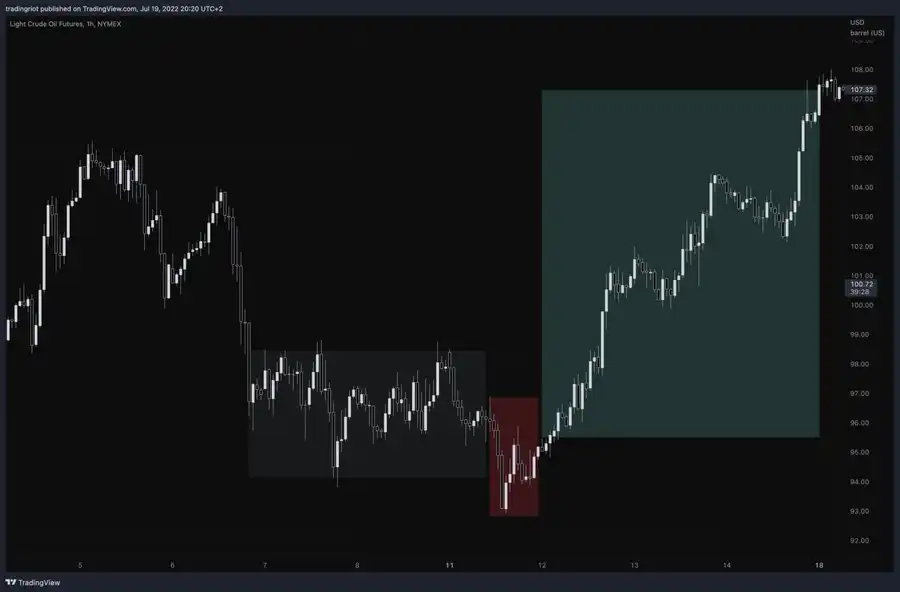
This is a good pattern that is often observable because prices tend to move to the lower liquidity side of the market to see how market participation is, but again, I would not consider it some kind of malevolent manipulation.
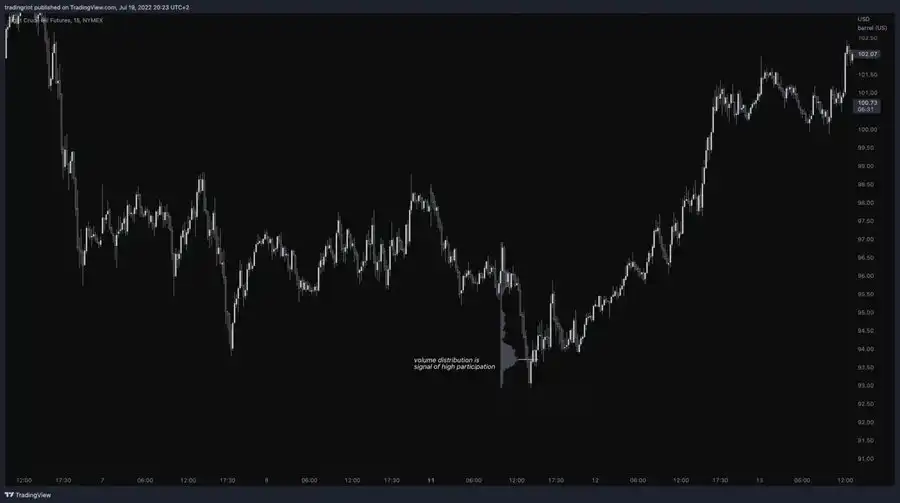
Similar to the previous example, the market usually breaks the previous high/low and triggers stop-loss orders while attracting more participants. When the price quickly rebounds and shows characteristics of a V-shaped reversal, it often means there was not enough time for acceptance at the new price level, which can lead to a "fakeout" and signal a potential reversal.
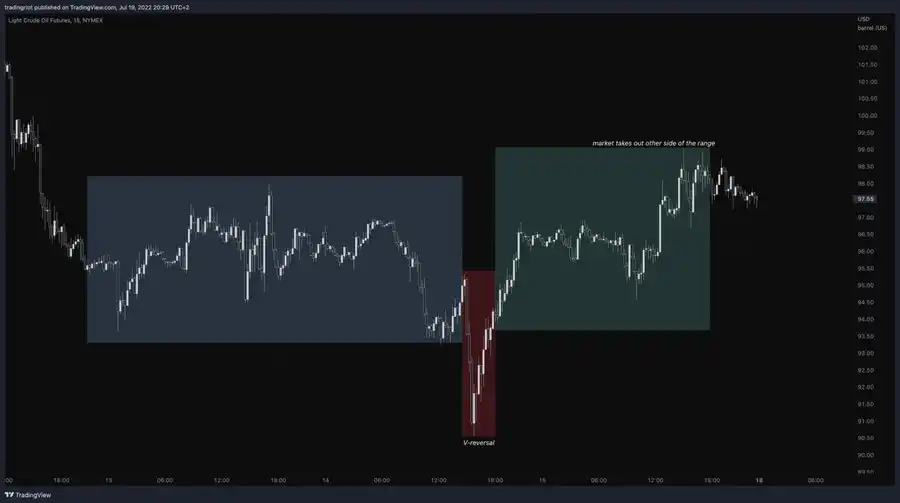
Once again, by carefully observing order flow and market participation at lows, we can find a logical explanation.
Another very popular concept is order blocks, these magical rectangles are used in trend continuation, and once the price touches them, it seems to bounce from these blocks.
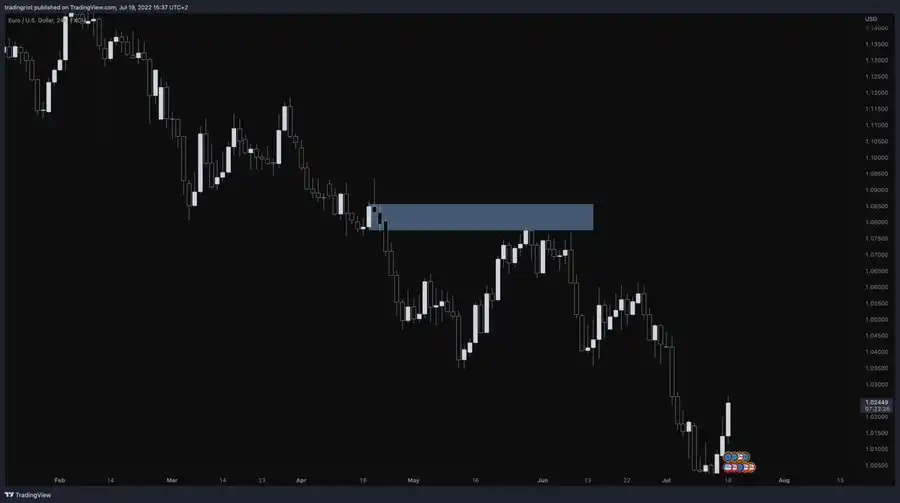
These concepts have had many different names and explanations over the years.
In ICT/SMC terminology, the main point is that these areas are where smart money fills orders. To be honest, this is not entirely wrong, but as always, the smart money/retail trader narrative makes things sound much more mysterious than they actually are.
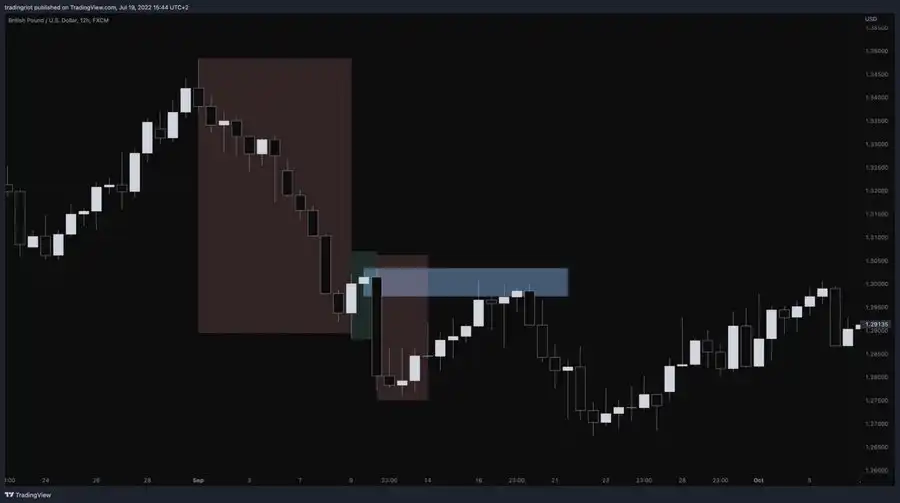
As mentioned earlier, large traders cannot execute their positions arbitrarily; they need to trade in areas with sufficient liquidity and that are favorable to them to avoid additional costs.
If you look at the example above, suppose you want to sell 1000 lots on GBPUSD. Would you sell in the red box area where prices are falling and buyers are scarce, or would you sell in the green box area where prices are rising and there are enough sellers for you?
Of course, the green box area is clearly more meaningful.
You may also like

Do you want to buy CRCL?
Wosh: Inflation has cooled in recent weeks, AI is reshaping the economy, and forward guidance has lost its necessity
The most secretive AI winner
Looking at Stripe's ambitions and the future of stablecoins from OUSD
From Pump.fun to Collector Crypt: Has Solana's income throne changed hands?
Dan Bin's latest speech: Don't miss out on a great era
Robinhood launches its own blockchain, no longer wanting to be a tenant on others' chains
Why Tokenized Stocks Are Booming in 2026 While Crypto Is Still Struggling
Former ByteDance employee's account: How I started with two Pinduoduo hard drives and made six times the profit with Seagate to achieve financial freedom?
MiCA reshuffle begins, Binance temporarily bids farewell to the EU
How does Gate redo "buying and selling stocks" from the cryptocurrency world to the stock market?
Visa and Mastercard join 140 giants to launch a new stablecoin, but the impact on the market landscape may still be limited
Circle CEO responds to OUSD's challenge: Stablecoins are a winner-takes-all business, and we will not slow down
Argentina vs Cape Verde: When a Record-Breaking Legend Meets an Unbreakable Underdog
WEEX exclusive pre-match analysis of Argentina vs Cape Verde, exploring Messi-led Argentina’s dominance and Cape Verde’s historic defensive breakout, with a breakdown of volatility, structure, and match dynamics.
WEEX Launches Depth Chart for Spot Trading
Raising interest rates to protect STRC and selling coins to maintain credit, this time the strategy has chosen the two most expensive paths
Morning Report | Samsung announces a 265.5 trillion won investment plan, focusing on semiconductor and AI computing power data centers; Vitalik publishes an article detailing the entire technology tree behind the confusion protocol (iO) mainline
In the era of AI, what is left of Bitcoin?
Do you want to buy CRCL?
Wosh: Inflation has cooled in recent weeks, AI is reshaping the economy, and forward guidance has lost its necessity
The most secretive AI winner
Looking at Stripe's ambitions and the future of stablecoins from OUSD
From Pump.fun to Collector Crypt: Has Solana's income throne changed hands?
Dan Bin's latest speech: Don't miss out on a great era