
From Aave to Ether.fi: Who Captured the Most Value in the On-Chain Credit System?


Original Title: Why the DeFi Lending Moat is Bigger Than You Think
Original Author: Silvio, Crypto Researcher
Original Translation: Dangdang, Odaily Planet Daily
As the market share of Vaults and Curators in the DeFi world continues to rise, the market is starting to question: Is the lending protocol's profit space being continuously squeezed? Is lending no longer a good business?
However, if we shift our focus back to the entire on-chain credit value chain, the conclusion is quite the opposite. Lending protocols still occupy the strongest moat in this value chain. We can quantify this with data.
On Aave and SparkLend, the interest fees paid by Vaults to the lending protocol actually exceed the income generated by the Vaults themselves. This fact directly challenges the mainstream narrative of "distribution is paramount".
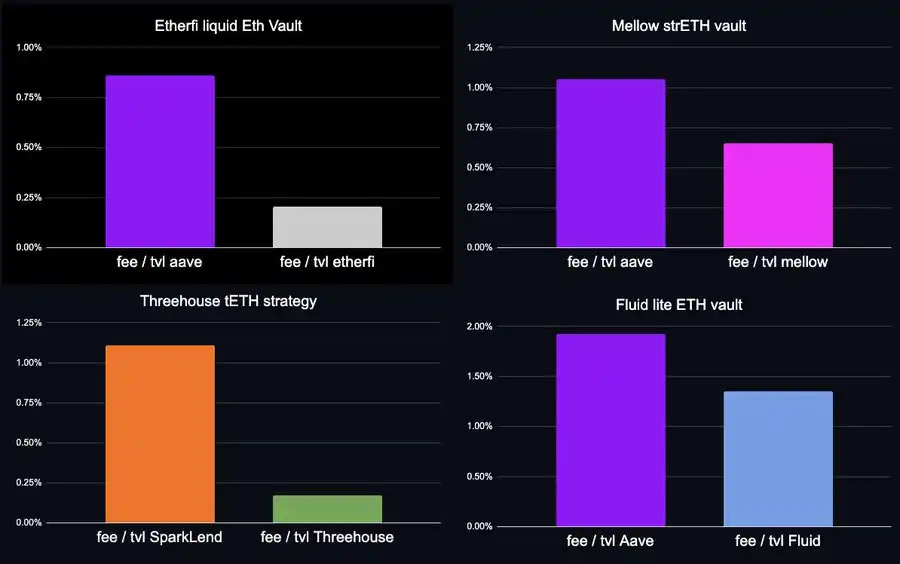
At least in the lending sector, distribution is not king.
In simple terms: Aave not only earns more than various Vaults built on top of it, but also surpasses those asset issuers used for lending, such as Lido and Ether.fi.
To understand the reasons behind this, we need to break down the complete value chain of DeFi lending and, following the flow of funds and fees, reassess the value capture capabilities of each role.
DeFi Lending Value Chain Breakdown
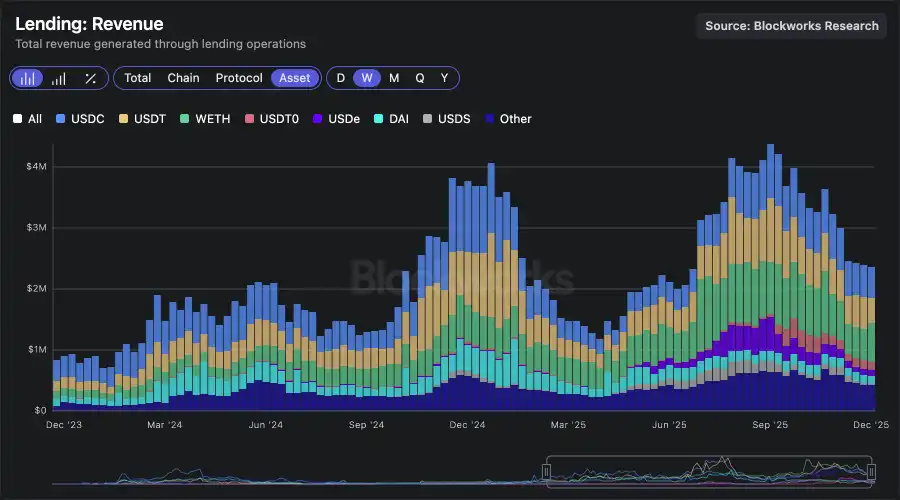
The total annual revenue of the entire lending market has exceeded 100 million US dollars. This part of the value is not generated by a single link, but is composed of a complex stack: the underlying settlement blockchain, asset issuers, fund lenders, the lending protocol itself, and the Vaults responsible for distribution and strategy execution.
In previous articles, we have mentioned that the widespread use cases in the current lending market stem from basis trading and liquidity mining opportunities, and have dissected the key strategic logic behind them.
So, who is really supplying capital in the "real" DeFi lending market?
I analyzed the top 50 wallet addresses on Aave and SparkLend and labeled the major borrowers.
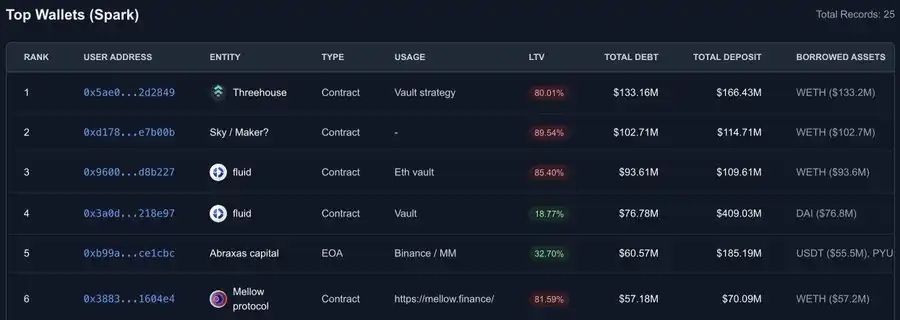
1. The largest borrowers are various types of treasuries and strategy platforms such as Fluid, Treehouse, Mellow, Ether.fi, Lido (also asset issuers). They have distribution capabilities to end users, helping users earn higher yields without having to manage complex strategies and risks themselves.
2. There are also large institutional funders like Abraxas Capital deploying external capital into similar strategies, with their economic model fundamentally akin to treasuries.
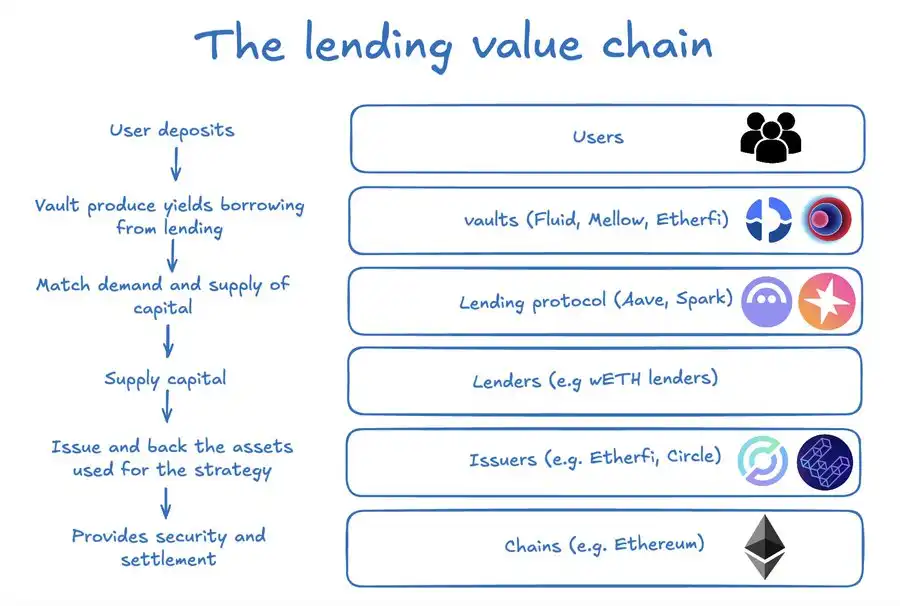
But treasuries are not the whole picture. In this chain, there are at least the following types of participants:
· Users: Deposit assets, seeking additional yield through treasuries or strategy managers
· Lending Protocol: Provides infrastructure and liquidity matching, earns interest from the borrowing side, and takes a certain percentage as protocol revenue
· Lenders: Capital providers, could be ordinary users or other treasuries
· Asset Issuers: Most on-chain lending assets are backed by underlying assets that generate revenue, some of which is captured by the issuer
· Blockchain Network: The underlying "railroad tracks" where all activities take place
Lending Protocols Earn More Than Downstream Treasuries
Take Ether.fi's ETH liquidity collateral treasury as an example. It is the second-largest borrower on Aave with an outstanding loan size of around 15 billion USD. The strategy itself is very typical:
· Deposit weETH (approx. +2.9%)
· Borrow wETH (approx. -2%)
· Treasury charges a 0.5% platform management fee on TVL
In Ether.fi's total TVL, approximately $215 million is actual net liquidity deployed on Aave. This portion of TVL generates approximately $1.07 million in platform fee revenue for the treasury annually.
However, at the same time, the strategy incurs approximately $4.5 million in interest cost to Aave annually (calculation: $1.5 billion borrowings × 2% borrowing APY × 15% reserve factor).
Even in one of the largest and most successful loop strategies in DeFi, the value captured by the lending protocol is still several times that of the treasury.
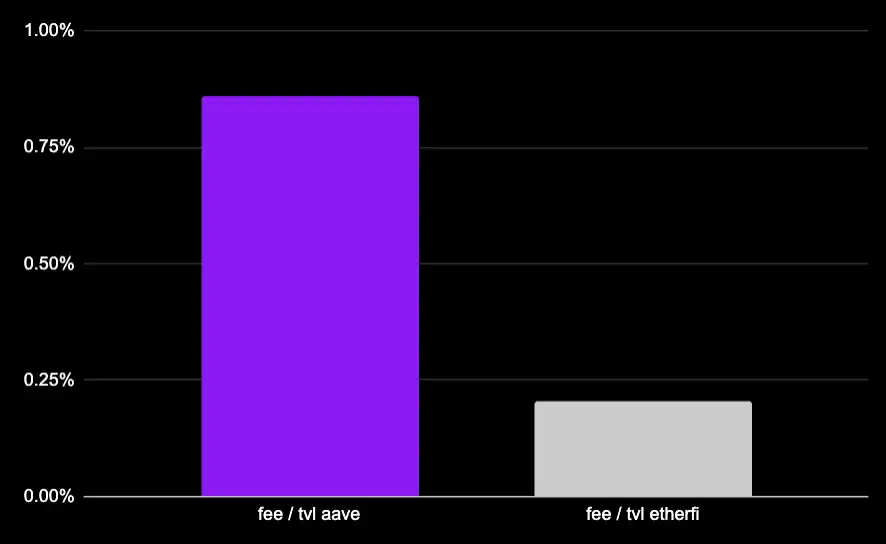
Of course, Ether.fi is also the issuer of weETH, and the treasury itself directly creates demand for weETH.
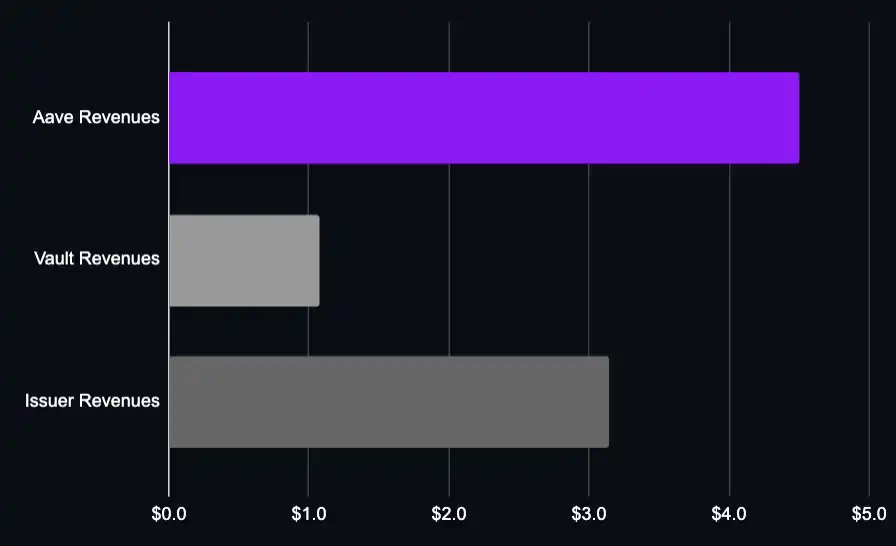
But even considering treasury strategy revenue + asset issuer revenue together, the economic value created by the lending layer (Aave) is still greater.
In other words, the lending protocol is the most value-enhancing part of the entire stack.
We can perform a similar analysis on other commonly used treasuries:
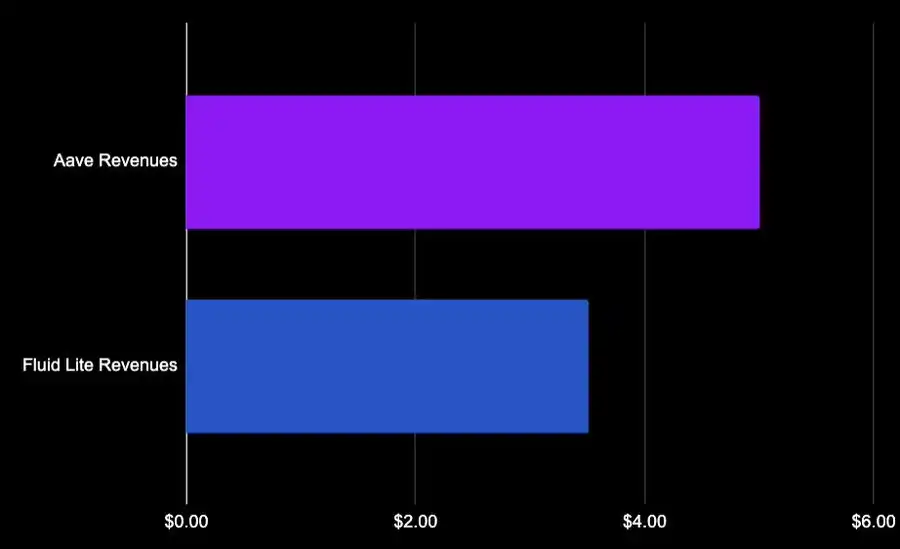
Fluid Lite ETH: 20% performance fee + 0.05% exit fee, no platform management fee. Borrowed $1.7 billion wETH from Aave, paid approximately $33 million in interest, of which about $5 million goes to Aave, Fluid's own revenue is close to $4 million.
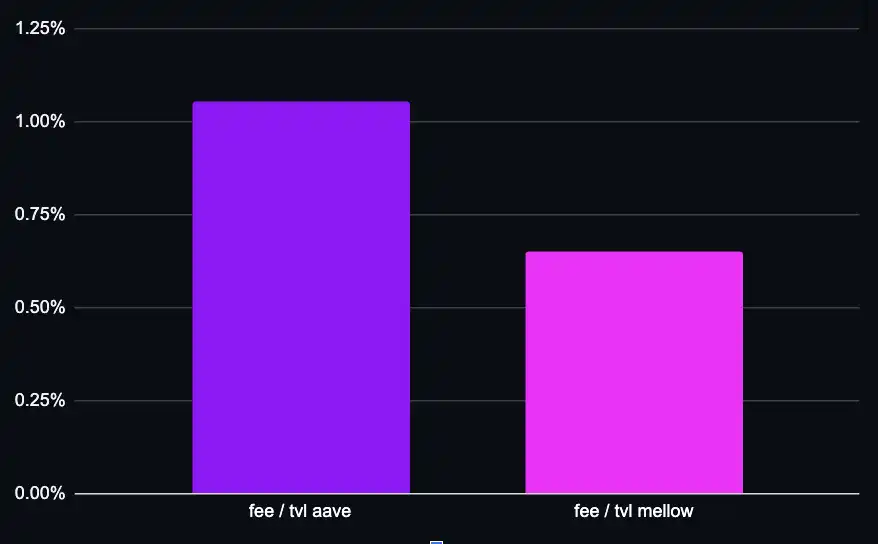
Mellow protocol charges a 10% performance fee on strETH, borrowing volume of $165 million, TVL only about $37 million. Once again, we see that in terms of TVL, the value captured by Aave exceeds that of the treasury itself.
Let's look at another example: in SparkLend, the second-ranked lending protocol on Ethereum, Treehouse is a key participant, operating an ETH loop strategy:
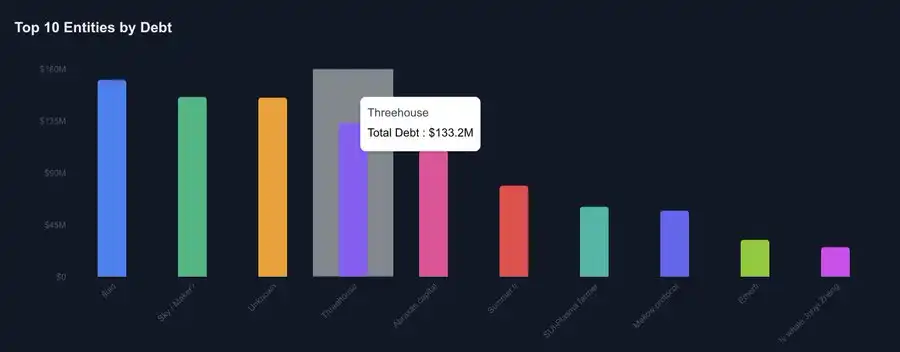
· TVL around 34 million USD
· Borrowing at 133 million USD
· Performance fee charged only on margin yield above 2.6%
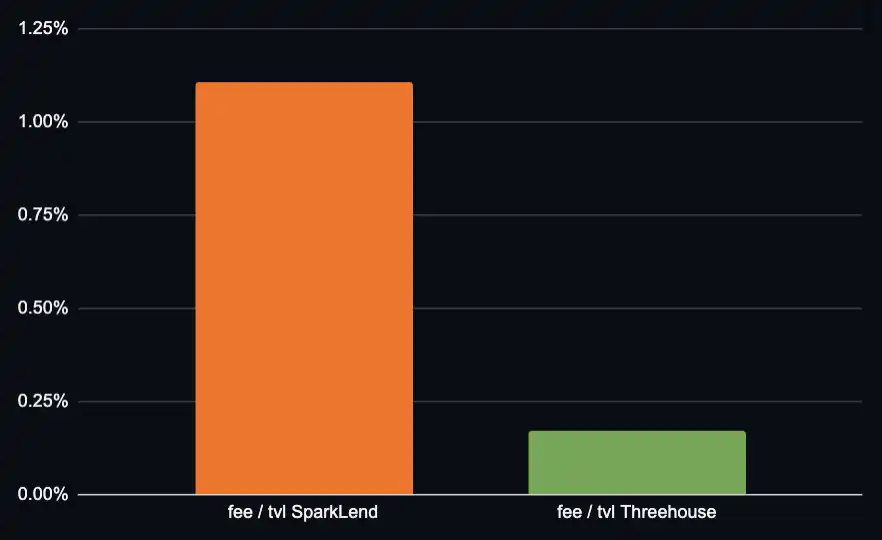
SparkLend, as a lending protocol, has a higher value capture potential in TVL terms compared to the treasury.
The treasury's pricing structure has a significant impact on its own captured value; however, for a lending protocol, its revenue depends more on the nominal size of borrowings, which is relatively stable.
Even with a shift to a dollar-denominated strategy, although the leverage is lower, higher interest rate levels often offset this impact. I do not believe the conclusion will fundamentally change.
In a relatively closed market, more value may flow to the curator, such as the Stakehouse Prime Vault (26% performance fee with incentives provided by Morpho). However, this is not the final state of the Morpho pricing mechanism, as the curator itself is also collaborating with other platforms for distribution.
Lending Protocol vs Asset Issuer
So, the question is: Is it better to be with Aave or with Lido?
This question is more complicated than comparing treasury models because the staked assets not only generate their own yield but also indirectly create stablecoin interest income for the protocol through the lending market. We can only make rough estimates.
Lido has about 44.2 billion USD in assets in the Ethereum core market, used to support lending positions, with an annualized performance fee income of about 11 million USD.
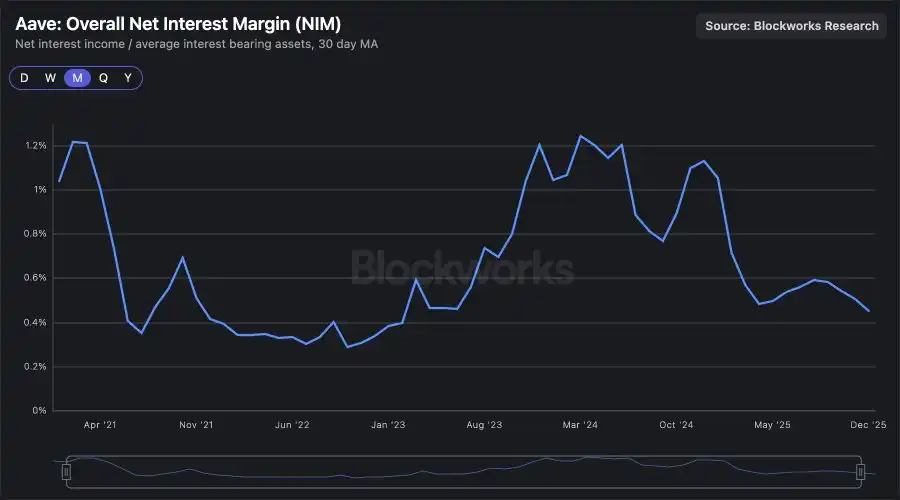
These positions roughly equally support ETH and stablecoin borrowing. Calculated with the current net interest margin (NIM) of about 0.4%, the corresponding lending revenue is about 17 million USD, which is already significantly higher than Lido's direct revenue (and this is at a historically low NIM level).
The True Moat of a Lending Protocol
If we were to compare using only the traditional financial deposit profit model, the DeFi lending protocol would seem to be a low-profit industry. However, that comparison overlooks where the true moat lies.
In an on-chain credit system, the value captured by lending protocols surpasses the downstream distribution layer and also, in aggregate, exceeds the upstream asset issuer.
Seen in isolation, lending may seem like a low-margin business; however, placed within the complete credit stack, it is actually the layer with the strongest value capture capability relative to all other participants—the custodian, issuer, distribution channels.
You may also like

Morning Report | CoinEx becomes a key hub for Iran to evade sanctions, involving over $3.8 billion in funds; Kalshi seeks a new round of financing, with a valuation potentially rising to $40 billion

From the white-haired stock god to the billionaire fund mogul, the smart people shorting Nvidia are all getting rich using the same framework

Why do cryptocurrency projects always like to change their names?

Global Launch: As predictions become the most scarce asset in the AI era, Manadia is defining the next generation of the value internet

Who is footing the bill for the $64 billion accounting frenzy?
I never expected that the first application of AI x Crypto would be in security auditing

What is your view on Binance's competitive advantages?

ETH has entered a non-consensus phase, and the turning point is approaching!
The shift in the cloud of the air: from despising stablecoins a year ago to the high-profile entry of capital today
The survival dilemma of small and medium exchanges behind the withdrawal anomalies exposed by AscendEX

Why Is Bitcoin Falling Below $60K? 5 Key Market Drivers Explained
Bitcoin has dropped sharply amid ETF outflows, Strategy stock weakness, AI stock rallies, and changing Fed expectations. Explore the key forces driving BTC’s latest correction and what traders should watch next.

Bitcoin vs. Gold in 2026: Which Asset Performs Better in Different Markets?

Morning News | The draft amendment to the People's Bank of China Law aims to clarify the legal status of digital renminbi; South Korea will transfer about 40 unregistered virtual asset service providers to law enforcement agencies
The cryptocurrency industry has entered the "Show Me" era: merely relying on vision is no longer enough

Interpreting the Ethereum Foundation's new structure: Reaffirming self-sovereignty amid institutional trends
Former SpaceX engineer reconstructs the financial execution system using first principles
Standard Chartered Bank sings a 50x rhapsody again, aiming for AAVE to reach 3500 USD

Tidal Investment: We still have a positive outlook on the AI industry chain, but the reasons have changed
Morning Report | CoinEx becomes a key hub for Iran to evade sanctions, involving over $3.8 billion in funds; Kalshi seeks a new round of financing, with a valuation potentially rising to $40 billion
From the white-haired stock god to the billionaire fund mogul, the smart people shorting Nvidia are all getting rich using the same framework
Why do cryptocurrency projects always like to change their names?
Global Launch: As predictions become the most scarce asset in the AI era, Manadia is defining the next generation of the value internet
Who is footing the bill for the $64 billion accounting frenzy?
I never expected that the first application of AI x Crypto would be in security auditing


