
 Buy Crypto
- Markets
 Futures
- Spot
- Copy Trade
- Earn
- More
Cross-chain Collaboration: Tom Lee Invests $200 Million, Joins Forces with Global Top Streamer Mr. Beast


Original Title: "Global Top Streamer MrBeast, Becomes a Trump Card for Tom Lee"
Original Author: Seed.eth, Reposted by BitpushNews
$200 million, that's the figure just announced today.
BitMine Immersion Technologies (BMNR), chaired by Wall Street's renowned analyst Tom Lee, announced an investment to acquire a stake in the holding company behind global top streamer MrBeast, known as Beast Industries. Simultaneously, Beast Industries mentioned in an official statement that the company will explore how to "integrate DeFi into the upcoming financial services platform."
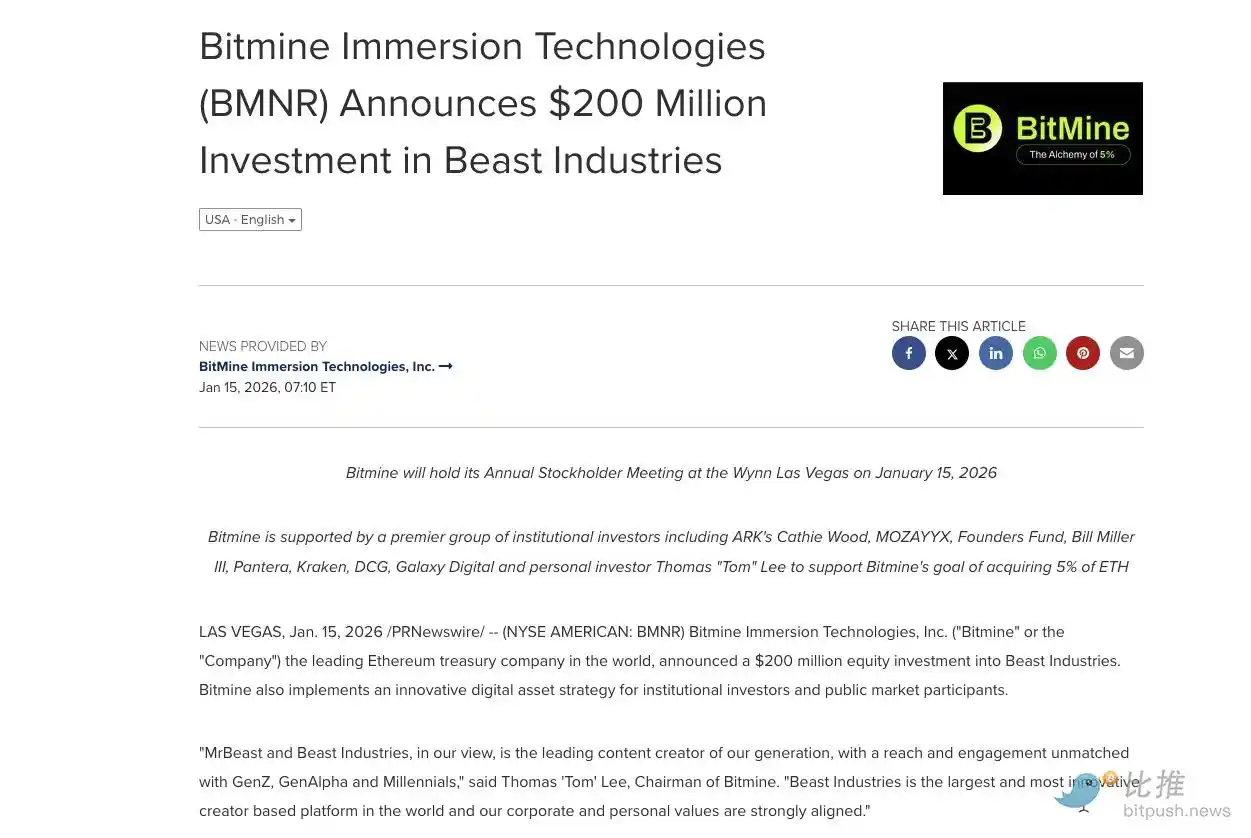
If you only read the news, this seems like another familiar cross-over: traditional, crypto, influencer, entrepreneurship. On one side, you have the YouTube powerhouse with over 4 billion cumulative subscriptions, where a single video can organically tip the algorithm in your favor. On the other side, you have the top stream analyst on Wall Street who excels in narrating the crypto story, adept at weaving blockchain's grand concepts into a balance sheet, making everything seem natural.

MrBeast's Journey Here
Looking back at MrBeast's early videos, it's hard to connect them to today's $5 billion valued Beast Industries.
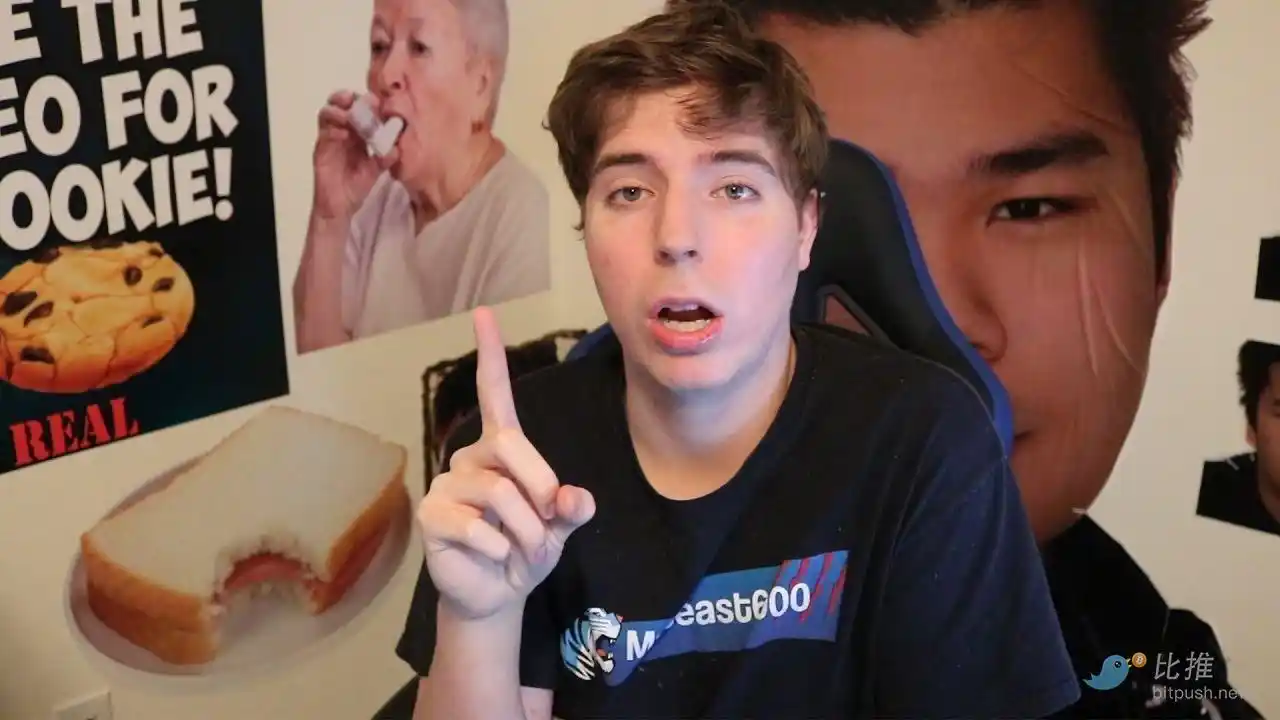
In 2017, shortly after graduating from high school, Jimmy Donaldson uploaded a video of himself counting from 1 to 100,000 consecutively for 44 hours - the "Counting to 100,000 Challenge!" The content was so simple to the point of being almost childish, with no plot, no edits, just one person facing the camera, repeating numbers over and over, yet it became the turning point of his content career.
At that time, he was not yet 19 years old, with channel subscriptions of only about 13,000. After the video was released, it quickly surpassed a million views, becoming the world's first phenomenal case of dissemination.
Later, in an interview, he recalled that time and said:
"I didn't actually want to be popular at the time; I just wanted to know if I was willing to devote all my time to something that no one else wanted to do, would the result be different."
Jimmy Donaldson successfully rose to fame, becoming the well-known MrBeast. But more importantly, from that moment on, he formed an almost obsessive belief: attention is not a gifted reward but something earned through effort and perseverance.
Running YouTube as a Business, Not a Creation Platform
Many creators, after gaining popularity, choose to "play it safe": reduce risk, increase efficiency, and turn content into a stable cash flow.
MrBeast chose the opposite path.
In multiple interviews, he repeatedly emphasized one thing:
"Most of the money I make is put into the next video."
This is the core of his business model.
By 2024, his main channel's subscriber count had exceeded 460 million, with total video views surpassing 100 billion. But behind this success is extremely high cost:
- The production cost of a single flagship video has been consistently between $3-5 million annually;
- Certain large-scale challenges or charity projects can cost over $10 million;
- His show "Beast Games" on Amazon Prime Video, he described the first season as "completely out of control" and admitted in interviews that it incurred losses of tens of millions of dollars.
When he made these statements, he showed no remorse:
"At this level, you can't save money and still expect to win."
This statement can almost be seen as the key to understanding Beast Industries.
Beast Industries: $4 Billion Annual Revenue, but Thin Profits
By 2024, MrBeast consolidated all his businesses under the name Beast Industries.
From publicly available information, this company has far exceeded the scope of a "creator's side hustle":
- Annual revenue exceeding $4 billion;
- Business spanning content production, fast-moving consumer goods retail, licensed merchandise, and tool products;
- After the latest round of funding, the market generally expects its valuation to be around $5 billion.
But it's far from easy.
MrBeast's YouTube main channel and Beast Games brought great exposure, but almost ate up all the profits.
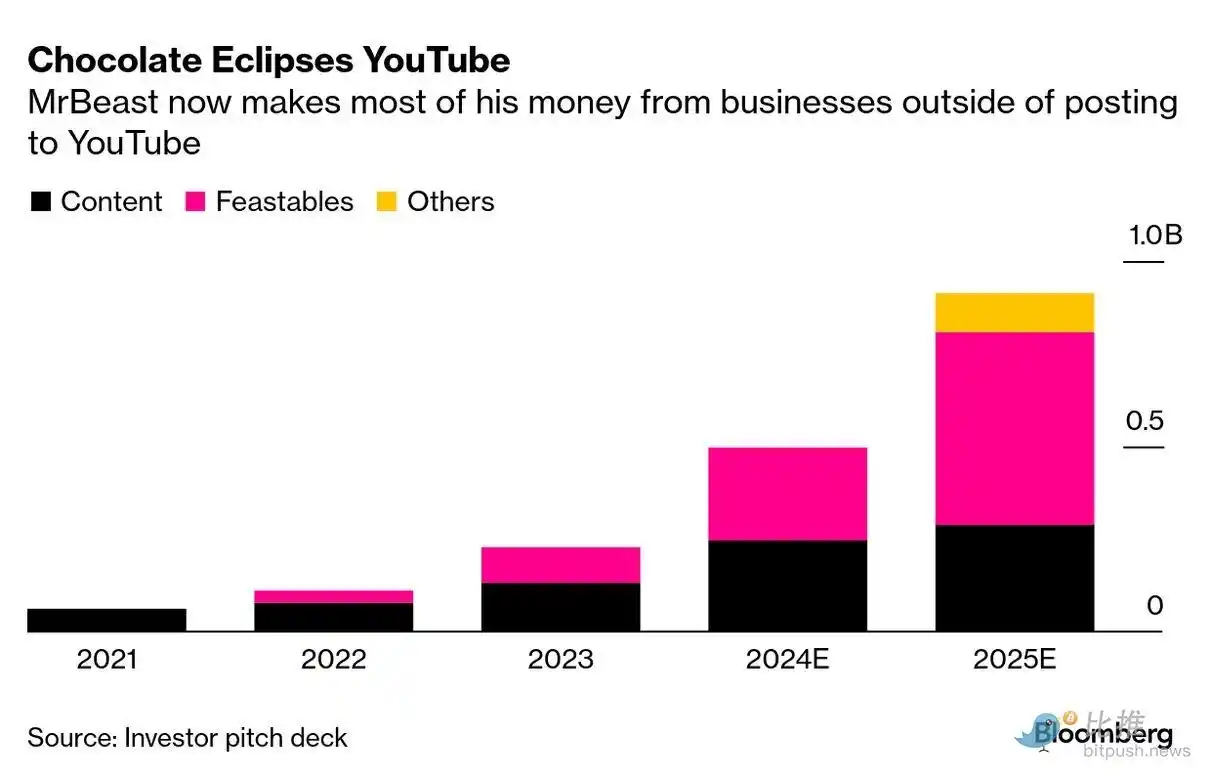
In stark contrast to the content is his chocolate brand, Feastables. Public data shows that in 2024 Feastables had sales of around $250 million, contributing over $20 million in profit. This marked Beast Industries' first stable, replicable cash flow business. By the end of 2025, Feastables had entered over 30,000 physical retail stores in North America (including Walmart, Target, 7-Eleven, etc.), covering the United States, Canada, and Mexico, significantly enhancing the brand's offline sales capabilities.
MrBeast has admitted on several occasions that the cost of video production is increasing, making it "increasingly hard to break even." However, he still insists on investing a large amount of funds into content production, as he sees it not simply as paying for videos but as buying traffic for the entire business ecosystem.
The core barrier of the chocolate business is not production but the ability to reach consumers. While other brands need to spend a fortune on advertising exposure, he just needs to release a video. Whether the video itself is profitable is no longer important. As long as Feastables continue to sell, this business loop will continue to operate.
“I'm Actually a Pauper”
In early 2026, MrBeast self-proclaimed himself a pauper in an interview with The Wall Street Journal, sparking discussions:
“I'm basically in a 'negative cash' state right now. They all say I'm a billionaire, but there's not much money in my bank account.”

This statement is not for show but a natural result of his business model.
MrBeast's wealth is highly concentrated in unlisted equity; although holding slightly over 50% of Beast Industries' shares, the company continues to expand with almost no dividends; he even deliberately avoids keeping cash.
In June 2025, he confessed on social media that because he had put all his savings into video production, he even had to borrow money from his mother to pay for the wedding.
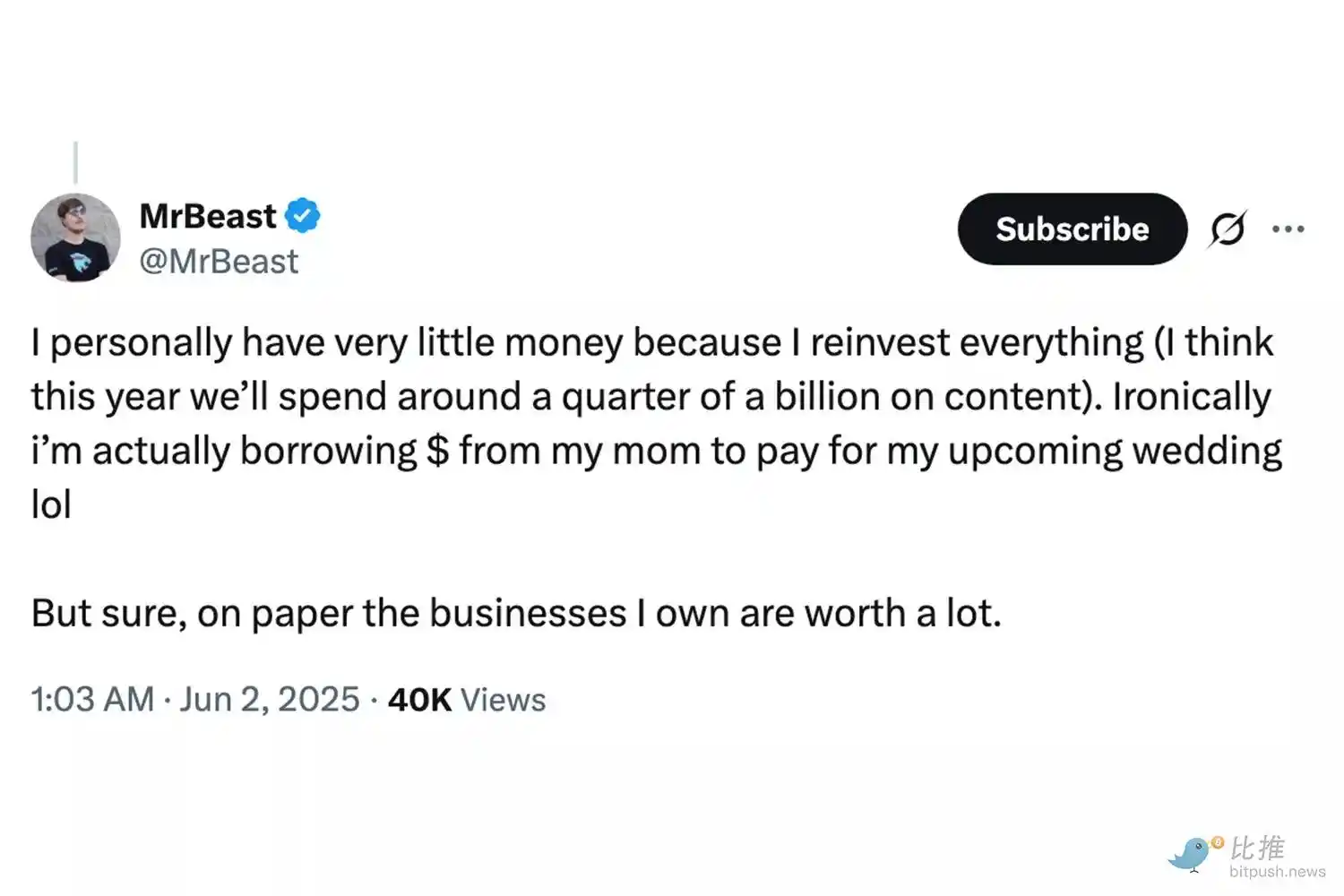
As he later put it more bluntly:
“I don’t look at my bank account balance — it would affect my decision-making.”
And his foray extended beyond content and consumer goods.
In fact, during the NFT boom of 2021, blockchain records show that he had bought and traded multiple CryptoPunks, some of which were sold for a price as high as 120 ETH each (equivalent to hundreds of thousands of dollars at the time).
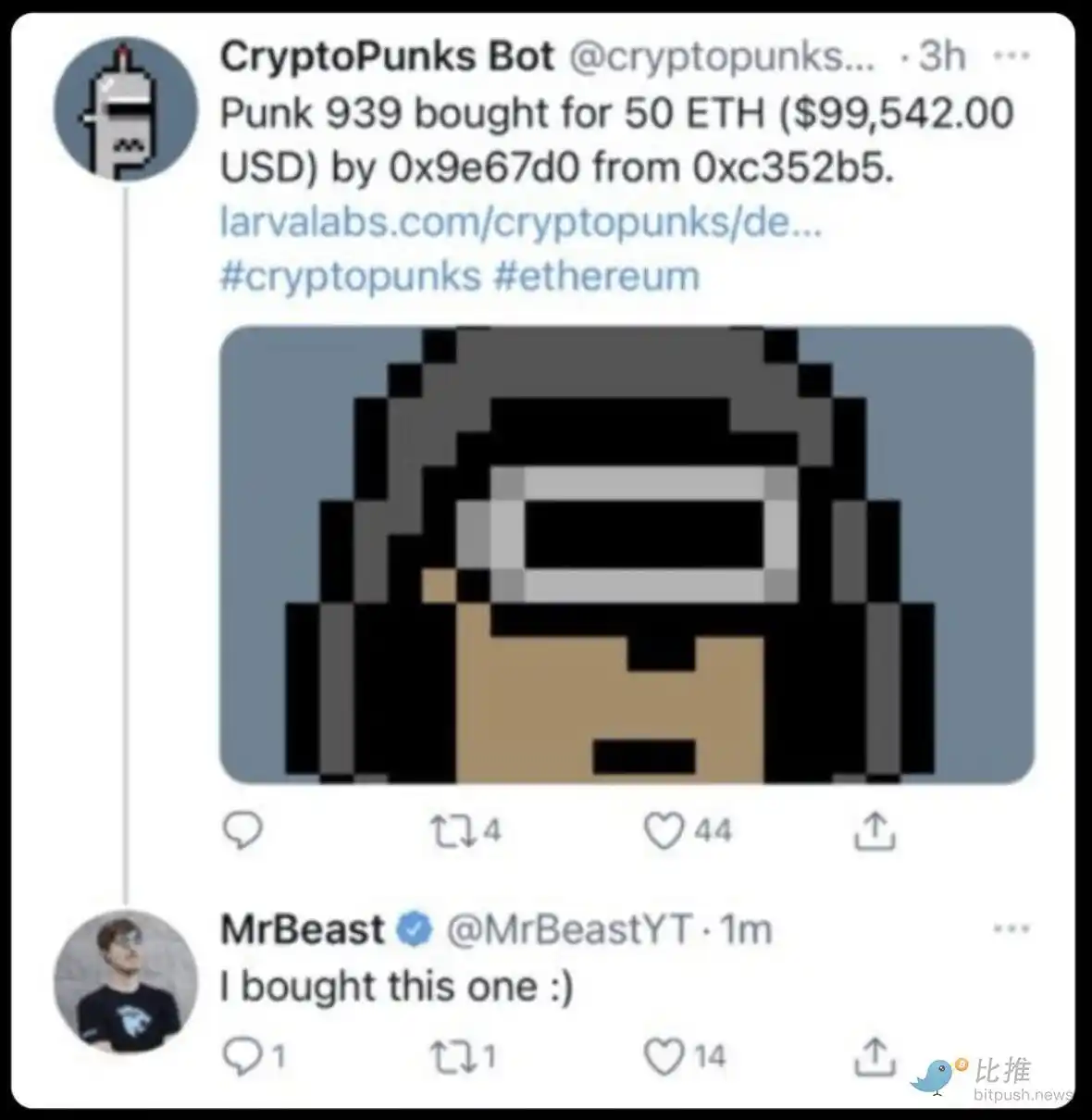
However, as the market entered a correction phase, his attitude shifted to caution.
The real turning point came when “Mr. Beast” himself found his business model reaching a critical juncture.
When one person holds the world’s top traffic funnel but has been in a prolonged state of high expenditure, cash flow strain, and expansion reliant on financing, finance stops being just an investment option and becomes a must-restructure infrastructure.
The proposition that Beast Industries internally debated in recent years gradually became clear: how to transform users from mere “content viewers and product buyers” to participants in a long-term, stable, and sustainable economic relationship?
This was precisely the direction that traditional internet platforms had been trying for years: payment systems, accounts, credit systems. And at this juncture, with the emergence of Tom Lee and BitMine Immersion (BMNR), this path led to a more structured possibility.
Teaming Up with Tom Lee to Build the Underlying DEFI
In Wall Street, Tom Lee has always played the role of a “narrative architect.” From early on explaining the value proposition of Bitcoin to emphasizing Ethereum’s strategic significance on a corporate balance sheet, he excels at translating technology trends into financial language. BMNR’s investment in Beast Industries is not a pursuit of internet celebrity hype but a bet on the programmable future of attention gateways.
So, what does DeFi mean in this context?
Current public information is extremely restrained: no issuance of a coin, no yield promises, and no fan-exclusive financial products. But the expression “integrating DeFi into a financial services platform” points to several possibilities:
- A lower-cost payment and settlement layer;
- A programmable account system for creators and fans;
- Asset record and ownership structure based on decentralized mechanisms.
The imaginative space is vast, but the challenges of reality are also clear. In the current market, whether it is a native DeFi project or a traditional institution exploring transformation, most have not yet truly established a sustainable model. If a differentiated path cannot be found in this intense competition, the complexity of financial operations may erode the core capital accumulated over many years: fan loyalty and trust. After all, he has publicly stated many times:
"If one day what I do harms the audience, then I would rather do nothing."
This statement may be repeatedly tested in every future financial attempt.
So, when the world's most powerful attention machine seriously begins to build financial infrastructure, will it become a new generation platform, or an "overly brave" cross-border move?
The answer will not be revealed quickly.
But one thing he understands better than anyone else: the greatest capital is not past glory, but the right to "start over."
After all, he is only 27 years old.
You may also like

6MV Founder: In 2026, the "landmark turning point" for crypto investment has arrived

Abraxas Capital Mints $2.89 Billion USDT: Liquidity Boost or Just More Stablecoin Arbitrage?
Abraxas Capital just received $2.89 billion in freshly minted USDT from Tether. Is this a bullish liquidity injection for crypto markets, or is it business as usual for a stablecoin arbitrage giant? We analyze the data and the likely impact on Bitcoin, altcoins, and DeFi.
A VC from the Crypto world said AI is too crazy, and they are very conservative
The Evolutionary History of Contract Algorithms: A Decade of Perpetual Contracts, the Curtain Has Yet to Fall

Kicked out by PayPal, Musk aims to make a comeback in the cryptocurrency market

Solana ETF News: What Is a Solana ETF and Why Is Goldman Sachs Betting $108 Million on SOL?
Solana ETF news today shows Goldman Sachs disclosed a $108M position while total SOL ETF inflows reached $1.45B. Analysts now expect up to $6B in institutional demand as Solana trades 71% below its all-time high.

Bitcoin ETF News Today: $2.1B Inflows Signal Strong Institutional Demand for BTC
Bitcoin ETFs news recorded $2.1B inflows over 8 consecutive days, marking one of the strongest recent accumulation streaks. Here’s what the latest Bitcoin ETF news means for BTC price and whether the $80K breakout level is next.
Michael Saylor: Winter is Over – Is He Right? 5 Key Data Points (2026)
Michael Saylor tweeted yesterday “Winter‘s Over.” It is short. It is bold. And it has the crypto world talking.
But is he right? Or is this just another CEO pumping his bags?
Let us look at the data. Let us be neutral. Let us see if the ice has really melted.

WEEX Bubbles App Now Live Visualizes the Crypto Market at a Glance
WEEX Bubbles is a standalone app designed to help users quickly understand complex crypto market movements through an intuitive bubble visualization.

Polygon co-founder Sandeep: Writing after the chain bridge chain explosion

Major Upgrade on Web: 10+ Advanced Chart Styles for Deeper Market Insights
To deliver more powerful and professional analysis tools, WEEX has rolled out a major upgrade to its web trading charts—now supporting up to 14 advanced chart styles.

Morning Report | Aethir secures a $260 million enterprise contract with Axe Compute; New Fire Technology acquires Avenir Group's trading team; Polymarket's trading volume surpassed by Kalshi

Why a Million-Follower Crypto KOL Chooses WEEX VIP?
Discover why top crypto KOL Carl Moon partnered with WEEX. Explore the WEEX VIP ecosystem, 1,000 BTC protection fund, and exclusive rewards for serious traders.

CoinEx Founder: The Crypto Endgame in My Eyes

Spark Coin (SPK): Explodes 73% as Aave Bleeds $15B, A Good Investment Now?
Spark coin (SPK) surged 73% as $15 billion fled Aave after the KelpDAO hack. This article explains what Spark is, why it’s pumping, and whether it is a good investment right now.

As Aave's building collapses, Spark's high-rise is rising

RootData: Q1 2026 Cryptocurrency Exchange Transparency Research Report

What Is Memecoin Trading? A Beginner's Guide to How It Works, the Risks, and 2026's Hottest Tokens
Memecoins surged 30%+ at the start of 2026 while Bitcoin was flat. RAVE spiked 4,500% then crashed 90% in days. MAGA jumped 350% overnight. This guide explains exactly how memecoin trading works — and how to not blow up your account doing it.
6MV Founder: In 2026, the "landmark turning point" for crypto investment has arrived
Abraxas Capital Mints $2.89 Billion USDT: Liquidity Boost or Just More Stablecoin Arbitrage?
Abraxas Capital just received $2.89 billion in freshly minted USDT from Tether. Is this a bullish liquidity injection for crypto markets, or is it business as usual for a stablecoin arbitrage giant? We analyze the data and the likely impact on Bitcoin, altcoins, and DeFi.
A VC from the Crypto world said AI is too crazy, and they are very conservative
The Evolutionary History of Contract Algorithms: A Decade of Perpetual Contracts, the Curtain Has Yet to Fall
Kicked out by PayPal, Musk aims to make a comeback in the cryptocurrency market
Solana ETF News: What Is a Solana ETF and Why Is Goldman Sachs Betting $108 Million on SOL?
Solana ETF news today shows Goldman Sachs disclosed a $108M position while total SOL ETF inflows reached $1.45B. Analysts now expect up to $6B in institutional demand as Solana trades 71% below its all-time high.





 App
App