
Conversation with Solana Foundation Chairperson Lily: AI Agent, Memecoin, and Collaboration with the US Government

Original Title: "Interview with Solana Foundation Chair Lily Liu: Building the Blockchain Ecosystem Is Like Climbing the Babel Tower"
Interviewee: Lily Liu, Chair of the Solana Foundation
Interviewer, Author: Anderson Sima, Executive Editor of Foresight News
If we were to conduct a background check on the entrepreneurs in the Web3 world, we would easily find that the founders of the top-tier ecosystems and projects are mostly immigrants. Ethereum's founder Vitalik Buterin is of Russian descent, Binance's founder Changpeng Zhao is of Chinese descent, and the world's richest person focused on the crypto field, Elon Musk, is of South African descent.
University of California scholar AnnaLee Saxenian once used a concept to describe these immigrants—the "New Argonauts"; in Greek mythology, the Argonauts refer to a group of heroes who set sail on the ship "Argo" to embark on a quest for the Golden Fleece. Saxenian borrowed this metaphor to describe modern technology immigrants. They leave their homeland for the "land of adventure," acquire valuable knowledge, skills, and resources, and then return to their homeland with the "Golden Fleece" to drive local innovation and technological advancement.
Solana, which has experienced multiple near-death experiences, is no exception. One of the two founders, Anatoly Yakovenko, has Ukrainian roots, while Raj Gokal hails from India, and Lily Liu, who is in charge of the Solana Foundation, is also of Chinese descent.
Lily, whose ancestral home is Changsha, Hunan, with the Chinese name Yuanli Liu, had parents who left the mainland for Taiwan in 1949 and settled there as first-generation immigrants after studying in the United States. Lily was born in the U.S. and still carries the cultural symbol of a "spicy girl"; this comes from the steam rising from her grandparents' cooking during her childhood, quietly accompanying her as she grew up. After graduating from Stanford University, Lily entered the workforce and returned to the mainland, where she gained years of work experience in Beijing, Shanghai, and other places. By a stroke of luck, she began to explore Bitcoin and blockchain technology in 2013. In 2021, at the invitation of Solana founders Anatoly Yakovenko and Raj Gokal, she officially joined Solana and took charge of foundation affairs.

At the beginning of 2025, Foresight News conducted an exclusive interview with Lily. In her view, the existing Solana ecosystem is not solely focused on a specific type of application innovation like Memecoins. Solana's ambition is to become a global emerging financial infrastructure, which explains why the community is flocking to the Solana ecosystem amidst the Memecoin craze. Faced with this "sky-high traffic," the Solana team remains exceptionally calm and restrained.
Here is the full content with some reduction:
Foresight News: As of 2024, what important progress has Solana made?
Lily: From any metric, in 2024 our ecosystem has seen significant growth. Whether it's transaction volume, user count, or total value locked, all show strong upward trends. Around September or October last year, we surpassed Ethereum in some key metrics. One is the blockchain's economic value capture, which we surpassed Ethereum in October. Moreover, if you look at application layer revenues, we also surpassed Ethereum. Also, according to the recent developer report, which annually provides a detailed breakdown of developer numbers by region, starting from last July, our developer community has been the fastest growing.
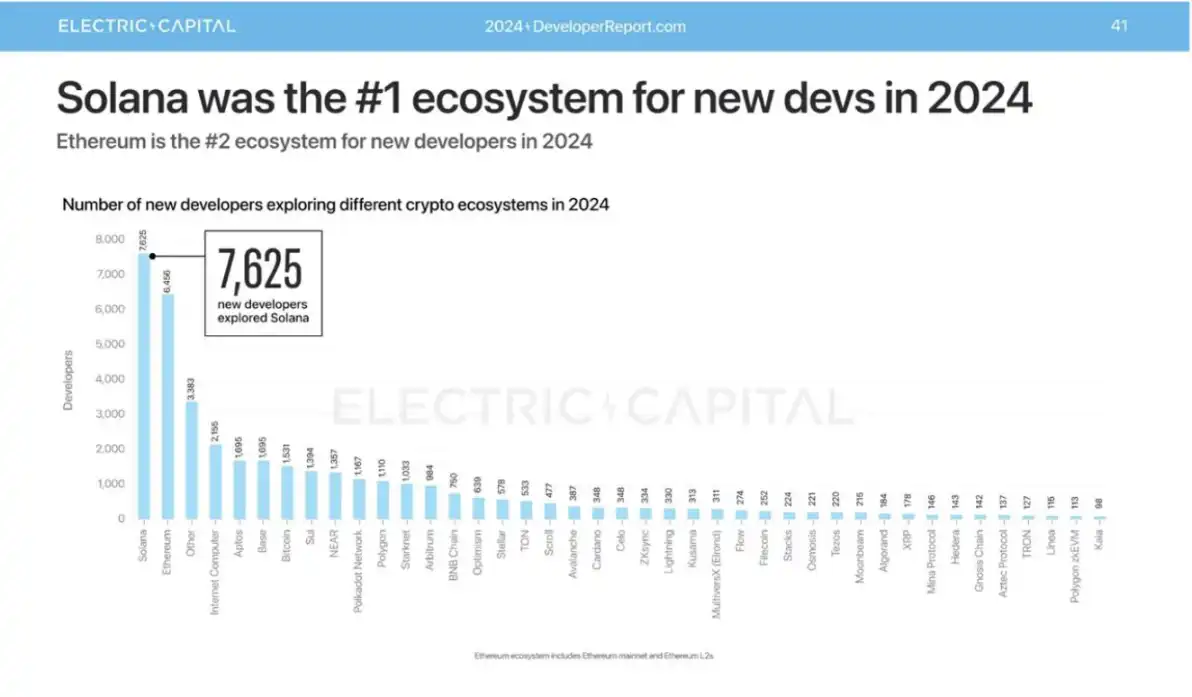
Ethereum may currently have around 20,000 developers who have been working on smart contracts since 2015, starting early. We now have around 7,500 developers, and although we started 5 years later than Ethereum, our growth rate is also very rapid.
From this data, it is evident that our blockchain ecosystem has become very rich and valuable, attracting more developers and community participants. The main goal of application development is to attract users and build profitable products, thus forming a virtuous cycle.
In 2024, based on these metrics, Solana achieved historical highs in various data points.
Foresight News: If you had to summarize Solana's 2024 performance in one keyword, what would it be?
Lily: It would not be Memecoin. (laughs)
Foresight News: What are the key focuses for Solana in 2025?
Lily: In fact, we have several internal plans. We have a framework for blockchain growth, akin to a three-tier architecture. The most foundational layer is the blockchain itself, which is the cornerstone of the entire ecosystem, like land; without the blockchain, developers and users cannot operate.
The second layer is the Application layer, which requires a developer community to build applications. This is akin to having land and houses; you also need people to develop and operate them to form a socio-economic system.
The third layer is the "City" layer. The ecosystem needs to be built into successful cities like New York, Hong Kong, and Singapore. On one hand, it requires culture, and on the other hand, it needs a unique economic model. In the development process, there needs to be more innovation in the blockchain network, continuously driving forward in technology. For example, at the network's base layer, our goal is to increase bandwidth and reduce latency.
At the application layer, our focus is on founders, applications, and tokens. In 2017, an industry article mentioned that on the blockchain, most value capture is at the application layer, similar to Facebook and Google in Web2, where significant value was realized in the application layer. In the blockchain industry, this has also formed a viewpoint that we should focus on the development of the second layer.
The core asset of our ecosystem is talent. If we were to use a city as an analogy, New York is New York because it has international talent. Blockchain requires technology, but talent is key. There have been many blockchain projects in the past decade, but only Ethereum and Solana have developed large developer ecosystems because building a successful ecosystem is hundreds of times harder than initiating a project.
We have always focused on developers, but now to create a successful application, a broader range of abilities is required. It's not just developers; you also need talents in product and marketing, among other areas. From the beginning, as described in the Bitcoin whitepaper, blockchain's vision is to achieve individual digital ownership and even community ownership, differing from the current ownership models of companies or nations, opening up possibilities for new ownership models.
To realize the vision of blockchain, several conditions are required: a high-performance network, a developer community, and sufficient assets along with a reasonable way to utilize them. At the application layer, we aim to establish a sound economic system, focusing on on-chain assets.
Moreover, to build a good blockchain ecosystem, besides hard power, we also need "soft power," such as culture. If we were to explain why New York has a unique culture and atmosphere, it's because of a certain intangible feeling. Constructing a city requires both hardware and software; here, the software includes the culture between people. Places like Abu Dhabi and Dubai, while constantly developing hardware facilities in the past 20-30 years, also attracted cultural institutions like the Louvre Museum to establish cultural appeal.
If we think deeper, we hope to establish a vast economic system on the blockchain to attract assets. To achieve this, we need to implement some things on-chain that cannot be done in a traditional way. So far, the allure of blockchain has mainly been in speculation, but in the long run, an economic system is not just about transactions but also an exchange system. Any economy has a transactional part, but payment is not just about buying and selling transactions; it is an exchange.
Currently, our industry is primarily driven by speculation, such as assets going from $0 to $10, which has given the industry early claims to market value. However, in the long term, we hope to have traditional transaction-focused applications and a larger market focused on payments. We are not just about transactions or payments; our goal is to become a universal platform, much like the internet is not just email or a single application. We aim to attract various assets and provide financial services across the whole asset spectrum.
Foresight News: With Trump about to take office, how does Solana view the new U.S. government's cryptocurrency regulatory measures?
Lily: We are closely monitoring Trump's inauguration. In the past four years, the U.S. government has not been very supportive of blockchain and has even been somewhat against cryptocurrency, but now things have changed. The new government has shown a different level of attention and support for technology. We know that the U.S. has been at the forefront of every round of technological development in Silicon Valley over the past 30 years, and we believe the new government will recognize the support role of blockchain in U.S. strategy. So we are very hopeful and have plans to collaborate with the U.S. government in the future.
Foresight News: Wall Street funds made a significant increase in holding Bitcoin spot ETF in 2024, but the funds did not enter the ecosystem. Under the leadership of the new U.S. government, will more talent and funds enter the cryptocurrency field?
Lily: Yes, each cycle will see more people from different backgrounds interested in and entering the blockchain field. It depends on what the hot application area is in each cycle; it will attract talent and assets from the relevant fields.
In this current cycle, there is a focus on some new application directions, such as on-chain structured products combined with traditional financial structured products, which have a lot of design space. In this regard, some Wall Street talent can participate. We also see some new developments, like Ethena, which is a new stablecoin with its technology and system. Some Wall Street talent can learn from its development and apply some of the designs from traditional finance to the blockchain. This combination will bring about new products and visions, thereby driving ecosystem development.
Foresight News: Vitalik has commented on Solana, stating that he believes Solana lacks decentralization. However, on the other hand, I have seen many projects recently stating that they are planning to move to Solana. How do you view this competitive relationship with Ethereum?
Lily: I have great respect for Ethereum's original team, who had the vision to build Ethereum in 2015 and were able to realize the technology, which was remarkable. They truly focused on decentralization and understood its importance. Last year, Vitalik also wrote an article explaining related principles and vision, which align with the principles and vision of blockchain.
However, Ethereum and the EVM have undergone significant changes. The EVM community has become very extensive, and some metrics and the actual situation no longer match. We cannot continue to view things with past perspectives. Regarding the measure of decentralization, there has been a significant difference from 2020 to now. Many people have an overly simplistic understanding of decentralization, thinking that the more nodes and the more decentralized, the better the chain. In reality, this is not the case.
We have made some technical choices, such as increasing the technical requirements and costs of nodes, roughly twice that of Ethereum (not tenfold). This is to better support products and user experience, and ease the tasks of users and developers. Therefore, some industry views on decentralization are inaccurate and based on outdated information.
Furthermore, some projects focusing on Layer 2 claim to prioritize decentralization but actually operate in a centralized manner, such as using a centralized sequencer, which is logically contradictory.
Foresight News: Regarding the Sui ecosystem and the Base ecosystem, how do you view the relationship between them?
Lily: I know that many developers like the Sui language. We welcome competition because competition will drive us to innovate faster and better. As of now, Sui is a relatively successful ecosystem that focuses on products, with applications, products, and users. We also hope to learn more from them.
Regarding Base, going back to Bitcoin's original vision, it is about community ownership, focusing on individual and community ownership. However, the contradiction of Base lies in the fact that, based on last year's data, most of its network fees have turned into Coinbase's profits, with very little going to the Ethereum mainnet, most of it being kept by Coinbase for themselves.
If calculated on an annualized basis, Coinbase's revenue from Base is close to one billion US dollars. As a company, there is nothing wrong with serving shareholders, but from the original values of blockchain, ownership should belong to individuals and the community. Base primarily represents ownership of the company, which is not in line with the concept of blockchain.
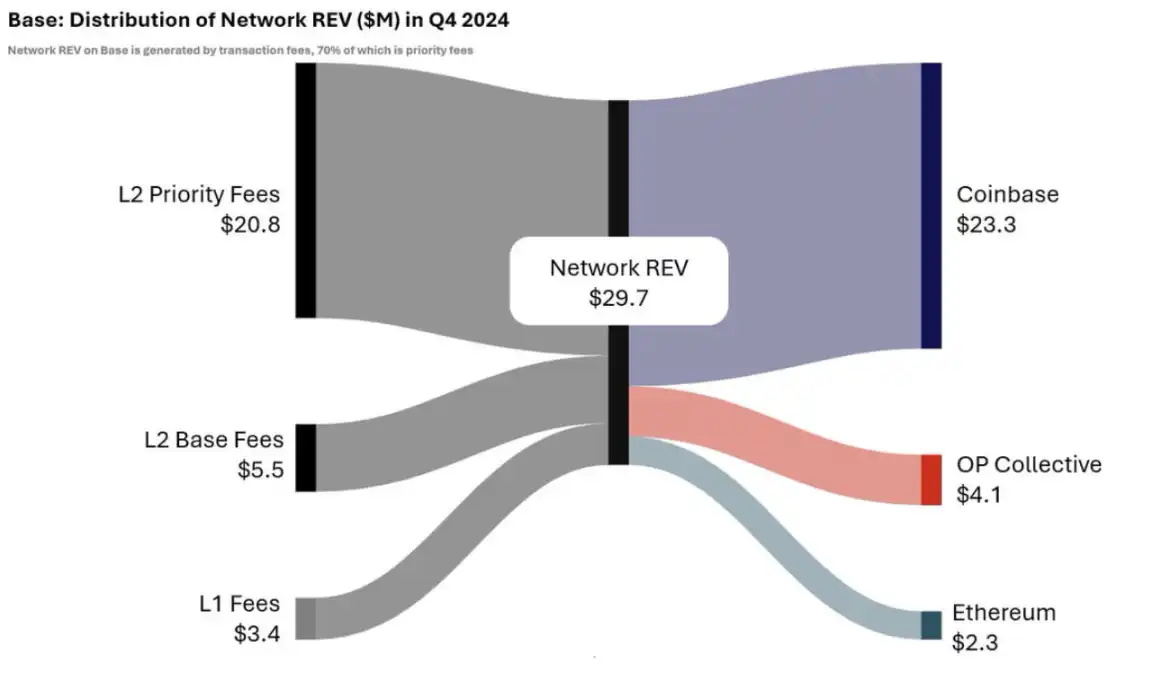
Coinbase 2024 Q4 Revenue Distribution, image source from X
Foresight News: The two hottest sectors in 2024 are Memecoin and AI Agent. What is your view on these two sectors?
Lily: In my opinion, Memecoin is a type of asset. Every cycle has different technological trends, such as NFTs, blockchain games, DeFi, and so on, but they all have one thing in common, which is the need for traffic. Where there is traffic, people will choose to go.
When I joined Solana, the community believed that Solana was an NFT chain, later viewing it as a DeFi chain, and now everyone jokingly calls it a "Meme chain." In fact, we never defined ourselves as an ecosystem serving only one track. We hope to become a general platform.
Many AI technology projects are now choosing to launch coins on Solana because of its high performance, speed, low fees, and most importantly, traffic can be found on Solana. Pricing can only be determined with traffic.
Just as no one says Ethereum is a chain focused on just one track, because Ethereum was originally intended to be a universal computer. After several years of development, we have also become a general platform.
Foresight News: AI + Crypto, what are your thoughts?
Lily: I think any new technology goes through a "Gartner Hype Cycle" (technology maturity curve). Each technology experiences a period of rapid growth upon discovery, followed by a trough, then a rise, and finally enters stable development. The blockchain field also develops in this way. It used to be NFTs, now it's Memes and AI. They will exist in the long run, but will all go through this process.
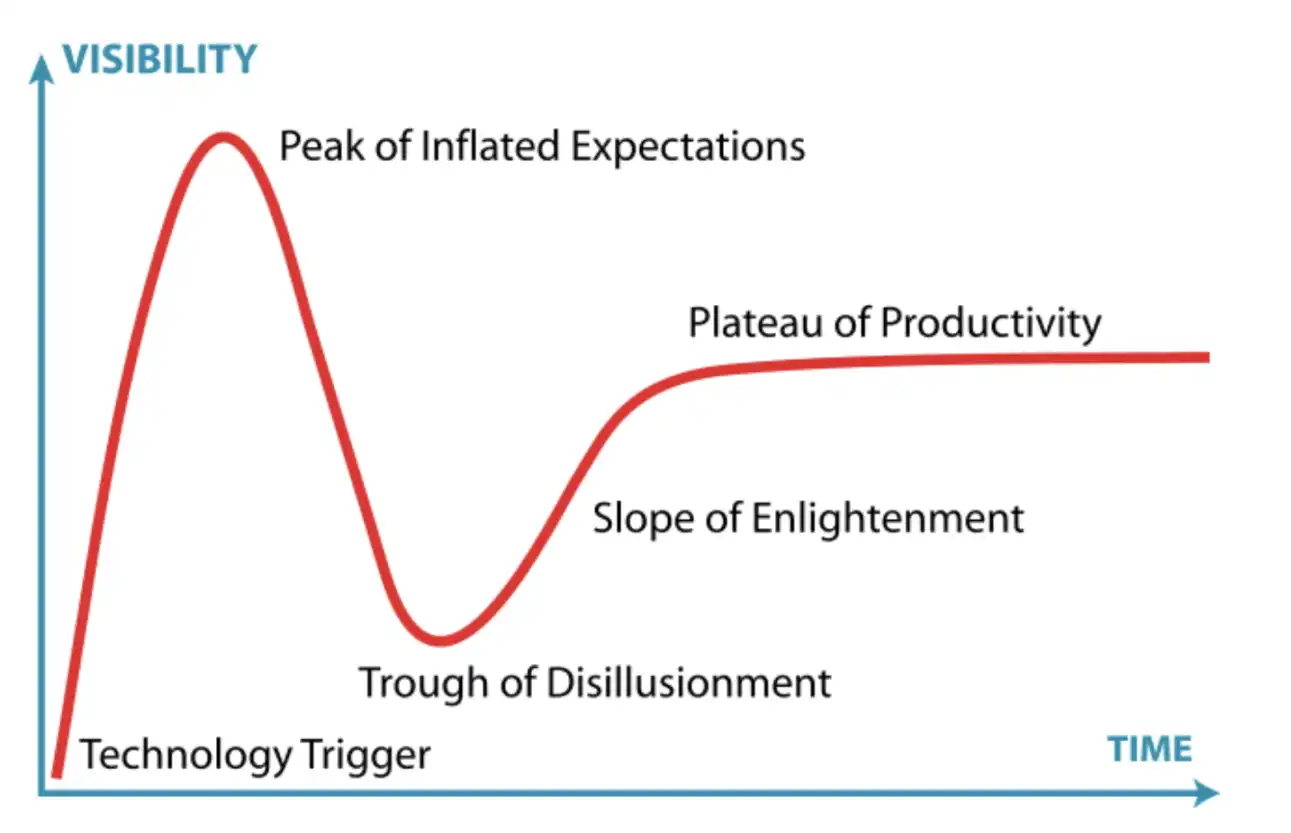
Technology Maturity Curve, Image Source Wikipedia
I believe AI is currently in the first stage. It has seen tremendous growth, will have long-term utility, but may be subject to hype. In fact, many innovative concepts were discussed a decade ago, such as AI+ trading, and now some applications are starting to realize these concepts.
Foresight News: Now, let's specifically discuss the Solana ecosystem. Recently, Backpack Exchange acquired the derivative brand license of FTX Europe. Did the Solana Foundation participate in and play a role in this?
Lily: Not at all. To be honest, you mentioning this news is how I learned about it from you. I should go congratulate them, I suppose. (laughs)
Foresight News: In 2024, we introduced Blinks, and the Solana hardware phone also upgraded to the second generation. But did they stagnate after the initial hype faded?
Lily: Blinks itself is a developer tool, not a direct-to-consumer product. It is designed to support developers in creating new products that consumers can enjoy and use. Looking ahead, Solana has many different features to integrate, and Blinks is an essential developer tool among them. It was released six months ago and is now an open-source product. Many people are using it behind the scenes to develop payment apps, tokens, and other functions. Its uniqueness lies in being visible on any social media platform and usable by consumers.
Foresight News: What about the Solana phone?
Lily: The phone is not a product directly developed by our foundation but by other teams. The second-generation phone, Seeker, has not been officially released yet. From the foundation's and the entire ecosystem's perspective, mobile devices are crucial to our industry and Solana's development because global consumers primarily use the internet via their phones. Currently, there are issues with the blockchain experience on mobile devices, including security concerns and Apple and Google's App Store policies, such as Apple's 30% profit share. This involves business models and software solutions. Some teams are trying to address the integration of blockchain and mobile devices from scratch. Our foundation welcomes various mobile phones, hardware, and software to support this. There are different smartphone projects at various price points, such as a $99 phone targeting the African and South American markets and around a $500 device. We welcome multiple options to meet the needs of different consumers.
Foresight News: The recent Solana hackathon's winning projects have been well received by the community. What is your view on this?
Lily: I believe our hackathon is still primarily a technical and development-focused event. It is normal for some people to focus on the projects' financial success, but our main goal is to cultivate from the perspective of technical development within the developer community. Additionally, I hope to see more representatives from the Chinese-speaking region participate in hackathons because I have always considered the Chinese-speaking region to be an important market.
We have two main markets in our industry, one being the United States and the other being the Chinese-speaking region. Since I joined the Solana Foundation three years ago, we have been working on global growth to transform Solana into an international brand. We have been working in about 20 countries. If we divide different markets into talent markets and capital markets, only the United States and China have both. For example, Europe is a market for high-end developer talent, India is a developer market, the Middle East is a capital market, and so on.
In the past four years, both the Chinese-speaking region and the U.S. market have faced regulatory restrictions. However, now the U.S. has become more open, and the Chinese-speaking region has also found some space for technical collaborations. So, I am very optimistic about the Chinese-speaking region and hope to attract talent from there because talent is the most valuable asset in an ecosystem.
Therefore, our challenge is how to attract that talent, mainly by looking at what our project can offer, as attracting talent means hoping they can leave their current jobs to start their own ventures, which is a high requirement. I also understand that different regions have different considerations, so we are constantly thinking about how to gain more recognition for Solana among talents.
Foresight News: There are many foundations in the industry. What distinguishes them from traditional foundations? What role do they play?
Lily: First of all, a foundation is an entity that provides a practical possibility for blockchain projects to operate within the existing legal framework because existing laws require us to have an entity. I remember Ethereum initially chose to register a foundation in Switzerland, which was a start and an experiment, and then everyone started to follow suit in registering foundations in Switzerland.
Traditional foundations like the Gates Foundation, which receives funds from Microsoft, are primarily for tax optimization or tax avoidance purposes. For example, they can donate part of the earnings to reduce taxes or donate all of it without paying taxes.
On the other hand, the purpose of blockchain foundations is entirely different from that of traditional foundations. Although they are both entities, a blockchain foundation's assets are not earned by itself but are allocated to it by the project. Therefore, its role is to become part of community ownership, help provide public facilities, just like how the government provides public services, such as supporting the development of developer tools and other public goods. Many companies focus on their profit-making products and do not take responsibility for these public affairs, so the foundation takes on this role. From this perspective, a blockchain foundation is more like a city government. We are civil servants in the tech field, serving the community.
Foresight News: In many industries, gender issues and related news are sensitive topics. How do you view the topic of female professionals in the blockchain field?
Lily: I have been working in this field for 10 years, and I have never thought that gender would affect my work efficiency or situation. Perhaps my experience is relatively fortunate, but I have always felt that this industry welcomes innovation and technological advancement from individuals of any background. Outstanding developers in their 20s and trading professionals in their 50s with extensive Wall Street experience can collaborate. Blockchain does not pay much attention to previous backgrounds but values contributions in the industry, regardless of gender, language, background, or age. Of course, there is crime everywhere, and individuals like the one harassing female students are just isolated cases and do not represent our industry.
I believe that blockchain provides an opportunity for many people. Once you enter this circle from any background, you have an equal opportunity, not an equal outcome, but an equal opportunity. This is actually something that is not achievable everywhere because many countries have limitations in terms of economics, politics, employment, and so on. So I think the concept of blockchain is very important. It attracts many people not only because of the technology and the opportunity to earn money but also because it has an egalitarian vision, allowing people from any background to enter an international platform.
You may also like

Will MicroStrategy fall into a death spiral? What will the macro trend be in the second half of the year?

Blockchain Capital Partner: The Core Secret of Arbitrage

STRC unanchored by 11%, can the perpetual motion machine of Strategy still operate?

Bitcoin Market Analysis 2026: Can BTC Reach $150K by Year-End?

Bitcoin ETF Outflows Hit a Record $4.4 Billion: What Are Traders Doing With Their Cash?

WEEX App Just Got Smarter – New Tabs for Faster Trades & Easy Asset Management

WEEX All-New Search Features: Find, Trade & Earn Faster Than Ever

Morning Report | Illinois signs the strictest digital asset tax law in the U.S.; RWA tokenization market size surpasses $43 billion, institutions accelerate the migration of on-chain assets

Full version of the debut Q&A! Federal Reserve Chairman Waller: Sticking to the 2% inflation target, establishing five special working groups, individual did not submit the dot plot

From Disruptor to Shadow Market: The Crypto Market is Becoming a Colony of Traditional Finance
Dalio's important long article: How to position in the current market environment?
OKX Star analyzes Binance's competitive advantages: when regulation levels the playing field, competition has just begun

New gameplay for participating in initial offerings on cryptocurrency exchanges
Why Is Bitcoin Down Today? What the Hawkish FOMC Means for SpaceX, Gold and Nasdaq

DeepSeek Financing Story

Morning Report | DeepSeek completes over $7 billion in financing, with a valuation exceeding $50 billion; Musk's personal wealth has surpassed the total market value of Bitcoin

Cursor, why did you get on Musk's spaceship?
In the name of charity, for the benefit of the family: How the Trump family turned charity into profit?
Will MicroStrategy fall into a death spiral? What will the macro trend be in the second half of the year?
Blockchain Capital Partner: The Core Secret of Arbitrage
STRC unanchored by 11%, can the perpetual motion machine of Strategy still operate?
Bitcoin Market Analysis 2026: Can BTC Reach $150K by Year-End?
Bitcoin ETF Outflows Hit a Record $4.4 Billion: What Are Traders Doing With Their Cash?
WEEX App Just Got Smarter – New Tabs for Faster Trades & Easy Asset Management

Popular coins
Latest Crypto News


