
 Buy Crypto
- Markets
 Futures
- Spot
- Copy Trade
- Earn
- More
CLARITY Act Stalls: Why Has the Interest-Bearing Stablecoin Become a Bank's "Thorn in the Side"?


Original Article Title: "Why Do Banks Have to Ban Stablecoin Yield?"
Original Article Author: Azuma, Odaily Planet Daily
With Coinbase's temporary "rebound" and the delay in the Senate Banking Committee's deliberations, the cryptocurrency market infrastructure bill (CLARITY) has once again entered a phase of stalemate.
Amidst the current market debate, the biggest point of contention surrounding CLARITY has centered around "interest-bearing stablecoins". Specifically, the GENIUS Act passed last year explicitly banned interest-bearing stablecoins in order to seek support from the banking industry. This act forbade stablecoin issuers from paying holders "any form of interest or return," but did not restrict third parties from providing returns or rewards. The banking industry was very unhappy with this "workaround" and attempted to overturn it in CLARITY, seeking to ban all types of interest-bearing mechanisms. This move drew strong opposition from some cryptocurrency groups represented by Coinbase.
Why are banks so resistant to interest-bearing stablecoins and determined to block various yield avenues? The purpose of this article is to answer this question in detail by dissecting the profit model of large U.S. commercial banks.
Bank Deposit Outflow? Utter Nonsense
In the arguments against interest-bearing stablecoins, the most common reason cited by the banking industry representatives is "concern that stablecoins will cause bank deposit outflows." Bank of America CEO Brian Moynihan said in a conference call last Wednesday: "Up to $6 trillion in deposits (about 30% to 35% of all U.S. commercial bank deposits) may migrate to stablecoins, thereby limiting banks' ability to lend to the overall U.S. economy... and interest-bearing stablecoins could accelerate deposit outflows."
However, with a basic understanding of the stablecoin operation logic, it is evident that this statement is highly misleading and deceptive. When $1 flows into the USDC or other stablecoin systems, this $1 does not simply disappear but is held in the reserve treasury of stablecoin issuers like Circle, ultimately flowing back into the banking system in the form of cash deposits or other short-term liquid assets (such as government bonds).
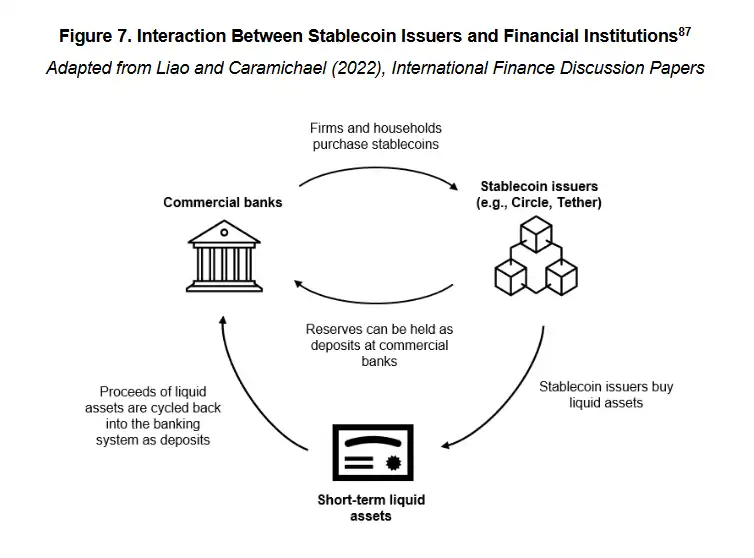
Other mechanisms of stablecoins involving crypto collateral, futures hedging, algorithms, etc., are not considered here.
One reason is that such stablecoins account for a smaller proportion.
Second, this is because these stablecoins do not fall within the scope of this article's discussion of compliant stablecoins in the U.S. regulatory system—last year's GENIUS Act clearly defined the reserve requirements for compliant stablecoins, with reserve assets limited to cash, short-term government securities, or central bank deposits, and must be segregated from operating funds.
So the fact is very clear that stablecoins will not lead to bank deposit outflows because funds will ultimately always flow back to banks and can be used for credit intermediation. This depends on the stablecoin's business model and has little to do with whether it is interest-bearing.
The real key issue lies in the change in deposit structure after the funds flow back.
The Money Tree of American Banks
Before analyzing this change, we need to briefly introduce the interest-earning business of U.S. major banks.
Van Buren Capital General Partner Scott Johnsson cited a paper from the University of California, Los Angeles, stating that since the 2008 financial crisis damaged the banking industry's reputation, U.S. commercial banks in the deposit-gathering business have differentiated into two completely different forms—high-rate banks and low-rate banks.
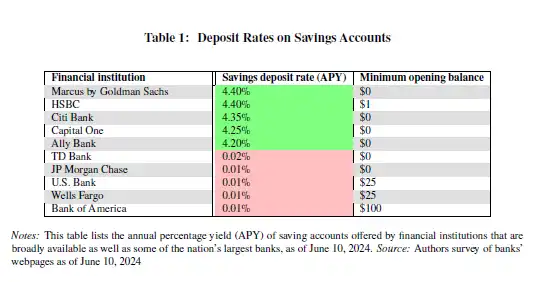
High-rate banks and low-rate banks are not a formal regulatory classification but rather commonly used terms in the market context—manifesting on the surface, the interest rate spread between high-rate banks and low-rate banks has reached over 350 basis points (3.5%).
Why, for the same deposit, is there such a significant interest rate spread? The reason is that high-rate banks are mostly digital banks or banks with a business structure that focuses on wealth management or capital markets business (such as Capital One). They rely on high-interest rates to attract deposits to support their lending or investment business; in contrast, low-rate banks are mainly national large commercial banks like Bank of America, JPMorgan Chase, and Wells Fargo, that hold the actual discourse power of the banking industry. They have a large retail customer base and payment network and can maintain extremely low deposit costs through customer stickiness, brand effects, and branch convenience, without needing to attract deposits through high-interest rates.
From a deposit structure perspective, high-rate banks generally focus on non-transactional deposits, mainly used for savings or interest returns—such funds are more sensitive to interest rates, resulting in higher costs for banks; low-rate banks mainly focus on transactional deposits, mainly used for payments, transfers, and settlement—these funds are characterized by higher stickiness, frequent liquidity, extremely low interest rates, and are the most valuable liabilities for banks.
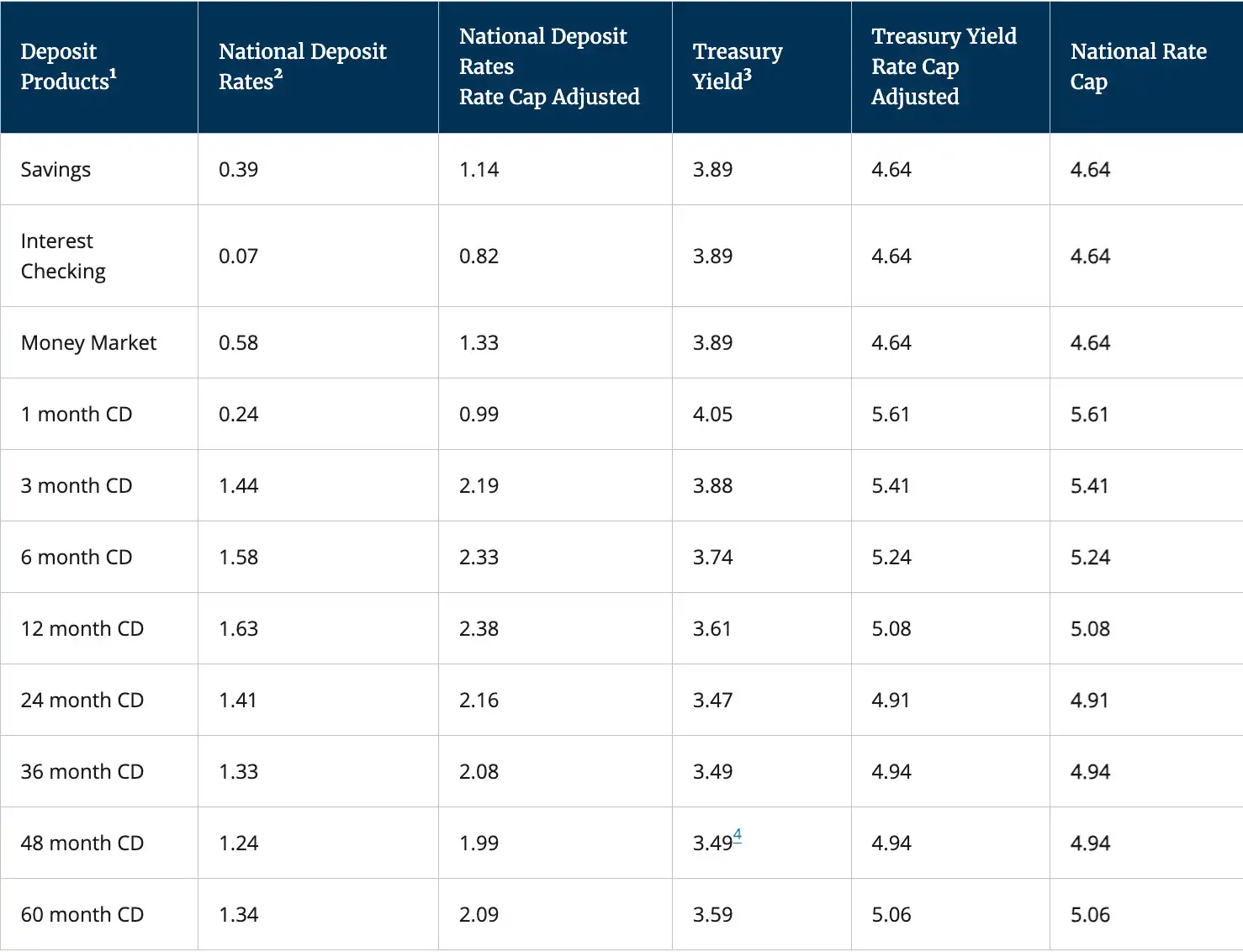
The latest data from the Federal Deposit Insurance Corporation (FDIC) shows that as of mid-December 2025, the average annual interest rate on U.S. savings accounts is only 0.39%.
It is worth noting that this data has already factored in the impact of high-yield banks. Due to the low-rate model of mainstream U.S. banks, the actual interest paid to depositors is much lower than this level. Galaxy Founder and CEO Mike Novogratz bluntly stated in an interview with CNBC that large banks pay almost zero interest to depositors (about 1-11 basis points), while the concurrent Fed benchmark interest rate is between 3.50% to 3.75%. This interest differential brings banks huge profits.
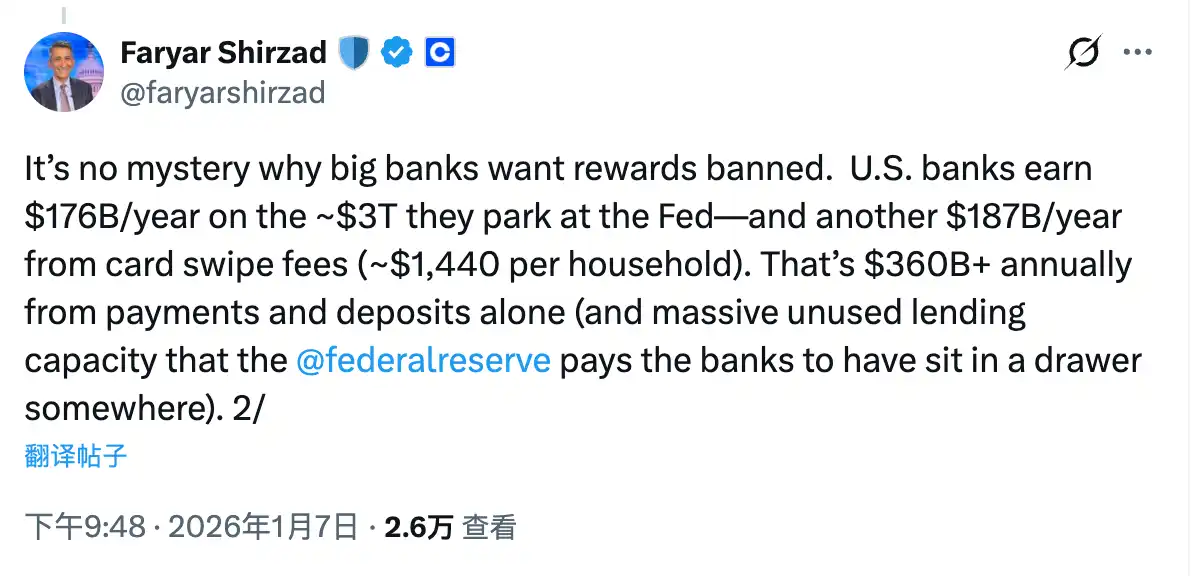
Coinbase's Chief Compliance Officer Faryar Shirzad did a clearer calculation on this—major U.S. banks can earn $176 billion annually from the approximately $3 trillion funds deposited in the Federal Reserve, and they can also earn $187 billion annually from transaction fees charged to depositors. Just from the deposit interest differential and transaction fee revenue, it brings in over $360 billion in annual income.
The Real Change: Deposit Structure and Interest Distribution
Back to the point, what changes will the stablecoin system bring to the bank deposit structure? How will an interest-bearing stablecoin drive this trend? The logic is actually very simple. What are the use cases of stablecoins? The answer is nothing but payments, transfers, settlements, and so on—sounds familiar, right?
As mentioned earlier, the above functions are precisely the core utility of transactional deposits, which are not only the main type of deposits for large banks but also the most valuable liability for banks. Therefore, the real concern of the banking industry about stablecoins is that—as a new type of transaction medium, stablecoins can directly compete with transactional deposits in terms of use cases.
If stablecoins do not have an interest-bearing function, that's one thing. Considering the existence of entry barriers and the meager interest advantage of bank deposits (no matter how small, it's still something), the likelihood of stablecoins posing an actual threat to this core area of large banks is not high. But once stablecoins are endowed with interest-bearing capability, driven by the interest differential, more and more funds may shift from transactional deposits to stablecoins. Although these funds will eventually flow back into the banking system, the stablecoin issuer, for profit reasons, will inevitably invest most of the reserve funds into non-transactional deposits, holding only a certain percentage of cash reserves to meet daily redemptions. This is the so-called change in deposit structure—while the funds remain within the banking system, bank costs will significantly increase (interest rate spread will be compressed), and income derived from transaction fees will also be substantially reduced.
At this point, the essence of the problem is very clear. The reason why the banking industry is so vehemently opposed to interest-bearing stablecoins has never been about whether "the total amount of deposits in the banking system will decrease," but about the potential changes in deposit structure and the resulting profit redistribution issues.
In the era without stablecoins, especially interest-bearing stablecoins, large U.S. commercial banks firmly controlled transactional deposits, a "zero-cost or even negative-cost" source of funds. They could earn risk-free returns through the spread between deposit interest rates and the benchmark rate, as well as continue to charge fees for basic financial services such as payment, settlement, and clearing, thereby building an extremely solid closed loop that required little to no profit-sharing with depositors.
The emergence of stablecoins is essentially dismantling this closed loop. On the one hand, stablecoins, at a functional level, are highly comparable to transactional deposits, covering core scenarios such as payment, transfers, and settlements; on the other hand, interest-bearing stablecoins further introduce the variable of yield, allowing transactional funds, which were originally not sensitive to interest rates, to potentially be repriced.
In this process, funds will not leave the banking system, but banks may lose profit control over these funds — liabilities that were almost zero-cost are forced to convert into liabilities that require market-based returns; payment fees that were once monopolized by banks are also beginning to flow to stablecoin issuers, wallets, and protocol layers.
This is the real change that the banking industry cannot accept. Understanding this point, it is not difficult to understand why interest-bearing stablecoins have become the most intense and difficult-to-compromise point of contention in the CLARITY milestone process.
You may also like

Polygon co-founder Sandeep: Writing after the chain bridge chain explosion

Major Upgrade on Web: 10+ Advanced Chart Styles for Deeper Market Insights
To deliver more powerful and professional analysis tools, WEEX has rolled out a major upgrade to its web trading charts—now supporting up to 14 advanced chart styles.

Morning Report | Aethir secures a $260 million enterprise contract with Axe Compute; New Fire Technology acquires Avenir Group's trading team; Polymarket's trading volume surpassed by Kalshi

Why a Million-Follower Crypto KOL Chooses WEEX VIP?
Discover why top crypto KOL Carl Moon partnered with WEEX. Explore the WEEX VIP ecosystem, 1,000 BTC protection fund, and exclusive rewards for serious traders.

CoinEx Founder: The Crypto Endgame in My Eyes

Spark Coin (SPK): Explodes 73% as Aave Bleeds $15B, A Good Investment Now?
Spark coin (SPK) surged 73% as $15 billion fled Aave after the KelpDAO hack. This article explains what Spark is, why it’s pumping, and whether it is a good investment right now.

As Aave's building collapses, Spark's high-rise is rising

RootData: Q1 2026 Cryptocurrency Exchange Transparency Research Report

What Is Memecoin Trading? A Beginner's Guide to How It Works, the Risks, and 2026's Hottest Tokens
Memecoins surged 30%+ at the start of 2026 while Bitcoin was flat. RAVE spiked 4,500% then crashed 90% in days. MAGA jumped 350% overnight. This guide explains exactly how memecoin trading works — and how to not blow up your account doing it.

Trump Extends Ceasefire: Bitcoin Hits $79K — What Crypto Traders Need to Know Right Now
Bitcoin surged past $79,000 after Trump extended the ceasefire indefinitely. We break down exactly what happened, how every major crypto reacted, and what traders should watch next — including the one level that could unlock an $85,000 BTC rally.

CHIP Crypto Price Prediction 2026: Can USD.AI's GPU Lending Token Reach $1?
CHIP's 24-hour trading volume hit $1.87 billion on a $236 million market cap — an 8x ratio that almost never happens on legitimate tokens. We explain what's driving it, what USD.AI actually does for GPU tokenization, and whether CHIP belongs in your AI crypto portfolio.

RootData: Q1 2026 Web3 Industry Investment Research Report

USDC is the only AI token

The voice of a senior Polymarket user: In fact, we have already been surpassed by our competitors

Transcript of Dr. Han, founder of Gate, speaking at the University of Hong Kong: Breaking the Matthew Effect and Winning in Asymmetric Competition

Who will replace AAVE as the new king?
Fu Peng 2026 First Public Speech: What Exactly Are Crypto Assets? Why Did I Join the Crypto Asset Industry?
Lattice Capital Founder: Crypto VC, Seeing is Believing Because of Faith
Polygon co-founder Sandeep: Writing after the chain bridge chain explosion
Major Upgrade on Web: 10+ Advanced Chart Styles for Deeper Market Insights
To deliver more powerful and professional analysis tools, WEEX has rolled out a major upgrade to its web trading charts—now supporting up to 14 advanced chart styles.
Morning Report | Aethir secures a $260 million enterprise contract with Axe Compute; New Fire Technology acquires Avenir Group's trading team; Polymarket's trading volume surpassed by Kalshi
Why a Million-Follower Crypto KOL Chooses WEEX VIP?
Discover why top crypto KOL Carl Moon partnered with WEEX. Explore the WEEX VIP ecosystem, 1,000 BTC protection fund, and exclusive rewards for serious traders.
CoinEx Founder: The Crypto Endgame in My Eyes
Spark Coin (SPK): Explodes 73% as Aave Bleeds $15B, A Good Investment Now?
Spark coin (SPK) surged 73% as $15 billion fled Aave after the KelpDAO hack. This article explains what Spark is, why it’s pumping, and whether it is a good investment right now.


 App
App