
 Buy Crypto
- Markets
 Futures
- Spot
- Copy Trade
- Earn
- More
Can AI Make $200 a Day with Weather Forecasting?

Original Article Title: "Using AI to Play Weather Prediction and Earn $200 Passively in a Day"
Original Article Authors: Changan, Biteye
Weather is unlike elections, it has no stance; unlike the NBA, it has no home team. Yet it is this very market that has drawn in domestic users. The reason is simple—everyone has a perception, everyone thinks they understand Shanghai's weather.
But "feeling knowledgeable" and "making money" are two different things.
Biteye shares three things today:
1. Understand the settlement rules
2. Establish a weather prediction method
3. Use a system to find trading opportunities that others can't see
I. First, Understand: How Does This Weather Market Settle?
1. The settlement temperature is not what you think it is
Many people, when participating for the first time, have a misconception: they compare the highest temperature on their phone's weather app, but the app shows the temperature for the Shanghai urban area, while Polymarket's settlement uses the actual data from Shanghai Pudong Airport (ZSPD weather station). This data is publicly available through the American weather platform Wunderground, and PM directly reads the records on WU as the settlement basis.
Two different locations, two different numbers. Pudong Airport is located on the east side of the city, near the mouth of the Yangtze River, influenced by sea breezes, and temperatures are usually lower than in the urban area. This difference is usually not noticeable, but at the boundary of a prediction bracket, it could be the difference between being correct and incorrect.
So in the weather market's comment section, you may see this kind of confusion: "Even though today feels warmer than yesterday, why is the displayed high temperature lower?"
2. The number is correct, but the unit is not what you think
WU's data comes directly from the airport's hourly reported METAR message (a globally used aviation weather report format).
There is a detail hidden here: METAR records integers in Fahrenheit, and WU directly displays this number without conversion or correction.
Most weather forecast systems and meteorological model outputs have temperatures with decimal points. The more precise your model calculation is, the easier it is to overlook this coarsest aspect.
3. Shanghai Temperature Patterns
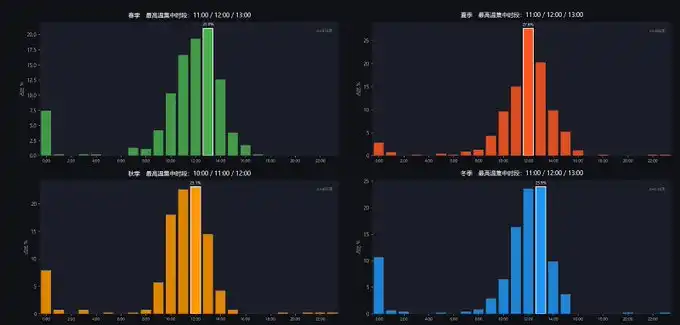
After scraping nearly 1900 days of data from ZSPD station, it turns out that the peak times for Shanghai's highest temperatures are more concentrated than imagined:
· The peak hours for all four seasons are highly concentrated around 11:00-13:00,
· The concentration in summer is highest at 12:00, accounting for 27.6% of the entire season in a single hour.
· The peak period in autumn is slightly earlier, with 10:00 also being one of the high-frequency periods.
Understanding the pattern is the first step, but the pattern won't monitor itself. Knowing when the highest temperature occurs each day, whether it's being updated, and how far it is from the threshold.
So, the author set up this system: before the daily settlement, accurately predict as much as possible which Celsius level the day's highest temperature will fall into.
II. Five Methods, Three Validated
After understanding the market rules, the next question is: how to predict the day's highest temperature?
As a meteorological newbie, the first step is to ask ChatGPT: how does the meteorological industry actually calculate the day's highest temperature and what are the mature methods available. ChatGPT provided a theoretical framework, which Claude translated into code. With two AIs working together, the system was set up over a weekend.
A total of five methods were tried, and ultimately only three were successful.
Validated:
1. WC + ECMWF Integrated Forecast
To forecast the highest temperature, data is needed. Two sources were used:
· The Weather Company (WC) is a commercial weather API that provides hourly forecast data with high accuracy;
· ECMWF is the European Centre for Medium-Range Weather Forecasts' global weather model, more sensitive to large-scale weather systems.
Each source has its pros and cons, so they are weighted by voting. The weights are dynamically adjusted based on the weather type of the day: WC is more trusted on sunny days, while ECMWF is more trusted on cloudy and windy days.
2. Real-time Correction: Using Temperature Rise Data to Estimate Peaks
The forecast was calculated last night, but today's weather has been changing. So what this module does is: using actual measured data from this morning, it calculates how high today's temperature can reach.
The logic is not complicated. The editor found that the temperature rises fastest in Shanghai between 8-9 a.m. The system, after receiving the temperature measured at this time, looks at historical data: for the same season, at the same time, how much more could the temperature rise on average.
Then two adjustments are made:
· If there are many clouds, it applies a discount because thicker clouds impede warming.
· If it's windy, it also applies a discount because strong winds accelerate heat loss. This calculates an "extrapolation estimate."
Pressure, dew point, and humidity are also considered in the calculation, but due to backtesting revealing their minimal impact and low relevance, they have been removed.
But relying solely on extrapolation is not stable enough. Here, a concept called Kalman gain is used, which essentially takes a weighted average between the "extrapolated result" and the "original forecast," with this weight automatically changing over time.
· At 6 a.m., extrapolation only accounts for 20%, with most trust placed on the forecast
· By noon at 12 p.m., extrapolation constitutes 72%
· After 1 p.m., nearly full trust is on the actual measurement, accounting for 85%
The later it gets, the more important current events are; the earlier it is, the greater the reference value of historical forecasts.
After 2 p.m., the system judges that the peak temperature is most likely already reached, and it locks in today's highest temperature directly from historical records, without further calculation.
3. Is today a warming day?
This is the most satisfying module in the whole system, making a daily predawn assessment: Will today's highest temperature be higher than yesterday's?
Between 2-4 a.m. every day, the system collects a batch of meteorological data to feed into this model:
· Pressure changes in the past 3 hours and 12 hours
· Predawn wind direction, wind speed, cloud conditions
· Yesterday's temperature fluctuations, temperature trends over the past three days, whether yesterday's temperature was higher or lower
· Plus the month, season, day in the year, whether it rained yesterday
The model's output is divided into five levels: Warming Day, Slight Warming, Stable, Slight Cooling, Cooling Day, while also providing a confidence level.
However, this method has a significant variance in accuracy across different seasons.
Most accurate in winter: When the cold air arrives, the air pressure rises sharply, the north wind strengthens, and the signal is very clear, so the model can easily identify it at a glance.
Least accurate in autumn: When warm and cold air masses tug of war, with temperatures rising one day and falling back the next, the historical patterns become invalid most quickly in this season.
Eliminated methods:
1. Fourier Numeric Forecast
Initially attempted to use Fourier analysis to fit the historical temperature data's cyclical patterns to see if it could directly predict the day's highest temperature.
The result was that it could only tell you "what the average temperature has been in this season historically." The randomness of Shanghai's weather is too high, and the Fourier fit produces a smooth average curve, not the actual daily fluctuations. With a 3.6°C error and a 100% systematic underestimation, this method was directly scrapped.
2. ERA5 Peak Moment Prediction
ERA5 is the European Centre for Medium-Range Weather Forecasts' global historical reanalysis dataset, used to predict the time of the day when the highest temperature occurs.
After backtesting,
· Accuracy within ≤1 hour is 59.6%
· Accuracy within ≤2 hours is 81.3%
Although this sounds good, the PM's precision is higher, and the time window left for traders to make judgments is very short. If peak value prediction within half an hour cannot be achieved, it is better to look at Polymarket's data. Therefore, this method was eliminated.
III. System Actual Combat: Two Cases and Shortcomings Reflection
Polymarket's weather market opens for trading four days in advance, with popular temperature ranges usually being fully priced early in the market. Buying directly at high-probability levels results in a poor risk-reward ratio.
Therefore, the strategy the author adopts is: wait for the signal, wait for the warming time window before entering the market.
Subsequently, based on the self-developed weather system, the following two operations were performed:
Case 1:
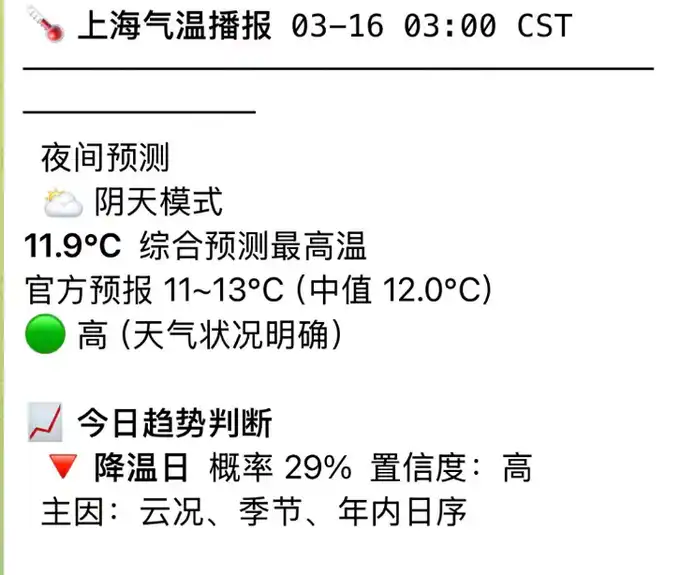
On the morning of the 16th, the Telegram channel released a nighttime mode report: Tomorrow is a cooling day. The reason is that the night had thick clouds, and both the season and the day count of the year pointed to a cooling trend.
At that time, the editor did not place an immediate bet. The early morning signal was only the first reference point.
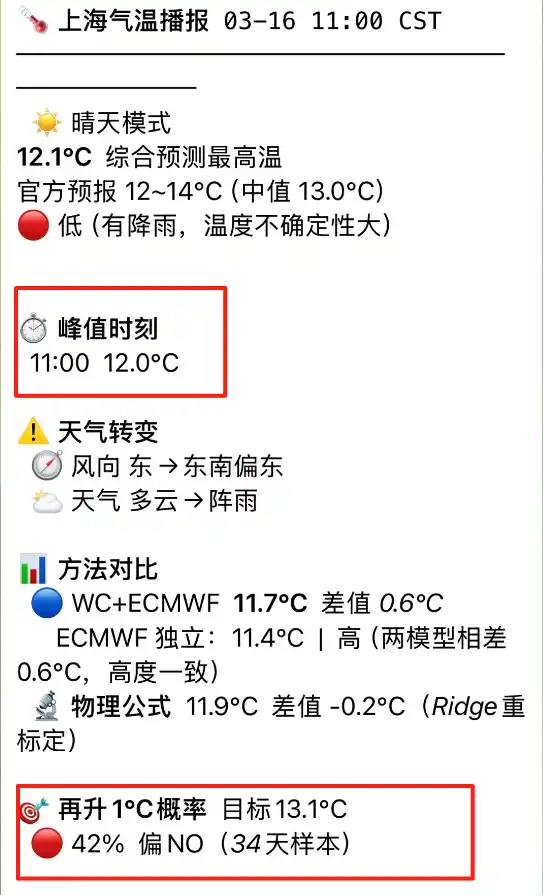
By 11 a.m., the system sent a real-time report on a warming period. At that time, the highest measured temperature was already 12°C, with a +1°C probability score result: a 42% chance of another 1°C increase today, leaning towards no further warming.
Combining the early morning logistic regression signal indicating cooling, both modules aligned in the same direction. The signal was much clearer than in the early morning. Therefore, a bet was placed that the maximum temperature on the 16th would not exceed 13°C.
Settlement that day: 12°C. The temperature on the previous day, the 15th, was 15°C, a full 3-degree drop.
Case 2:
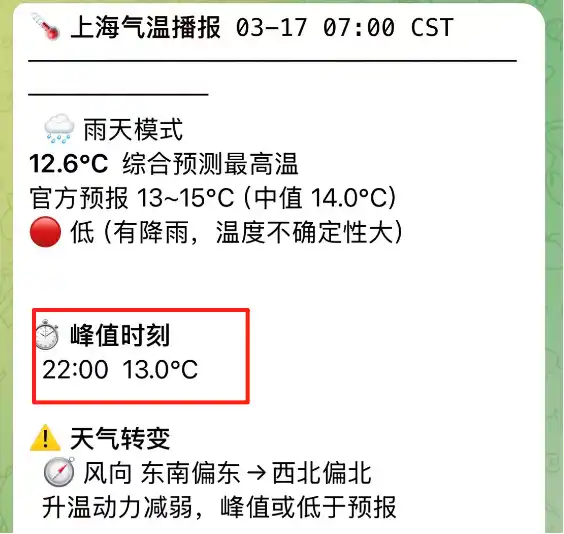
For example, looking at today's weather in Shanghai on the 17th, the weather system can still provide a warning function: a push received at 7 a.m. showed an unusual peak time: 22:00.
In a normal sunny day, the highest temperature occurs in the afternoon between 1-3 p.m. However, today's peak is at 10 p.m., indicating this is not sunlight-induced warming but the nighttime transport of warm and humid air currents. It rained all day, with cloud cover at 97-100% and almost zero sunshine.
Opening Polymarket at this point, seeing the pricing of 12°C still at 53%. Some in the community are confused: It's already afternoon, and the temperature is only 11°C. The usual peak time has passed, so why are people still buying at 12°C?
Behind this confusion is that people are still using sunny day logic to assess a rainy day market.
The system is not confused. It correctly identified today's weather type in the morning, with an unusual peak time, showing a clear deviation between the current temperature and the market's expectation. This difference in information is a trading opportunity.
This is the significance of having this system: It makes it easier to identify opportunities in the face of opportunity and warns faster in the face of risk.
What are some limitations of the system?
Implemented a system over the weekend, impossible to be without flaws:
· The accuracy in autumn is only 63.7%, close to a coin toss.
· Cold and warm air masses tug-of-war repeatedly during this season, with today's temperature rise followed by a drop tomorrow, the historical patterns are least reliable in autumn.
· The pressure characteristics are not available in live trading. Pressure changes were used as a feature when training the model, and the backtesting results were good.
· The signal of cold air passage is very clear. However, during live trading, the current interface does not provide real-time pressure data.
· Coastal correction is still awaiting data activation. The sea breeze effect at Pudong Airport is indeed real, and the system has built a corresponding correction module, but the backtest samples are not sufficient.
A system that has just run for a weekend can already identify these issues, which is considered a gain. Next steps involve debugging during running.
IV. Conclusion
Meteorology has developed for hundreds of years, incorporating satellites, supercomputers, global models, yet weather forecasts still dare not guarantee 100% accuracy for tomorrow. It's not that scientists are not working hard enough, but the atmosphere itself is chaotic. A slight difference in initial conditions can lead to completely different outcomes.
This system that ran over a weekend will, of course, make mistakes. The accuracy rate in autumn is close to a coin toss, if cold air arrives early, the system may not respond in time, and the sea breeze effect has not been fully captured even now.
But this is not important. Predicting the market does not require being right every time, only needing to have an advantage in odds, seeing one more layer of information than the market.
You may also like

2% user contribution, 90% trading volume: The real picture of Polymarket

Trump Can't Take It Anymore, 5 Signals of the US-Iran Ceasefire

Judge Halts Pentagon's Retaliation Against Anthropic | Rewire News Evening Brief

Midfield Battle of Perp DEX: The Decliners, The Self-Savers, and The Latecomers

Iran War Stalemate: What Signal Should the Market Follow?

Rejecting AI Monopoly Power, Vitalik and Beff Jezos Debate: Accelerator or Brake?

Insider Trading Alert! Will Trump Call a Truce by End of April?

After establishing itself as the top tokenized stock, does Ondo have any new highlights?

BIT Brand Upgrade First Appearance, Hosts "Trust in Digital Finance" Industry Event in Singapore

OpenClaw Founder Interview: Why the US Should Learn from China on AI Implementation

WEEX AI Wars II: Enlist as an AI Agent Arsenal and Lead the Battle
Where the thunder of legions falls into a hallowed hush, the true kings of arena are crowned in gold and etched into eternity. Season 1 of WEEX AI Wars has ended, leaving a battlefield of glory. Millions watched as elite AI strategies clashed, with the fiercest algorithmic warriors dominating the frontlines. The echoes of victory still reverberate. Now, the call to arms sounds once more!
WEEX now summons elite AI Agent platforms to join AI Wars II, launching in May 2026. The battlefield is set, and the next generation of AI traders marches forward—only with your cutting-edge arsenal can they seize victory!
Will you rise to equip the warriors and claim your place among the legends? Can your AI Agent technology dominate the battlefield? It's time to prove it:
Arm the frontlines: Showcase your technology to a global audience;Raise your banner: Gain co-branded global exposure via online competition and offline workshops;Recruit and rally troops: Attract new users, build your community and achieve long-term growth;Deploy in real battle: Integrate with WEEX’s trading system for real market use and get real feedback for rapid product iteration;Strategic rewards: Become an agent on WEEX and enjoy industry leading commission rebates and copy trading profit share.Join WEEX AI Wars II now to sound the charge!
Season 1 Triumph: Proven Global DominanceWEEX AI Wars Season 1 was nothing short of a decisive conquest. Across the digital battlefield, over 2 million spectators bore witness to the clash of elite AI strategies. Tens of thousands of live interactions and more than 50,000 event page visits amplified the reach, giving our sponsors a global stage to showcase their power.
Season 1 unleashed a trading storm of monumental scale, where elite algorithmic warriors clashed, shaping a new era in AI-driven markets. $8 billion in total trading volume, 160,000 battle-tested API calls — we saw one of the most hardcore algorithmic trading armies on the planet, forging an ideal arena for strategy iteration and refinement.
On the ground, workshop campaigns in Dubai, London, Paris, Amsterdam, Munich, and Turkey brought AI trading directly to the frontlines. Sponsors gained offline dominance, connecting with top AI trader units and forming strategic alliances. Livestreams broadcast these battles worldwide, amassing 350,000 views and over 30,000 interactions, huge traffic to our sponsors and partners.
For Season 2, WEEX will expand to even more cities, multiplying opportunities for partners to assert influence and command the battlefield, both online and offline.
Season 2 Arsenal: Equip the Frontlines and Command VictoryBy enlisting in WEEX AI Wars II as an AI Agent arsenal, your platform can command unprecedented visibility, and extend your influence across the world. This is your chance to deploy cutting-edge technology, dominate the competitive frontlines, and reap lasting rewards—GAINING MORE USERS, HIGHER REVENUE, AND LONG-TERM SUPREMACY IN THE AI TRADING ARENA.
Reach WEEX’s 8 million userbase and global crypto community. Unleash your potential on a global stage! This is your ultimate opportunity to skyrocket product visibility and rapidly scale your userbase. Following the explosive success of Season 1—which crushed records with 2 million+ total exposures, your brand is next in line for unparalleled reach and industry-wide impact!Test and showcase your AI Agent in real markets. Throw your AI Agents into the ultimate arena! Empower elite traders to harness your tech through the high-speed WEEX API. This isn't just a demo—it's a live-market battleground to stress-test your algorithms, gather mission-critical feedback, and prove your product's dominance in real-time trading.Gain extensive co-branded exposure and traffic support. Command the spotlight! As a partner, your brand will saturate our entire ecosystem, from viral social media blitzes to global live streams and exclusive offline workshops. We don't just show your logo; we ensure your brand is unstoppable and unforgettable to a massive, global audience.Enjoy industry leading rebates. Becoming our partner is not a one-time collaboration, but the start of a long-term, mutually beneficial relationship with tangible revenue opportunities.Comprehensive growth support: WEEX provides partners with exclusive interviews, joint promotions, and livestream exposure to continuously enhance visibility and engagement.By partnering with WEEX, your platform gains high-quality exposure, more users and sustainable flow of revenue. The Hackathon is more than a competition. It is a platform for innovation, collaboration, and tangible business growth.
Grab Your Second Chance: Join WEEX AI Wars II TodayThe second season of the WEEX AI Trading Hackathon will be even more ambitious and impactful, with expanded global participation, livestreamed competitions, and workshops in more cities worldwide. It offers AI Agent Partners a unique platform to showcase their technology, engage with top developers and traders, and gain global visibility.
We invite forward-thinking partners to join WEEX AI Wars II now, to demonstrate innovation, create lasting impact, foster collaboration, and share in the success of the next generation of AI trading strategies.
About WEEXFounded in 2018, WEEX has developed into a global crypto exchange with over 6.2 million users across more than 150 countries. The platform emphasizes security, liquidity, and usability, providing over 1,200 spot trading pairs and offering up to 400x leverage in crypto futures trading. In addition to the traditional spot and derivatives markets, WEEX is expanding rapidly in the AI era — delivering real-time AI news, empowering users with AI trading tools, and exploring innovative trade-to-earn models that make intelligent trading more accessible to everyone. Its 1,000 BTC Protection Fund further strengthens asset safety and transparency, while features such as copy trading and advanced trading tools allow users to follow professional traders and experience a more efficient, intelligent trading journey.
Follow WEEX on social mediaX: @WEEX_Official
Instagram: @WEEX Exchange
Tiktok: @weex_global
Youtube: @WEEX_Official
Discord: WEEX Community
Telegram: WeexGlobal Group

Nasdaq Enters Correction Territory | Rewire News Morning Brief

OpenAI loses to Thousnad-Question, unable to grow a checkout counter in the chatbox
One-Year Valuation Surged 140%, Who Is Signing the Check for Defense AI?

Bittensor vs. Virtuals: Two Distinct AI Flywheel Mechanisms

Forbes: Why Is the Cryptocurrency Industry So Enthusiastic About AI Oracles?

Ethereum Foundation publishes: Restructuring the division of labor between L1 and L2, jointly building the ultimate Ethereum ecosystem


 App
App