
 Buy Crypto
- Markets
 Futures
- Spot
- Copy Trade
- Earn
- More
After the doubling, how much more "war dividend" can Circle claim?

Original Title: Circling Back to Circle
Original Author: Thejaswini MA, Token Dispatch
Original Translation: Bitpush News
There is a class of companies that tend to thrive when the world is in turmoil: defense contractors, oil unions, gold miners. These are the common tropes, with business models inherently unstable, pricing in that risk.
Circle is not supposed to be in this category. Its token was designed to always be pegged to 1 USD. Stability is the very essence of its product.
However, Circle's stock price has surged from $49.90 on February 5th to around $123 today, more than doubling in just five weeks. Meanwhile, the broader cryptocurrency market remains 44% below its peak in October last year.
A company whose product is meant to pursue price stability has become the hottest trade in the market as the world grows more uncertain.
This article will explain the reasons behind this phenomenon, as well as the disconnect between the true nature of Circle and the current market pricing.
What is Circle Really About (Let's Get Back to Basics)
Strip away the branding, payments narrative, and infrastructure talk, and what you have left is: Circle holds US Treasuries.
Every circulating USDC dollar is backed by a dollar held in short-term US government bonds. The interest on this debt accrues to Circle. This accounts for about 90% of the company's revenue in any given quarter. Once you see this, the business model isn't complicated: Circle is a stablecoin issuer money market fund.
This means that a key metric for Circle's revenue is the federal funds rate. When rates are high, bond yields are just higher, and Circle earns more for every circulating USDC. As rates fall, so does revenue. Everything else is just noise.
Here are the chain reactions that led to a 150% rebound from the February low:
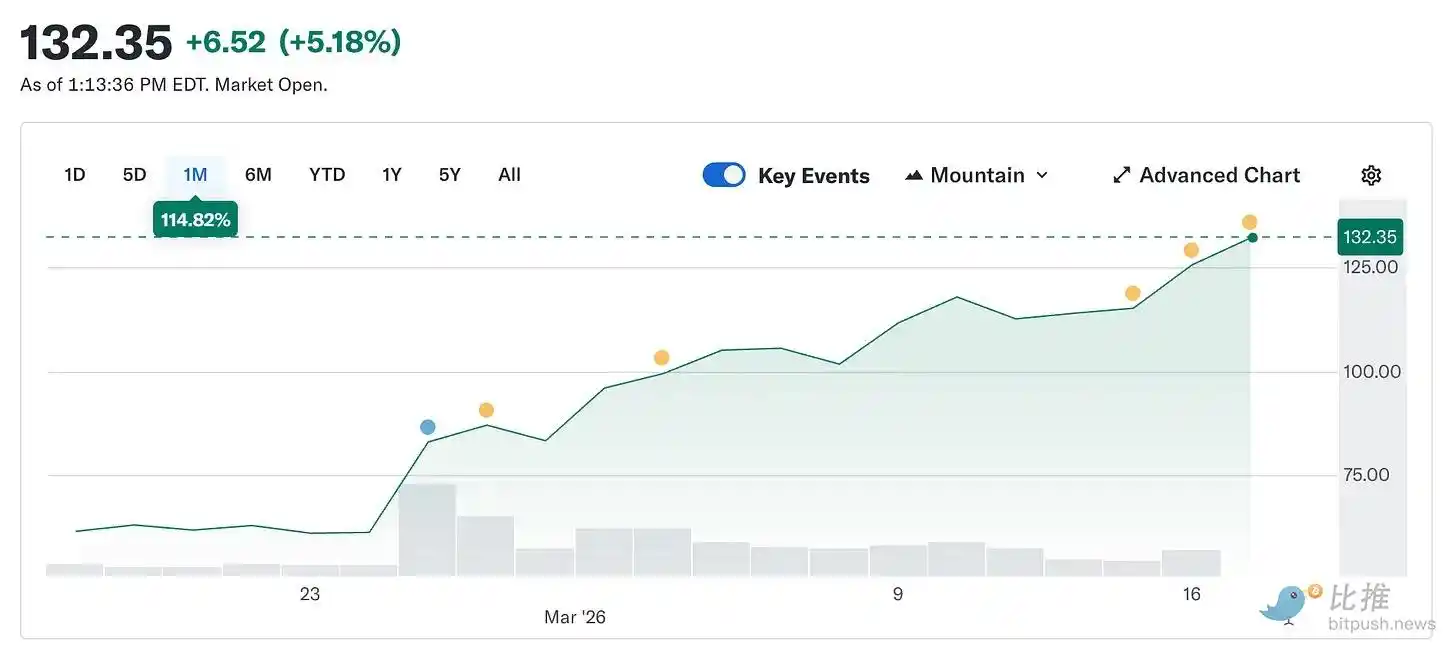
According to @finance.yahoo, the Iran conflict has driven rates up by about 35% since February 28. A move of over $100 implies excessive panic, and excessive panic implies a Fed rash if it cuts. The March 18 rate hold was never really in question. As far back as before the war, the CME FedWatch showed over a 90% probability of rates on hold.
What has truly shifted is this year's war of expectations. Prior to the conflict, the market priced in two 25 bps cuts in 2026. Post-conflict, that expectation was cut to one, and pushed out to post-September. The probability of no cuts in 2026 doubled. With rates staying elevated for a longer period, the cyclical bond reserve continues to yield. More yield means more income, more income means higher stock prices. War broke out, and a stablecoin issuer becomes the beneficiary. This was never in anyone's playbook.
Background: The February put on Circle at $49 essentially bet against the rate cuts.
Back then, the market was pricing in multiple rate cuts by the Fed in 2026, which would directly squeeze Circle's FX revenue. Rough math: At the current $79B USDC supply level, each 25 bps cut would cost Circle between $40-60M in annualized revenue. A double cut would wipe out nearly $100M in top-line revenue by year-end. The war made this calculus moot overnight.
How the Short Squeeze Started
While the rate story supported the stock price, the initial surge came from a position squeeze.
Prior to the release of Q4 earnings on February 25, about 17.8% of Circle's float was short. Hedge funds had built up large put-back ratios. Their argument was that rates would ultimately fall, domestic revenue would compress, and this company's revenue did not depend on a rate floor. Fundamentally, this was a hard argument to refute.
Additionally, Circle reported an EPS of $0.43 for the beginning of the year, while the market consensus was $0.16. Revenue came in at $7.7B, with an expectation of $7.49B. On-chain USDC transaction volumes approached nearly $12T QoQ, a 247% YoY rise. The shorts covered. The stock soared 35% in a single day. Per 10x Research, hedge funds estimated losses of $500M on their short positions that day. Subsequently, the war picked up the baton from the earnings report.
Coinbase Issue
Here is a portion referenced in an update narrative.
Circle's 2025 Loss was $70 million, not a profit. While it performed well in Q4, this year has been tough. To understand why, you need to grasp its relationship with Coinbase, the most significant and underrated fact of Circle's business.
When USDC launched in 2018, Circle and Coinbase formed a consortium to manage it. The consortium dissolved in 2023, giving Circle full control of USDC issuance. However, Coinbase retained the revenue source.
Coinbase took 100% of the interest on USDC reserves held on its platform, splitting all other revenue with Circle fifty-fifty. In 2024, under this arrangement, $908 million out of Circle's total distribution cost of $10.1 billion was effectively donated to Coinbase.
Roughly, for every $1 in Circle's funds, 54 cents flowed to a company that neither issues the token nor manages the reserves. In early 2025, Coinbase held 22% of the total USDC supply, up from 5% in 2022. The more USDC grows on the Coinbase platform, the more intra-circle payments rise.
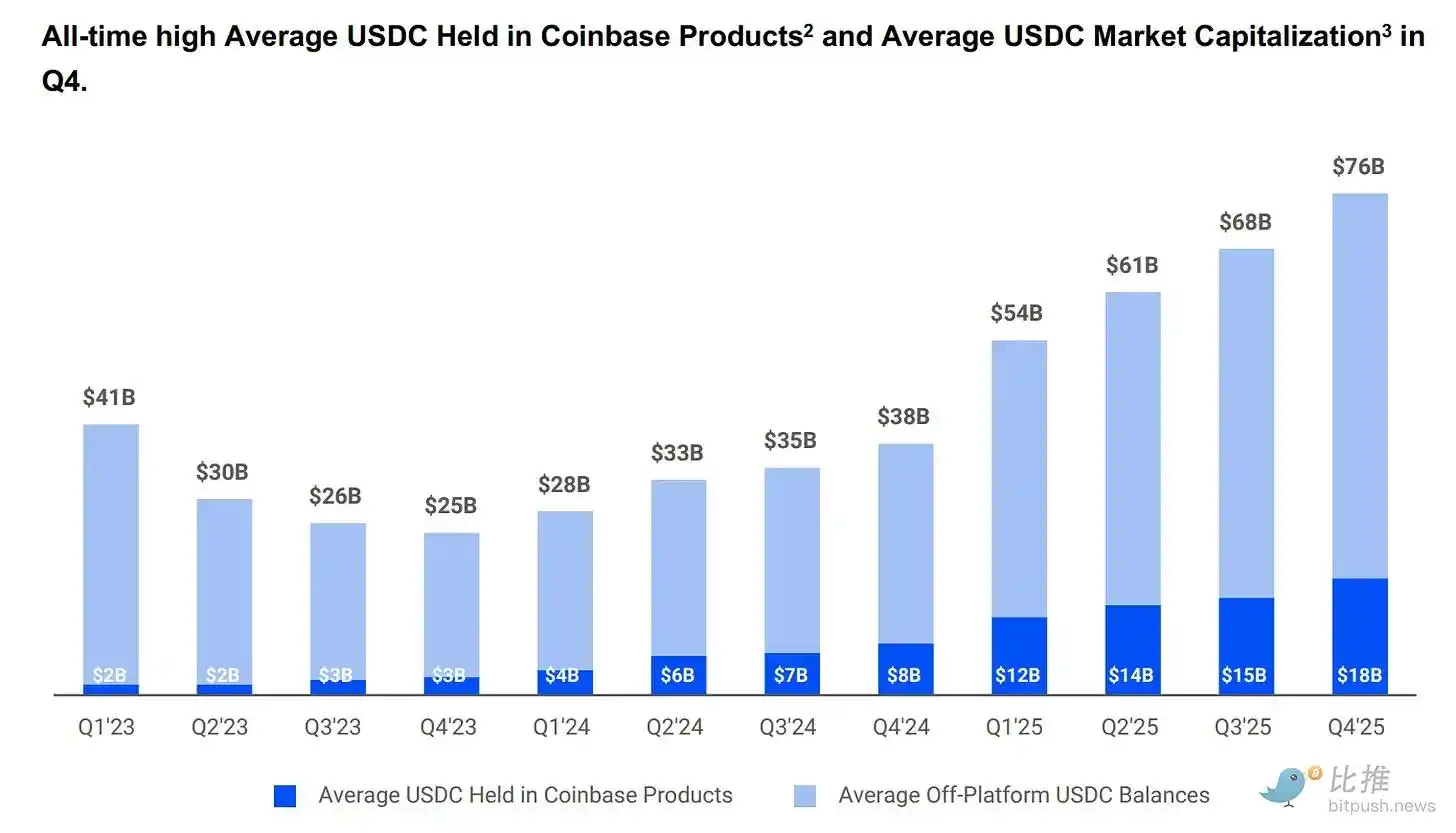
As reported by @q4cdn.com, this partnership automatically renews every three years, and Circle cannot unilaterally exit. Any outcomes of the next renegotiation will directly impact Circle's profit margin. In Q4 2025, the distribution cost alone soared to $461 million, a 52% increase year over year.
The current $70 million net loss stems from an IPO-related $424 million in equity compensation, making the overall figures look worse than the actual business situation. However, the actual business still faces a structural cost issue that no interest rate environment can fully alleviate.
The market prices Circle as infrastructure, yet its income statement reveals it as a rate-trading tool burdened with expensive distribution costs. Both views can coexist. They simply follow different pricing logics, and the market is currently buying into the "best version" of both simultaneously.
Why This Is More Than Just a Macro Trade
The supply of USDC recently hit a record high of $79 billion, while the broader crypto market plunged 44% from October. This divergent growth is worth considering. During market downturns, speculative assets typically fall. The growth of USDC has been sustained by people using it to move funds, rather than solely as a speculative bet.
During the Iran conflict, the demand for USDC in the Middle East surged due to the traditional banking system becoming unreliable. When normal channels were blocked, people turned to it for cross-border and cross-border transfers. This is the performance of payment infrastructure under pressure: its usage frequency increases rather than decreases.
Transaction data confirms this. In February alone, USDC processed about $1.26 trillion in adjusted transaction volume, compared to $514 billion for USDT. Tether (USDT) still has a market cap of $184 billion, while USDC is at $79 billion. In terms of total supply, the two are incomparable. But USDC's current level of funds already exceeds USDT.
As shown by @visaonchainanalytics, "dormant supply" and "active settlement" are distinct concepts. Previously indicating where people park dollars, at night it shows which dollar they use when they need to transfer value.
Druckenmiller made some related points this week. In a Morgan Stanley interview recorded on January 30 and released on Thursday, he predicted that the global payment system would be running on stablecoins for 10 to 15 days throughout the year and referred to cryptocurrencies as "a solution in search of a problem."
The world's most trusted macro investor divides this space in two: stablecoins are the foundational layer, and everything else is looking for a reason for their existence. This framework provides an endorsement for the bullish thesis.
Infrastructure Deposit
Tokenized assets have grown from around $1.5 billion in early 2023 to around $26.5 billion today. Many such products (including Belld Holdings' BUIDL, a tokenized government bond fund holding over $2 billion in assets) rely on USDC for subscription, redemption, and settlement processing.
The prediction market processed over $22 billion in transaction volume in 2025, mostly settled through USDC (solely Polymarket). Visa currently supports 130+ fiat-backed stablecoin-linked cards in 50+ countries globally, with an annual settlement volume of around $4.6 billion.
Circle is building the infrastructure underlying all of this. The Circle Payments Network connects 55 financial institutions with an annualized processing volume of $5.7 billion, enabling banks and payment providers to cross-border convert USDC and settle directly into local currencies.
Arc is Circle's proprietary Layer-1 blockchain designed to fully support institutional systems. This system is independent of Ethereum or Solana settlement infrastructure. While Ethereum and Solana currently have minimal impact on revenue, both are strategic plays for the future in case interest rates drop.
The scale of the AI system is relatively small but structurally interesting. Data released by Circle's Global Spend Lead in March shows that over the past 9 months, the AI smart contract has completed 140 million payments totaling $43 million. 98.6% settled in USDC, with an average transaction size of $0.31. There are now over 400,000 AI smart contracts with spending power. While the dollar amount is still small, the trend is undeniable.
If AI smart contracts need computing power, data access, and API calls to interact and pay each other high-frequency, sub-cent payments, they need tools for instant settlement and near-zero-cost transfers. Circle has recently introduced Nano payments tailored to this need: supporting sub-micro USDC payments down to $0.000001, off-chain resources, and batch settlements. The testnet already supports 12 chains, including Arbitrum, Base, and Ethereum's native chain.
This is why the market is willing to pay a $123 stock price for Circle: a company at the intersection of tokenized finance, AI smart contracts, cross-border payments, and prediction markets, with regulatory scrutiny under the GENIUS Act and likely approval of the CLARITY Act before summer. Bernstein has set a target price of $190, while Clear Street targets $136. Wall Street's most bullish Harbor Global has a target price as high as $280.
The Lingering Contradiction
Here, I want to candidly discuss a point that bullish investors often overlook.
Circle's profitability relies on maintaining a high interest rate. This is not a permanent condition. The Federal Reserve will eventually cut rates. At that point, the Treasury bond reserve yield supporting USDC will shrink, and Circle's interest income will also dwindle.
Circle is aware of this. It has been expanding its transaction fees, enterprise services, payment network, and Arc—businesses that do not rely on an interest rate environment to operate. However, currently, these revenue streams are still small in scale. Interest income extraction still reigns supreme.
Therefore, you will find these two logics coexisting in the same stock price, but they are not the same bet.
The fundamental thesis posits that USDC is on its way to becoming a true payment rail. A conduit that is regulated, transparent, and eager to deeply embed itself in traditional finance, regardless of interest rates, this embedment has stickiness. The argument is supported by data: digitized transaction volumes, integrations, the Druckenmiller framework, and Maguire's characterization of stablecoins as the base layer of global financial infrastructure.
If this argument holds, then Circle looks cheap in any interest rate environment because its potential market is the entire global payment system.
The interest rate trading thesis, on the other hand, sees Circle as a leveraged bet on "higher and longer rates," with the stock price already reflecting the expectation that the Fed will never cut rates again. If this is the primary driver of the price, then every future Fed rate cut is a headwind, and the stock price has priced in the fundamentals under normalized rates.
Both viewpoints are priced in. The war makes it hard to tell which narrative the market is buying into.
This may be the most useful thing to understand about CRCL (Circle stock ticker) currently. It's not about whether it will surge to $190, but whether you are buying into "infrastructure," a "national debt turned reseller with a good storytelling ability." It's a long-term position first; then a collapse at the moment Powell changes his mind.
Currently, keeping both sides alive is valuable. The dollar is doing the most difficult job it must. And in the gap between the two scenarios lies the true essence of this company—it figured out how to create a dollar-denominated internet currency, but now it has figured out how to survive when the dollar no longer yields 5%.
You may also like

2% user contribution, 90% trading volume: The real picture of Polymarket

Trump Can't Take It Anymore, 5 Signals of the US-Iran Ceasefire

Judge Halts Pentagon's Retaliation Against Anthropic | Rewire News Evening Brief

Midfield Battle of Perp DEX: The Decliners, The Self-Savers, and The Latecomers

Iran War Stalemate: What Signal Should the Market Follow?

Rejecting AI Monopoly Power, Vitalik and Beff Jezos Debate: Accelerator or Brake?

Insider Trading Alert! Will Trump Call a Truce by End of April?

After establishing itself as the top tokenized stock, does Ondo have any new highlights?

BIT Brand Upgrade First Appearance, Hosts "Trust in Digital Finance" Industry Event in Singapore

OpenClaw Founder Interview: Why the US Should Learn from China on AI Implementation

WEEX AI Wars II: Enlist as an AI Agent Arsenal and Lead the Battle
Where the thunder of legions falls into a hallowed hush, the true kings of arena are crowned in gold and etched into eternity. Season 1 of WEEX AI Wars has ended, leaving a battlefield of glory. Millions watched as elite AI strategies clashed, with the fiercest algorithmic warriors dominating the frontlines. The echoes of victory still reverberate. Now, the call to arms sounds once more!
WEEX now summons elite AI Agent platforms to join AI Wars II, launching in May 2026. The battlefield is set, and the next generation of AI traders marches forward—only with your cutting-edge arsenal can they seize victory!
Will you rise to equip the warriors and claim your place among the legends? Can your AI Agent technology dominate the battlefield? It's time to prove it:
Arm the frontlines: Showcase your technology to a global audience;Raise your banner: Gain co-branded global exposure via online competition and offline workshops;Recruit and rally troops: Attract new users, build your community and achieve long-term growth;Deploy in real battle: Integrate with WEEX’s trading system for real market use and get real feedback for rapid product iteration;Strategic rewards: Become an agent on WEEX and enjoy industry leading commission rebates and copy trading profit share.Join WEEX AI Wars II now to sound the charge!
Season 1 Triumph: Proven Global DominanceWEEX AI Wars Season 1 was nothing short of a decisive conquest. Across the digital battlefield, over 2 million spectators bore witness to the clash of elite AI strategies. Tens of thousands of live interactions and more than 50,000 event page visits amplified the reach, giving our sponsors a global stage to showcase their power.
Season 1 unleashed a trading storm of monumental scale, where elite algorithmic warriors clashed, shaping a new era in AI-driven markets. $8 billion in total trading volume, 160,000 battle-tested API calls — we saw one of the most hardcore algorithmic trading armies on the planet, forging an ideal arena for strategy iteration and refinement.
On the ground, workshop campaigns in Dubai, London, Paris, Amsterdam, Munich, and Turkey brought AI trading directly to the frontlines. Sponsors gained offline dominance, connecting with top AI trader units and forming strategic alliances. Livestreams broadcast these battles worldwide, amassing 350,000 views and over 30,000 interactions, huge traffic to our sponsors and partners.
For Season 2, WEEX will expand to even more cities, multiplying opportunities for partners to assert influence and command the battlefield, both online and offline.
Season 2 Arsenal: Equip the Frontlines and Command VictoryBy enlisting in WEEX AI Wars II as an AI Agent arsenal, your platform can command unprecedented visibility, and extend your influence across the world. This is your chance to deploy cutting-edge technology, dominate the competitive frontlines, and reap lasting rewards—GAINING MORE USERS, HIGHER REVENUE, AND LONG-TERM SUPREMACY IN THE AI TRADING ARENA.
Reach WEEX’s 8 million userbase and global crypto community. Unleash your potential on a global stage! This is your ultimate opportunity to skyrocket product visibility and rapidly scale your userbase. Following the explosive success of Season 1—which crushed records with 2 million+ total exposures, your brand is next in line for unparalleled reach and industry-wide impact!Test and showcase your AI Agent in real markets. Throw your AI Agents into the ultimate arena! Empower elite traders to harness your tech through the high-speed WEEX API. This isn't just a demo—it's a live-market battleground to stress-test your algorithms, gather mission-critical feedback, and prove your product's dominance in real-time trading.Gain extensive co-branded exposure and traffic support. Command the spotlight! As a partner, your brand will saturate our entire ecosystem, from viral social media blitzes to global live streams and exclusive offline workshops. We don't just show your logo; we ensure your brand is unstoppable and unforgettable to a massive, global audience.Enjoy industry leading rebates. Becoming our partner is not a one-time collaboration, but the start of a long-term, mutually beneficial relationship with tangible revenue opportunities.Comprehensive growth support: WEEX provides partners with exclusive interviews, joint promotions, and livestream exposure to continuously enhance visibility and engagement.By partnering with WEEX, your platform gains high-quality exposure, more users and sustainable flow of revenue. The Hackathon is more than a competition. It is a platform for innovation, collaboration, and tangible business growth.
Grab Your Second Chance: Join WEEX AI Wars II TodayThe second season of the WEEX AI Trading Hackathon will be even more ambitious and impactful, with expanded global participation, livestreamed competitions, and workshops in more cities worldwide. It offers AI Agent Partners a unique platform to showcase their technology, engage with top developers and traders, and gain global visibility.
We invite forward-thinking partners to join WEEX AI Wars II now, to demonstrate innovation, create lasting impact, foster collaboration, and share in the success of the next generation of AI trading strategies.
About WEEXFounded in 2018, WEEX has developed into a global crypto exchange with over 6.2 million users across more than 150 countries. The platform emphasizes security, liquidity, and usability, providing over 1,200 spot trading pairs and offering up to 400x leverage in crypto futures trading. In addition to the traditional spot and derivatives markets, WEEX is expanding rapidly in the AI era — delivering real-time AI news, empowering users with AI trading tools, and exploring innovative trade-to-earn models that make intelligent trading more accessible to everyone. Its 1,000 BTC Protection Fund further strengthens asset safety and transparency, while features such as copy trading and advanced trading tools allow users to follow professional traders and experience a more efficient, intelligent trading journey.
Follow WEEX on social mediaX: @WEEX_Official
Instagram: @WEEX Exchange
Tiktok: @weex_global
Youtube: @WEEX_Official
Discord: WEEX Community
Telegram: WeexGlobal Group

Nasdaq Enters Correction Territory | Rewire News Morning Brief

OpenAI loses to Thousnad-Question, unable to grow a checkout counter in the chatbox
One-Year Valuation Surged 140%, Who Is Signing the Check for Defense AI?

Bittensor vs. Virtuals: Two Distinct AI Flywheel Mechanisms

Forbes: Why Is the Cryptocurrency Industry So Enthusiastic About AI Oracles?

Ethereum Foundation publishes: Restructuring the division of labor between L1 and L2, jointly building the ultimate Ethereum ecosystem


 App
App