
About the Ethereum Pectra Upgrade, Everything You Need to Know


Original Article Title: Everything you need to know about Pectra: the new Ethereum Upgrade
Original Article Author: @francescoweb3, Co-Founder of Castle Labs
Original Article Translation: zhouzhou, BlockBeats
Editor's Note: This article introduces the Pectra upgrade, a significant improvement to Ethereum, divided into three main areas: enhancing Ethereum accounts, improving validator experience, and expanding block data. The article details several Ethereum Improvement Proposals (EIPs), including EIP-7702, EIP-7251, among others, enhancing account functionality, reducing validator operational complexity, and increasing network efficiency. It also discusses how to scale the network by increasing block capacity and gradually achieving the goal of a stateless client, advancing the security and scalability of the Ethereum network.
The following is the original content (slightly reorganized for better comprehension):
Ethereum is improving its account functionality, streamlining network validation, and enhancing block efficiency. This article will introduce Pectra, this highly anticipated upgrade, which has brought many new Ethereum Improvement Proposals (EIPs), with the first phase already live.
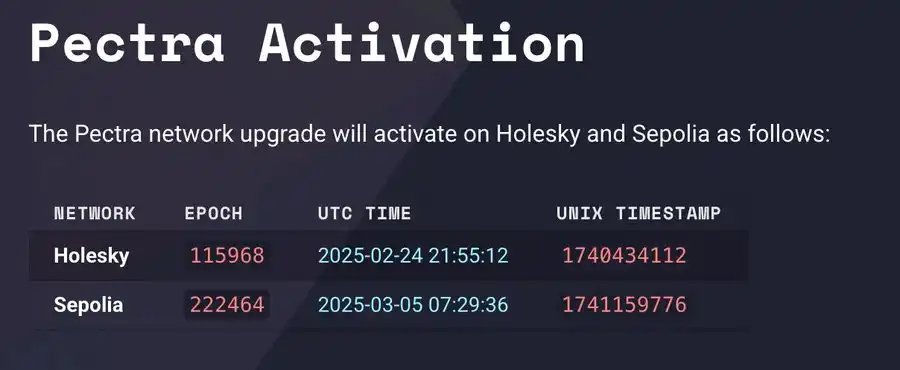
Live on Holesky on February 24
Live on Sepolia on March 5
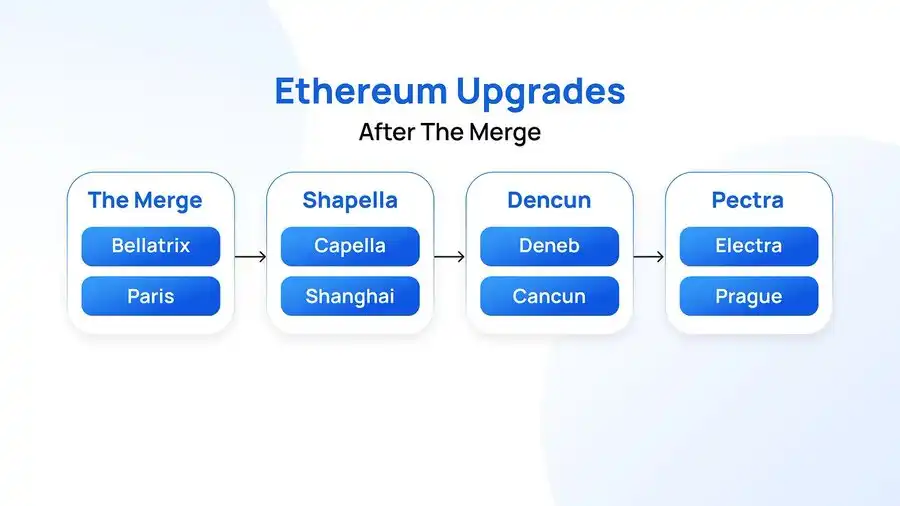
Once the implementation is successful, the mainnet update date will be determined. We can expect the mainnet update to take place between 3 to 9 months after the testnet implementation. Pectra is a rather significant upgrade, bringing improvements from multiple EIPs:
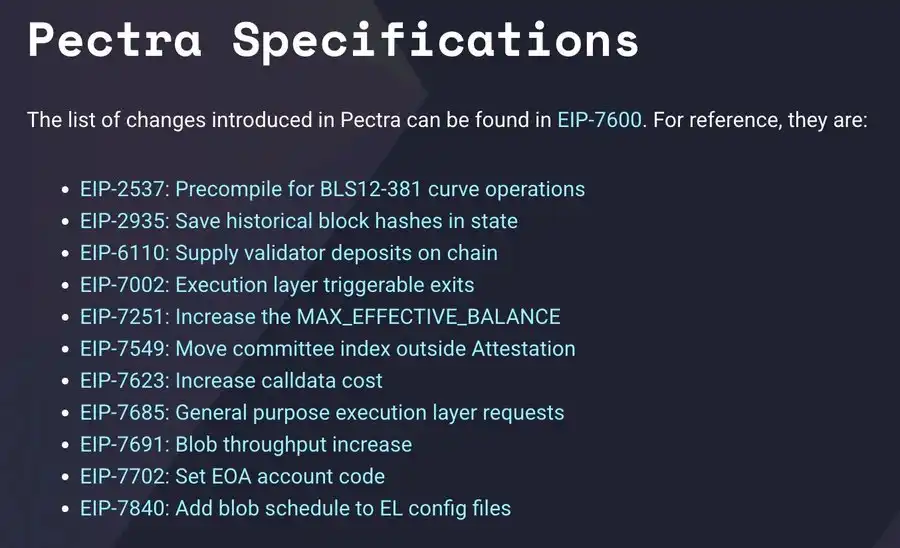
We can categorize these improvements into three key areas:
· Enhancing Ethereum Accounts
· Improving Ethereum Validator User Experience
· Expanding Block Data Capacity
Let's delve into some of the upcoming EIPs and how they enhance the Ethereum protocol and user experience.
Improving Ethereum Accounts: EIP-7702
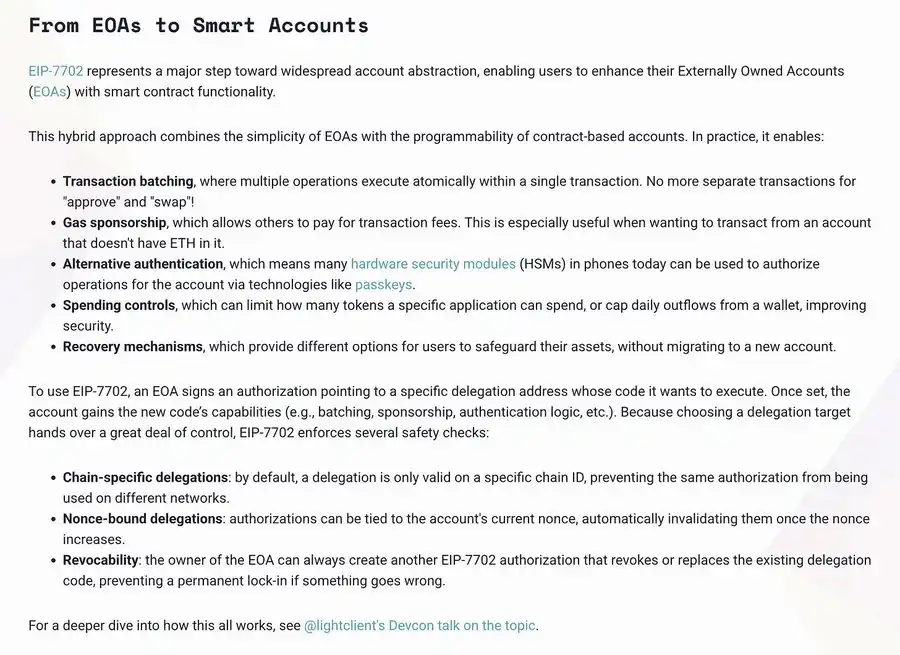
EIP-7702 advances Ethereum's protocol layer towards account abstraction. It extends Ethereum's externally owned account (EOA) functionality to include smart contract features, such as:
· Transaction Batch Execution: Performing multiple operations in a single transaction
· Gas Sponsorship: Allowing accounts with no ETH to have their transaction fees paid by others
· Enhanced identity verification and recovery mechanisms
Enhancing Ethereum Validator User Experience: EIP-7251/7002/6110
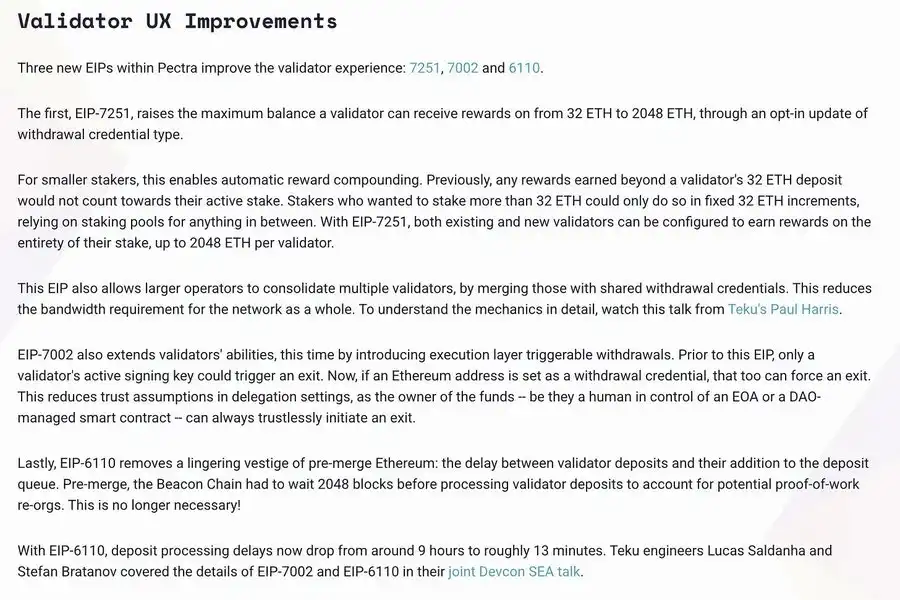
· EIP-7251: Raises the validator's maximum balance to 2048 ETH and enables them to automatically compound rewards on larger active stakes. Previously, rewards were only considered for a 32 ETH balance. Furthermore, larger validators can now merge multiple 32 ETH validators into one.
·️ EIP-7002: Reduces trust assumptions by allowing execution layer addresses to trigger withdrawals (as long as they are set as "withdrawal credentials"). Previously, only validators could trigger exits.
· EIP-6110: Eliminates the 2048-block delay for validator deposits to be queued. This time is expected to reduce from 9 hours to 13 minutes.
Extending Data Blocks: EIP-7691
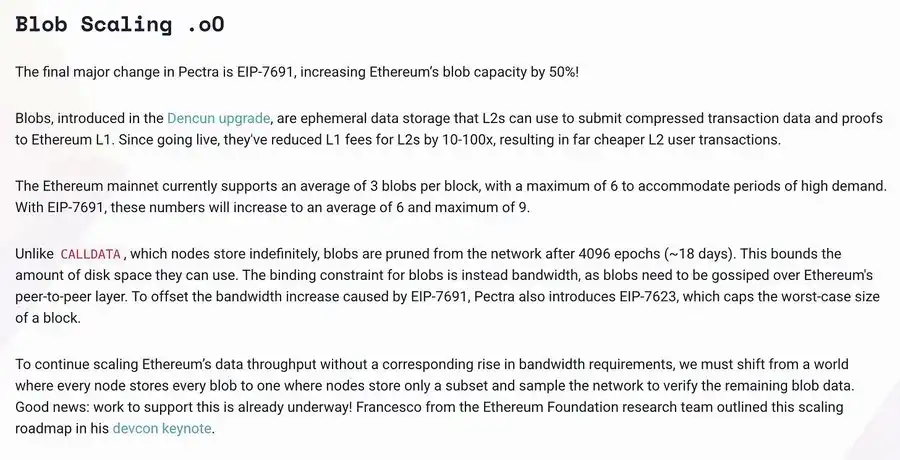
With the rising cost of data blocks, the need for extending data blocks has emerged.
Through EIP-7691, the capacity of data blocks will increase by 50%: currently, each Ethereum block can accommodate approximately 3 data blocks (up to 6 at peak demand). After implementing EIP-7691, on average, support for 6 data blocks will be available, reaching up to 9 during high demand.
The next step in further extending data blocks is to reduce the requirement to store all data blocks and move towards shards, which can still be used to validate block data.
Other EIPs in Pectra include:
· EIP-2537: Increases the security bit length of operations to over 120 bits, currently above 80 bits.
·EIP-2935: Designed for stateless clients, this EIP proposes storing historical block hashes in state as part of the block processing logic. Through contract storage implementation, the EIP allows for a smooth transition without impacting block hash logic. Rollups will be able to benefit from a longer history and directly query the storage contract.
·EIP-7549: This EIP focuses on enhancing the efficiency of the Casper client. By reducing the number of pairings required for consensus validation, particularly by removing one of the three elements from Casper client attestation messages: the committee index. By moving it out of the attestation message, achieving consensus votes can now be more efficiently aggregated into blocks, increasing the number of votes per block from 2 slots to 8.
·EIP-7623: EIP-7623 proposes an increase in the calldata cost, being one of the significant developments affecting Layer 2. This proposal aims to adjust the call data cost to address the difference between the average (100 KB) and maximum block size (7.15 MB). This will not affect regular users but only transactions mainly used for data publishing.
This increase will be introduced through a base fee that depends on the gas ratio consumed in call data operations: reduce block size to accommodate more data blocks or increase gas limits.
·EIP-7685: Introduces a framework to store requests triggered by smart contracts. This allows validators controlled by smart contracts to delegate management operations to the latter, reducing the need for intermediaries.
·EIP-2935: Designed for stateless clients, this EIP proposes storing historical block hashes in state as part of the block processing logic. Through contract storage implementation, the EIP allows for a smooth transition without impacting block hash logic. Rollups will be able to benefit from a longer history and directly query the storage contract.
The focus of this upgrade is a significant signal for Ethereum; we know these improvements have been in the works for a long time and are not in response to recent criticisms. However, focusing on simplifying network security, improving Ethereum account capabilities, and enhancing the ability to expand block data are key development directions needed to achieve Ethereum's goals.
You may also like

The large models in the United States are moving towards closure in the name of security

Morning Report | CoinEx becomes a key hub for Iran to evade sanctions, involving over $3.8 billion in funds; Kalshi seeks a new round of financing, with a valuation potentially rising to $40 billion

From the white-haired stock god to the billionaire fund mogul, the smart people shorting Nvidia are all getting rich using the same framework

Why do cryptocurrency projects always like to change their names?

Global Launch: As predictions become the most scarce asset in the AI era, Manadia is defining the next generation of the value internet

Who is footing the bill for the $64 billion accounting frenzy?
I never expected that the first application of AI x Crypto would be in security auditing

What is your view on Binance's competitive advantages?

ETH has entered a non-consensus phase, and the turning point is approaching!
The shift in the cloud of the air: from despising stablecoins a year ago to the high-profile entry of capital today
The survival dilemma of small and medium exchanges behind the withdrawal anomalies exposed by AscendEX
Why Is Bitcoin Falling Below $60K? 5 Key Market Drivers Explained
Bitcoin has dropped sharply amid ETF outflows, Strategy stock weakness, AI stock rallies, and changing Fed expectations. Explore the key forces driving BTC’s latest correction and what traders should watch next.

Bitcoin vs. Gold in 2026: Which Asset Performs Better in Different Markets?

Morning News | The draft amendment to the People's Bank of China Law aims to clarify the legal status of digital renminbi; South Korea will transfer about 40 unregistered virtual asset service providers to law enforcement agencies
The cryptocurrency industry has entered the "Show Me" era: merely relying on vision is no longer enough

Interpreting the Ethereum Foundation's new structure: Reaffirming self-sovereignty amid institutional trends
Former SpaceX engineer reconstructs the financial execution system using first principles
Standard Chartered Bank sings a 50x rhapsody again, aiming for AAVE to reach 3500 USD
The large models in the United States are moving towards closure in the name of security
Morning Report | CoinEx becomes a key hub for Iran to evade sanctions, involving over $3.8 billion in funds; Kalshi seeks a new round of financing, with a valuation potentially rising to $40 billion
From the white-haired stock god to the billionaire fund mogul, the smart people shorting Nvidia are all getting rich using the same framework
Why do cryptocurrency projects always like to change their names?
Global Launch: As predictions become the most scarce asset in the AI era, Manadia is defining the next generation of the value internet
Who is footing the bill for the $64 billion accounting frenzy?


