
A 500% Surge in One Week: Understanding Sonic's "DeFi Engine" Shadow Exchange




Currently in the Sonic ecosystem, one of the hottest sectors is Shadow Exchange, with its native token $SHADOW seeing its market cap surge from around $5 million to the current $31.84 million in a week, marking a growth of over 500%. Shadow Exchange currently has a total of 457 liquidity pools, with a 7-day trading volume of $557 million and a daily peak trading volume of $171 million.
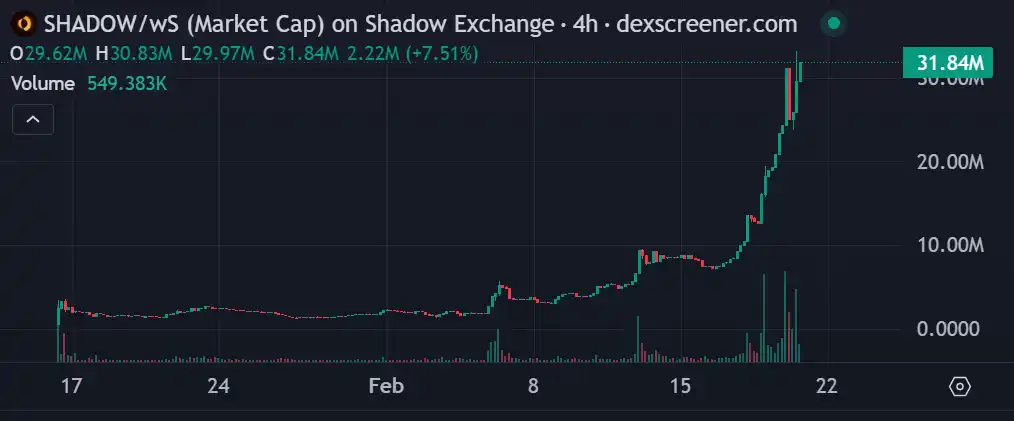
While other chains have been continuously distracted by various unexpected events in the meme market, Sonic Labs has been focusing on DeFi development. Sonic has announced several new measures to incentivize DeFi projects in its ecosystem, causing Sonic's TVL to surge by 500% in the past month. In just two months, Sonic has grown from 0 to over $500 million in TVL, with a net inflow of external funds of $110 million on-chain. Solana accounts for the majority, followed closely by Base and ETH. The DEX trading volume on Sonic has also surpassed the $1 billion mark.
Shadow Exchange is a native centralized liquidity layer and exchange on Sonic. In Sonic's high-speed, low-cost EVM-compatible Layer 1 ecosystem, Shadow Exchange, as one of its core trading protocols, has transformed the traditional ve(3,3) model into an x(3,3) incentive model, attracting the attention of many investors.
Related Sonic Reading: "TVL grows fivefold in one month, will AC Brother turn Sonic into the new DeFi profit center?"
Familiar (3,3), but with an added x
The history of decentralized finance has always been marked by repeated attempts to solve the "DEX trilemma," that is, how to coordinate incentive mechanisms among traders, liquidity providers, and token holders. Although Andre Cronje's ve(3,3) model theoretically addressed this issue by balancing incentives among all participants, the long lock-up period created a high-friction system, forcing users to lock up tokens to fairly participate in the incentive model.
Uniswap focuses on a simple two-sided system: traders and liquidity providers (LPs). ve(3,3) improves on this by adjusting the incentive mechanism to align with token holders' interests, but the distribution of these incentives is unfair and heavily favors the protocol.
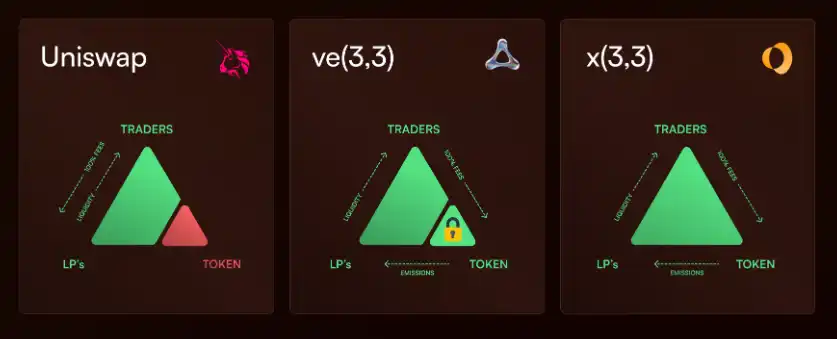
On the other hand, the x(3,3) model addresses these issues, allowing for instant withdrawals and unlocking restrictions through incentives. Users can participate in governance by staking platform tokens and vote on the emission weight of the liquidity pool. Voters can receive fee revenue share and additional "bribe rewards," incentivizing long-term token holders to actively participate in ecosystem development. The following diagram clearly illustrates the entire DeFi model flow:
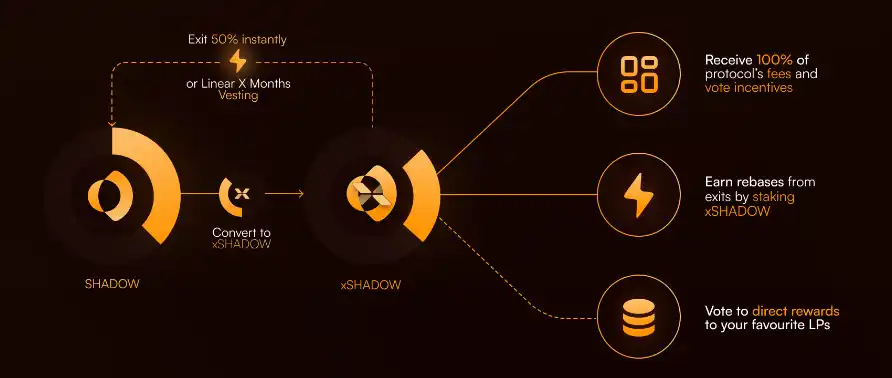
The $SHADOW token is the most fundamental token, freely exchangeable with other currencies. $SHADOW can be exchanged 1:1 with xSHADOW tokens, which are core to the entire model. xSHADOW stakers can vote to direct rewards straight to LPs, and through staking, they can also receive 100% of protocol fees, voting rewards, and exit penalties.
Regarding user exits, Shadow has implemented a unique Player vs. Player (PvP) rebasing mechanism where exit penalties flow to xSHADOW stakers. When a user prematurely exits their xSHADOW position, 100% of the seized tokens will flow pro-rata to existing xSHADOW stakers. In terms of token selection, users can claim more liquid SHADOW for default APY or illiquid xSHADOW for double APY.
Users can convert xSHADOW to SHADOW at any time: an immediate conversion (50% penalty) or a conversion within a user-selected vesting period (based on a ratio, e.g., 3 months = 1:0.73). The longer the vesting period, the more favorable the conversion rate, with a full 6-month vesting period allowing for penalty-free 1:1 conversion.
Voting Incentives
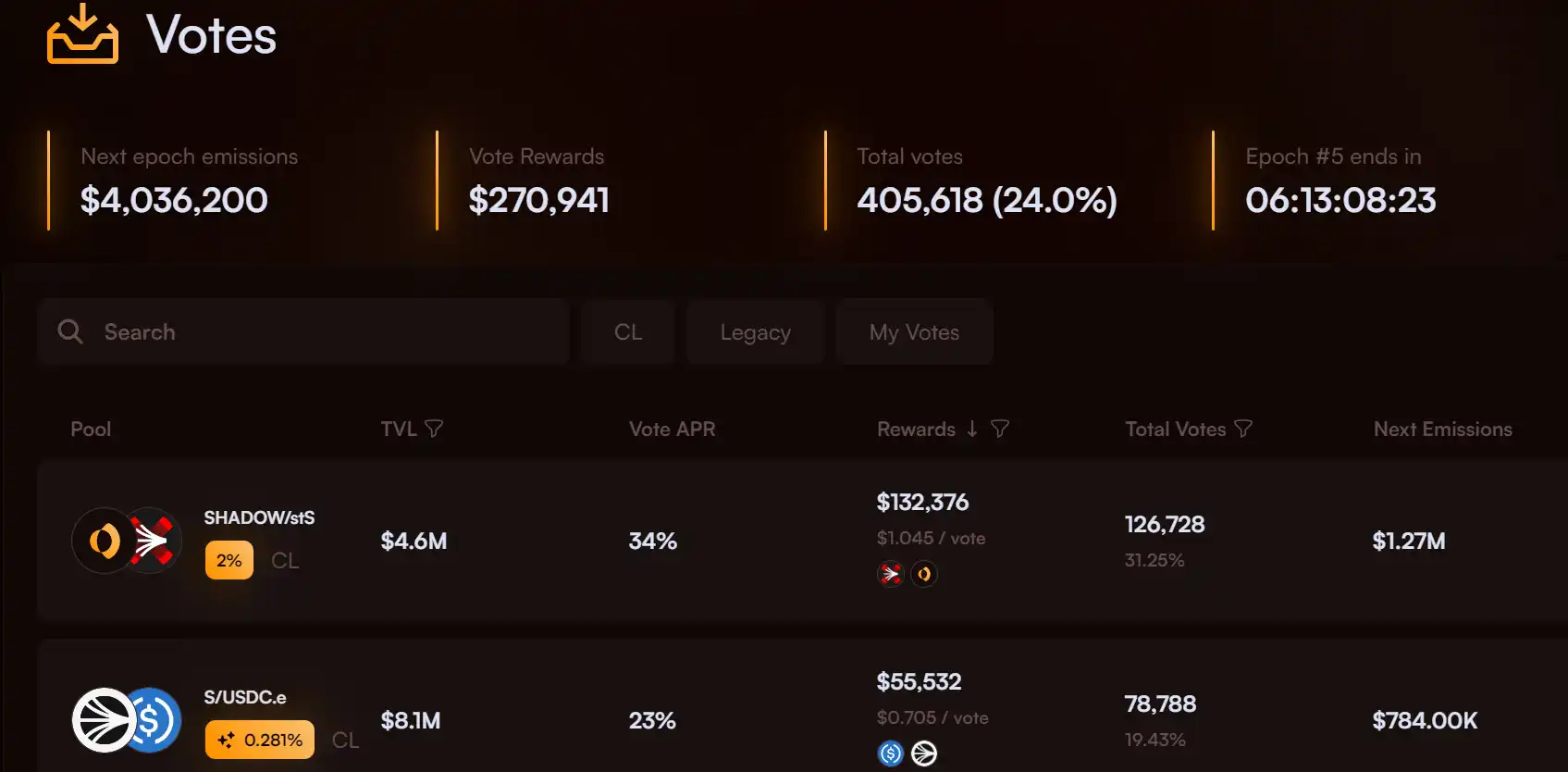
xSHADOW holders earn rewards through active participation and voting. When holders vote to support liquidity through a gauge, they proportionally share in all fees generated by that liquidity pair and additional voting incentives provided by the protocol to encourage participation. The primary purpose of xSHADOW tokens is to direct distributed token rewards through voting toward increasing liquidity, with this portion of the token rewards distributed in proportion to the total percentage of votes in that period. For example, if 100,000 xSHADOW are distributed in a single period and 10% of all votes are allocated to the SHADOW/USDC pair, then that pair will receive 10,000 xSHADOW tokens, which will be linearly distributed to the liquidity providers of the relevant LP pair throughout the period.
Liquidity Staking
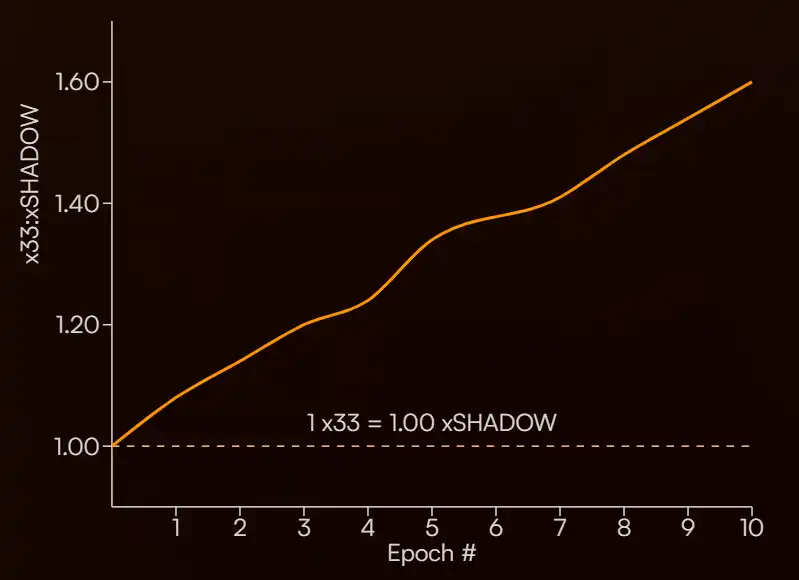
The design goal of Shadow is to eliminate friction in the ve(3,3) model, with governance staking being one of the biggest sources of friction. After staking liquidity in xSHADOW, you can mint $x33, simplifying this process through automated voting and reward claiming without disrupting the core mechanism of xSHADOW. The $x33:xSHADOW ratio starts at 1.00:1.00 and gradually skews towards $x33 as rewards accumulate from fees, voting incentives, and resets. At the end of each period, rewards from fees and voting incentives are automatically sold to increase the $x33:xSHADOW ratio. While $x33 provides instant liquidity, it still does not avoid the exit penalty of xSHADOW. As a liquidity staking version of xSHADOW, the market price of $x33 will naturally reflect the instant exit fee structure and cannot be traded below the redemption value of xSHADOW.
Shadow employs a unique Player vs. Player (PvP) mechanism, enhancing the traditional ve(3,3) anti-dilution model to both protect xSHADOW holders from dilution and incentivize them to maintain their positions and participate in the ongoing success of SHADOW. Stakers who stay longer in xSHADOW will earn more fees, voting incentives, user, and emission exit rewards. Users can exit their positions at any time, ensuring rewards flow to those who value and continue to participate in it the most. This mechanism not only encourages avoiding early exits but also ensures that remaining participants are rewarded for loyalty and active participation.
With the rapid growth of Sonic Chain TVL (increasing 13x from early 2025 to $357 million), and endorsements from core developers like Andre Cronje, Shadow Exchange is poised to leverage ecosystem momentum and become a benchmark for the next generation of DeFi trading protocols. Shadow Exchange is not only a technological playground for the Sonic Chain but also a frontier for DeFi governance and liquidity innovation, offering a new paradigm for traders, liquidity providers, and projects.
You may also like

Bitcoin vs. Gold in 2026: Which Asset Performs Better in Different Markets?

What is your view on Binance's competitive advantages?
I never expected that the first application of AI x Crypto would be in security auditing

Global Launch: As predictions become the most scarce asset in the AI era, Manadia is defining the next generation of the value internet

Who is footing the bill for the $64 billion accounting frenzy?
Morning Report | CoinEx becomes a key hub for Iran to evade sanctions, involving over $3.8 billion in funds; Kalshi seeks a new round of financing, with a valuation potentially rising to $40 billion

Why do cryptocurrency projects always like to change their names?

From the white-haired stock god to the billionaire fund mogul, the smart people shorting Nvidia are all getting rich using the same framework

Morning News | The draft amendment to the People's Bank of China Law aims to clarify the legal status of digital renminbi; South Korea will transfer about 40 unregistered virtual asset service providers to law enforcement agencies

The cryptocurrency industry has entered the "Show Me" era: merely relying on vision is no longer enough
Interpreting the Ethereum Foundation's new structure: Reaffirming self-sovereignty amid institutional trends
Former SpaceX engineer reconstructs the financial execution system using first principles

Tidal Investment: We still have a positive outlook on the AI industry chain, but the reasons have changed

Standard Chartered Bank sings a 50x rhapsody again, aiming for AAVE to reach 3500 USD

The interim executive director of the Ethereum Foundation speaks out: What is our mission?
Why does OKX want to start a new company with the parent company of the New York Stock Exchange?

Why Is PAXG Price Different From Gold? 5 Reasons Crypto Traders Should Know

WEEX OpenAPI 101: 5 Powerful Modules, AI Trading Tools, and Grab Up to 70% Revenue Opportunities
Learn how WEEX OpenAPI connects traders, developers, AI agents, and trading platforms. Discover WEEX API features, Binance-compatible integration, automated trading workflows, revenue opportunities, and ecosystem possibilities.
Bitcoin vs. Gold in 2026: Which Asset Performs Better in Different Markets?
What is your view on Binance's competitive advantages?
I never expected that the first application of AI x Crypto would be in security auditing
Global Launch: As predictions become the most scarce asset in the AI era, Manadia is defining the next generation of the value internet
Who is footing the bill for the $64 billion accounting frenzy?
Morning Report | CoinEx becomes a key hub for Iran to evade sanctions, involving over $3.8 billion in funds; Kalshi seeks a new round of financing, with a valuation potentially rising to $40 billion


