
- Buy Crypto
- Markets
 Futures
- Spot
- Copy Trade
- Earn
- More
500 Million Dollars, 12 Seconds to Zero: How an Aave Transaction Fed Ethereum's "Dark Forest" Food Chain

In the world of crypto, losses of tens of millions of dollars usually mean a hacked contract, a manipulated oracle, or a protocol exploit. However, this amount rarely occurs in individual and ordinary DEX trading behavior. On March 13, a user, without suffering any attack, lost $50.43 million in just 12 seconds through a single on-chain transaction.
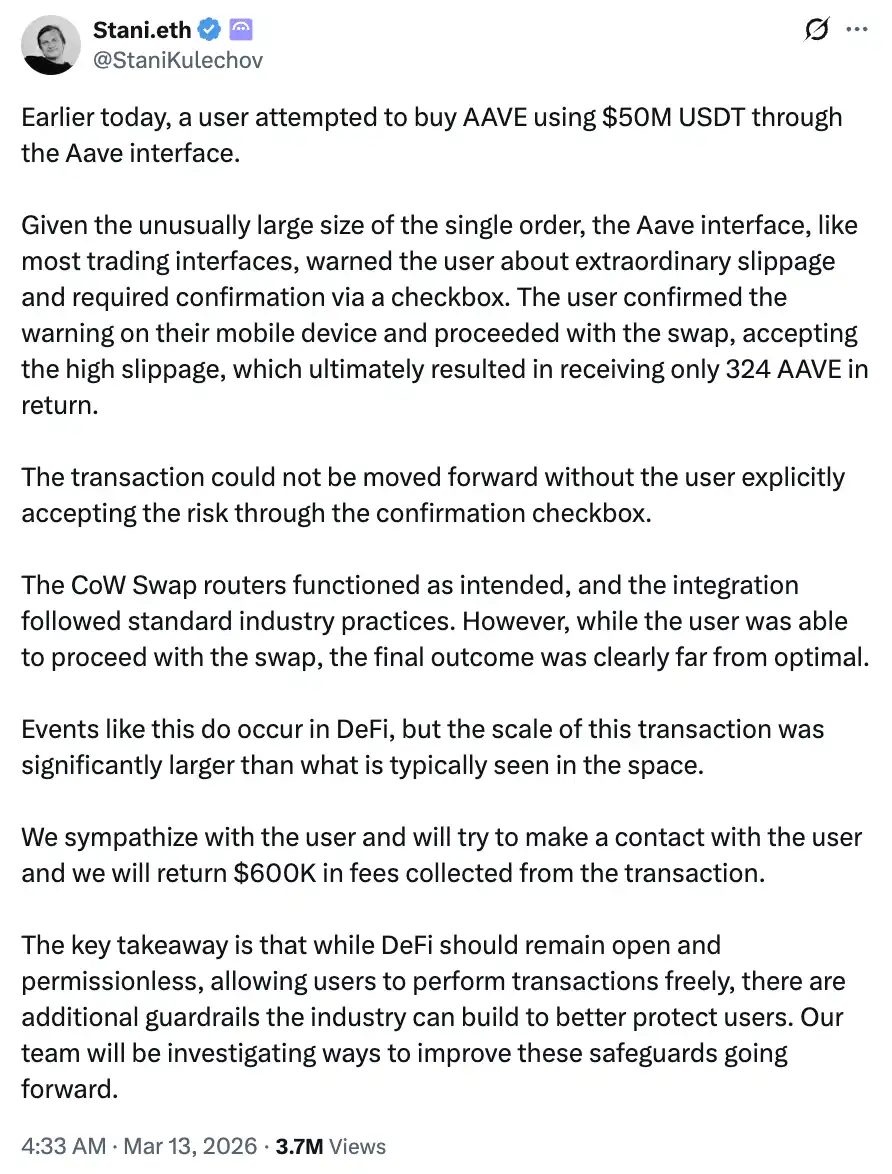
The sequence of events is not complex. The user tried to swap $50.43 million USDT for AAVE tokens through the Aave frontend interface. The Aave interface displayed a warning of a 99% price impact and required the user to check a confirmation box to proceed. The user confirmed on their phone, and the transaction went through. In the end, they only received 324 AAVE tokens, worth about $36,100.
This equated to a cost of $154,000 per AAVE token. The market price was only $111.
Aave founder Stani Kulechov later tweeted his sympathy, pledged to refund the approximately $600,000 frontend fee charged in the transaction, and stated that they would "research how to improve these protective measures." However, the $50 million loss has been finalized and is irreversible on-chain.
This article will not rehash the headline you've already seen. What we want to track is where exactly this $50 million went. Who consumed it in 12 seconds? And why would someone use $50 million to do such a thing?
Three Routes, Progressive Evaporation
This transaction was initiated through the Aave frontend's "Collateral Swaps" feature, with the routing execution handled by the CoW Protocol's Solver. On-chain data shows that the entire transaction was split into three steps.
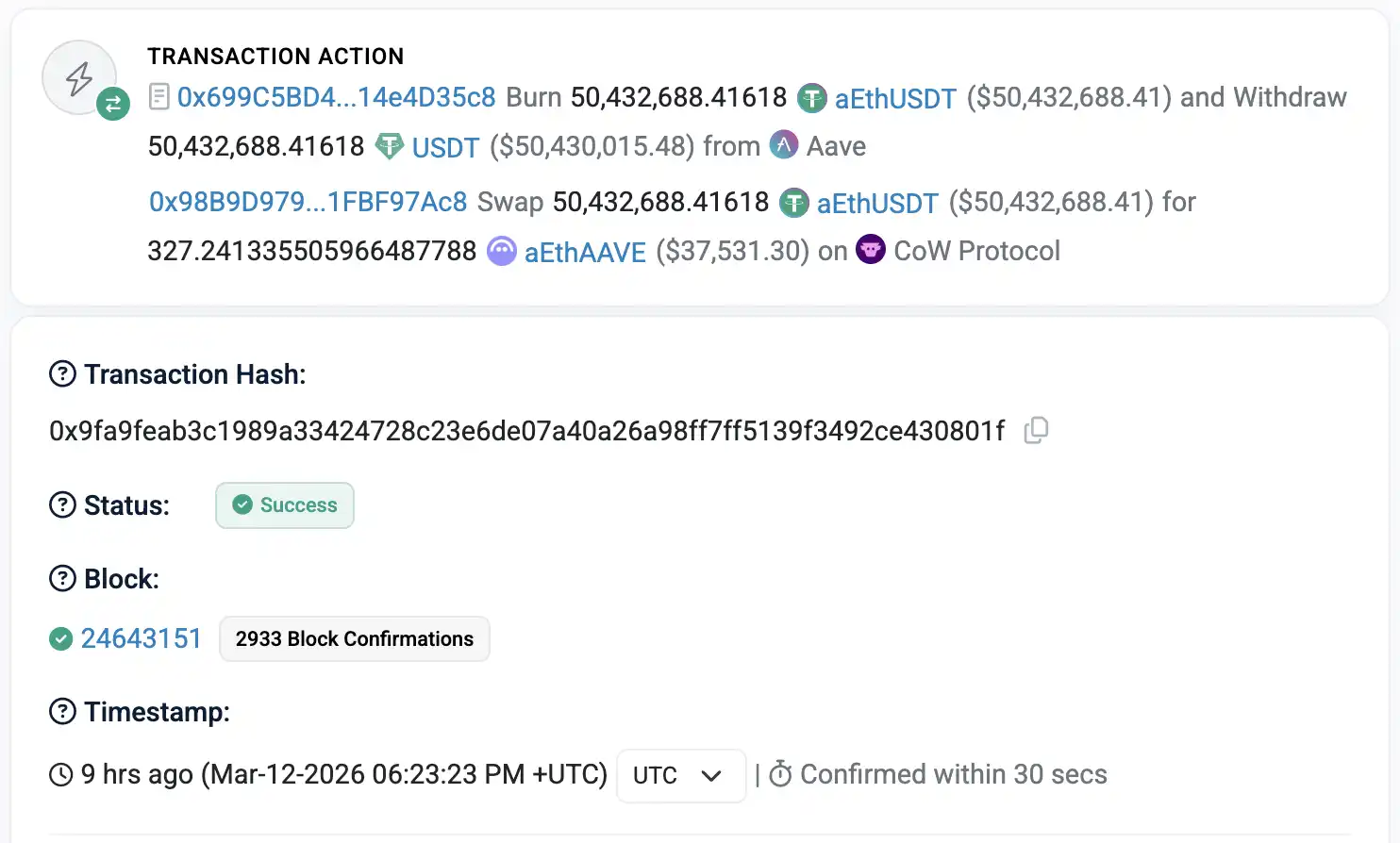
In the first step, the user's aEthUSDT (interest-bearing USDT certificate) held on Aave V3 was redeemed for 50.43 million USDT. This step was an internal redemption operation within the protocol, with the funds arriving intact, and no losses incurred.
In the second step, the $50.43 million USDT was pushed into the USDT/WETH trading pool of Uniswap V3. Based on the prevailing market price, this money should have been exchanged for approximately 24,600 WETH. However, due to the single order size far exceeding the liquidity depth of the pool, only 17,958 WETH, worth about $37.07 million, were received. In just this step, approximately $13.36 million was lost. These losses were not deducted fees but a direct result of the Price Impact. When you put too much USDT into the pool, the WETH in the pool becomes more "expensive," and you end up buying more at a loss on the slip. This difference was passively absorbed by the liquidity providers (LPs) in the pool.
Step three, also at the core of the disaster. The CoW Protocol's solver pushed all 17,958 WETH (worth $37.07 million) into an AAVE/WETH trading pool on SushiSwap. How shallow was this pool? Total liquidity was only about $73,000.
Putting $37 million into a $73,000 pool is like trying to pour the entire Pacific Ocean into a swimming pool. The AMM (Automated Market Maker) pricing curve almost vertically spikes at this extreme ratio, with the AAVE token in the pool being "bought" at a sky-high price of $154,000 per token, whereas the market price was only $111.
Ultimately, 17,958 WETH exchanged for 331 AAVE, worth about $36,700. The loss in this step was about $37.03 million, with a price impact of 99.9%. These 331 AAVE tokens were deposited back into Aave V3, minted into aEthAAVE, and delivered to the user.
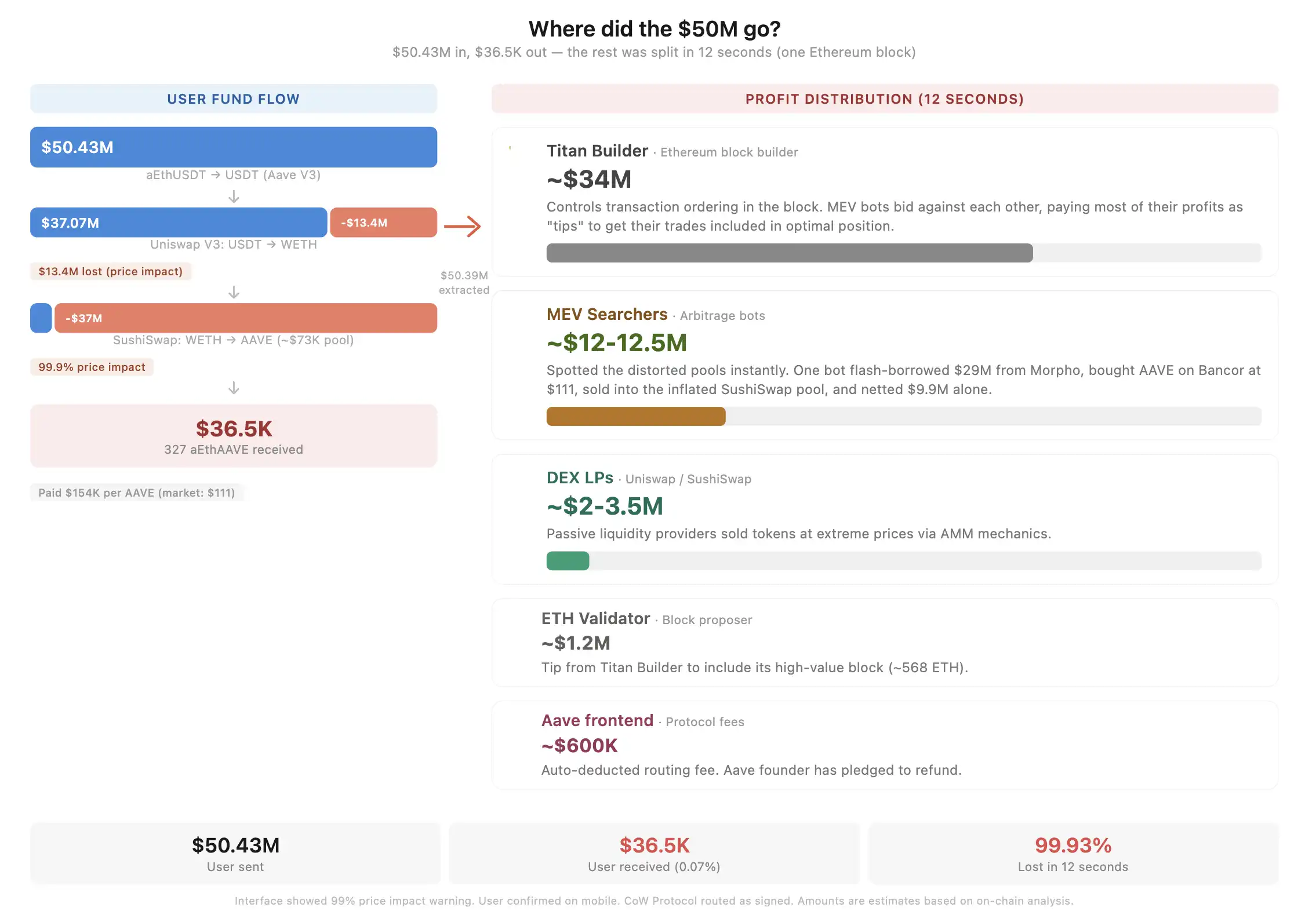
The overall transaction path can be succinctly summarized as a three-hop gradual evaporation. The first hop redeemed from Aave V3, converting 50.43 million aEthUSDT to 50.43 million USDT without loss. The second hop passed through Uniswap V3, converting 50.43 million USDT to 17,958 WETH (worth about $37.07 million) with a loss of about $13.36 million. The third hop passed through SushiSwap, converting 17,958 WETH to 331 AAVE (worth about $36,700) with a loss of about $37.03 million. The total loss was $50.39 million. The user ultimately retained $36,100, representing 0.07% of the initial funds.
Aave developer Martin Grabina later clarified a widely misunderstood concept on Twitter. He stated that the core issue was not "Slippage" but "Price Impact." The quote field on the CoW Explorer showed that, before accounting for fees and slippage, the original quote for this transaction was "50 million USDT for 140 AAVE," indicating a severely unfavorable trade from the start. The user's 1.21% slippage tolerance setting was entirely meaningless in the face of this level of price impact.
Who Snatched $50 Million in 12 Seconds?
In the dark forest of DeFi world, every on-chain transaction is exposed to all, and well-equipped "hunters" are always ready to extract value from any exploitable price imbalance. This transaction perfectly showcases the complete food chain of the Ethereum MEV (Maximal Extractable Value) ecosystem.
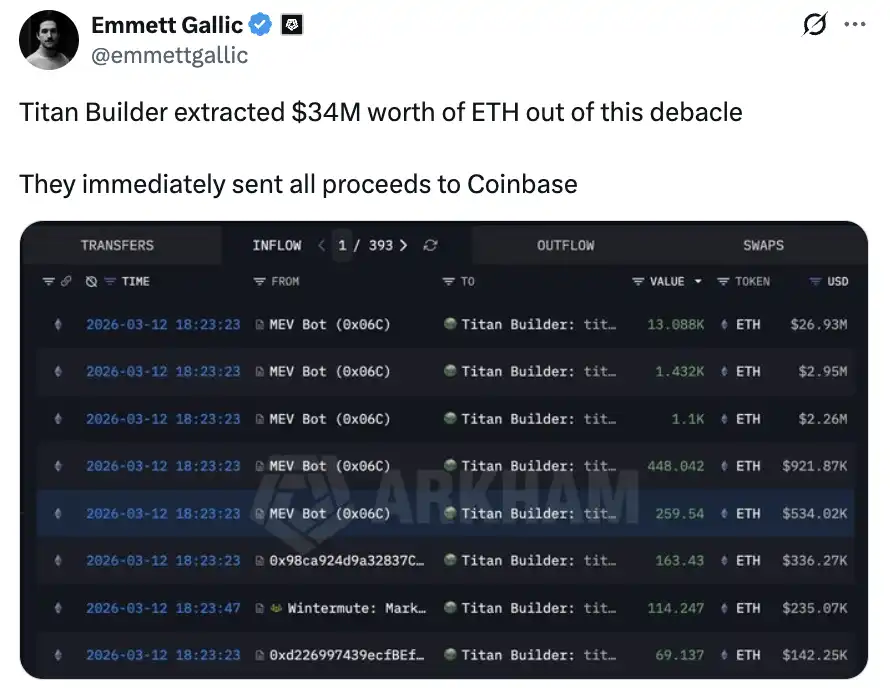
The biggest MEV extractor, Titan Builder, ate the largest slice of the pie, around $34 million, from an Ethereum block. On-chain analyst @emmettgallic discovered that Titan extracted this significant amount of ETH from the block containing the transaction and immediately sent the entire proceeds to Coinbase after block confirmation.
To understand the source of this money, one must first grasp Ethereum's current block-building mechanism. Since Ethereum shifted to proof of stake (PoS) and introduced the MEV-Boost system, block production has been divided into two roles. Block builders are responsible for assembling transactions inside the block and determining transaction order, while block proposers (validators) are responsible for signing and propagating the block. Builders compete via bidding; the higher the profit from a block, the more likely it is to be selected by validators.
Titan Builder is one of Ethereum's largest block builders, collectively responsible for about 90% of Ethereum blocks alongside Beaverbuild. In this transaction, Titan's "God's-eye view" allowed it to perfectly orchestrate the order of all transactions in the block, maximizing the value extracted from price distortions. MEV bots, in pursuit of optimal transaction positioning, were compelled to offer most of their arbitrage gains as a "bribe" to Titan.
The second biggest winner was MEV Searchers, the arbitrage bots, totaling around $12 to $12.5 million. These are automated arbitrage programs lurking on the Ethereum chain for 24 hours, monitoring every pending transaction and swiftly executing when exploitable price distortions are detected.
On-chain analyst @CryptoKaleo identified the most iconic MEV arbitrage operation in this event. A MEV bot, in the same block (12 seconds), executed a risk-free arbitrage of $9.9 million.
The logic of this operation is as follows. The bot first initiated a flash loan from the lending protocol Morpho, instantly borrowing around $29 million worth of WETH without any collateral, only needing to repay within the same transaction. It then used the borrowed WETH to buy AAVE tokens on the Bancor exchange at the prevailing market price (about $111 per token). Subsequently, as a significant user transaction had driven up the price of AAVE in the SushiSwap pool to around $154,000 per token, the bot sold the market-bought AAVE at this inflated price back into the distorted pool, reaping WETH far above cost. Finally, it repaid Morpho's flash loan principal, netting $9.9 million. The entire operation was completed in one transaction with zero capital input and zero risk.
This is the cruelest part of the DeFi "Dark Forest." A user's disastrous transaction created a massive price distortion, and bots completed a full arbitrage cycle of buying low and selling high within the same 12-second block. In addition to this largest arbitrage, other MEV Searchers also conducted similar arbitrage operations in that Uniswap V3 trade.
The third-layer beneficiaries were DEX liquidity providers, receiving approximately $2 to $3.5 million. LPs in Uniswap V3 and SushiSwap pools acted as passive participants, selling tokens to users at extremely high prices through the AMM mechanism. They did not need to take any proactive steps, as the algorithm automatically priced along the curve of "the more you buy, the more expensive it gets." The user's large orders allowed LPs to sell their WETH and AAVE at prices far above market value.
The fourth layer consists of Ethereum validator nodes, approximately $1.2 million (around 568 ETH). This amount was the fixed bribe paid by Titan Builder to ensure that its carefully constructed "high-profit block" would be selected by the currently proposing validator. For the validator, this was just a normal block proposal reward, but much richer than a regular block.
The final layer is the Aave frontend itself, around $600,000. Regardless of the transaction outcome, the Aave frontend's routing integration automatically collects a fee proportionally. Stani Kulechov has publicly committed to attempting to refund this amount.
Adding up these figures, the approximately $50.39 million lost by users in a single Ethereum block (12 seconds) was systematically divided among the five layers of the MEV ecosystem. The biggest winner was not the bot that found the arbitrage opportunity, but the block producer Titan Builder, which monopolized around $34 million by collecting the bot's "bribe" and extracting value directly from transaction ordering, representing 67% of the total user loss.
This is the Ethereum "Dark Forest Food Chain." Users create price distortions, MEV bots discover and exploit the distortion, bots contribute most of the profits to the block producer, the producer pays block fees to validators. With clear delineation of roles, layer-by-layer extraction, the entire settlement is completed within 12 seconds.
Motivation Mystery
As of the time of writing, the identity of the owner of this wallet (0x98B9D979...1FBF97Ac8) remains unknown. However, on-chain traces and community analysis have left several clues.
@CryptoKaleo pointed out that this is a brand new wallet address that received a total of $50.43 million USDT from Binance 20 days prior to the transaction. There were no other deposits after that until this catastrophic transaction took place.
Moreover, this was no ordinary "buying the dip" transaction. DeFi analyst YAM highlighted on Twitter that this transaction utilized Aave's Collateral Swap feature, with the inputs and outputs of the transaction being aEthUSDT and aEthAAVE, which are deposit certificates on Aave, rather than regular USDT and AAVE. This suggests that the user may have intended to directly convert their USDT deposit position into an AAVE deposit position within the Aave protocol, rather than simply purchasing AAVE tokens on the market.
This brings us to the biggest question of the entire ordeal. The funds originated from Binance, where the AAVE trading depth far exceeds any on-chain DEX. Buying AAVE in batches of $50 million on Binance could incur a slippage of no more than 1% to 2%. Opting to withdraw from Binance and operate through the Aave front end on-chain is arguably one of the least efficient and most costly methods.
The community has put forward several speculations. Some believe this could be for tax planning purposes. The user might be located in a jurisdiction where trades on centralized exchanges are taxed but on-chain DeFi operations are either tax-exempt or subject to weaker tax tracking. By withdrawing from Binance and then operating on-chain, they may be attempting to avoid taxable transaction records on centralized exchanges.
Some community members also speculate that this could be a case of an automated trading script or bot gone wrong, automatically confirming an anomalous transaction without human review. However, this does not explain why the script would check the risk confirmation box. Thus, this is more likely a "fat finger" incident. The Aave interface did indeed show a warning for a 99% price impact, but the user proceeded on their mobile phone. Factors such as small-screen mobile operations, habitual disregard for pop-up warnings, and inadequate understanding of DeFi mechanics may have contributed to this disaster.
In hindsight, every step of this transaction could have been avoided.
One fundamental rule is order splitting. $50 million should not have been sent in a single transaction. Professional traders would use a TWAP (Time-Weighted Average Price) strategy, breaking down large orders into dozens or even hundreds of smaller trades executed across different times and liquidity sources. Even without TWAP, simply splitting the transaction into 50 trades of $1 million each would have reduced the loss by an order of magnitude.
Next is using a limit order. The CoW Swap integrated into the Aave interface supports limit order functionality. If a user sets a reasonable limit instead of a market order, the transaction will automatically cancel if the desired price is not reached, instead of executing at a disastrous price. Martin Grabina specifically mentioned this afterward.
Then there's taking warning messages seriously. The interface displays a 99% price impact warning. This is not your usual "Are you sure you want to proceed?" pop-up. 99% means you will lose 99% of your funds. Ignoring this number in any transaction amount is fatal.
Another often overlooked aspect is understanding the magnitude of on-chain liquidity. The AAVE/WETH liquidity on SushiSwap is only $73,000, meaning even a few thousand dollars in a trade would incur a significant price impact, let alone $37 million. Before executing any large DEX trade, checking the liquidity depth of the target pool is a fundamental step.
Lastly, if you must conduct a large on-chain transaction, you should use the intelligent routing feature of aggregators like 1inch, Paraswap, which can split orders across multiple liquidity sources, significantly reducing price impact, instead of relying on a single route to push all funds into a shallow pool.
Decentralization has given everyone complete freedom, including the freedom to make irreversible mistakes. In this world without customer service phone numbers or transaction rollback buttons, every on-chain click is a final decision.
And at the moment you click "Confirm," the hunters in the dark forest have already prepared their flash loans in the same block.
You may also like

Inter-generational Prisoner's Dilemma Resolution: The Nomadic Capital and Bitcoin's Inevitable Path

Upstream and downstream are starting to fight, all for the sake of everyone being able to "Lobster"

Circle and Mastercard Announce Partnership, the Next Stage for the Crypto Industry Belongs to Payments

From 5 Mao per kWh of Chinese electricity to a $45 API export: Tokens are rewriting currency units

Why is OpenAI playing catch-up to Claude Code instead?

Vitalik wrote a proposal teaching you how to secretly use AI large models

The doubling of Circle's stock price and the paradigm shift of stablecoins

Key Market Information Discrepancy on March 13th - A Must-See! | Alpha Morning Report

On-Chain Options Explosion.ActionEvent

《Time》 Magazine Names Anthropic as the World's Most Disruptive Company
Predictions market gains mainstream traction in the US, Canada, Claude launches Chart Interaction feature, What's the English community talking about today?

AI Agent needs Crypto, not Crypto needs AI

Stablecoins are breaking away from cryptocurrency, becoming the next generation of infrastructure for global payments

Web3 teams should stop wasting marketing budgets on the X platform

Strive buys Strategy stocks, and Bitcoin treasury companies start nesting each other
Strive to buy Strategy stock, Bitcoin Treasury company starts nesting dolls with each other

Key Market Intel on March 12th, how much did you miss out on?


 App
App